



Exploring how AI systems can reason more reliably — not just generate more tokens.


Click a project preview to open its repository · Open the expandable sections to explore further
I'm a computer science student focused on understanding how intelligent systems reason, plan, and solve difficult problems.
My primary long-term direction is AI reasoning research. I'm especially interested in hierarchical reasoning approaches, Hierarchical Reasoning Models (HRM), and deliberate, multi-step inference inspired by the System 2 idea.
Alongside that direction, I build software, interactive learning environments, and tools for AI-assisted engineering. I use projects to strengthen the fundamentals, test ideas, and make technical concepts easier to inspect.
The question that motivates me: How can we build AI systems that spend computation more thoughtfully, structure difficult problems better, and produce reasoning that can be evaluated rather than merely trusted?
What I'm exploring
| Area | Questions I'm interested in |
|---|---|
| Hierarchical reasoning | Can multi-level computation help a model decompose and solve problems that are difficult to handle in one pass? |
| System 2-inspired inference | When should a model pause, plan, verify, or use additional inference-time computation? |
| Reasoning evaluation | How do we measure correctness, robustness, consistency, and reasoning efficiency—not just answer length? |
| Compute and efficiency | What trade-offs exist between reasoning quality, inference cost, latency, and model size? |
| Experimental methodology | How can experiments be reproducible, baselines fair, and improvements supported by evidence? |
| 📐 Studying hierarchical reasoning architectures and the ideas behind HRM. | 🧠 Understanding deliberate, multi-step inference and inference-time computation. |
| 🔬 Building stronger foundations in neural networks, deep learning, and optimization. | 📊 Learning how to design useful reasoning benchmarks, ablations, and evaluations. |
| ⚖️ Comparing systems using measurable outcomes instead of relying on impressive-looking examples. | |
This is an evolving research direction. I share projects and experiments as I build the knowledge and evidence behind them.
My repositories cover different parts of the engineering journey—from understanding neural networks to building reusable AI-agent workflows. They are supporting projects around my broader interest in intelligent systems, not claims of completed research results.
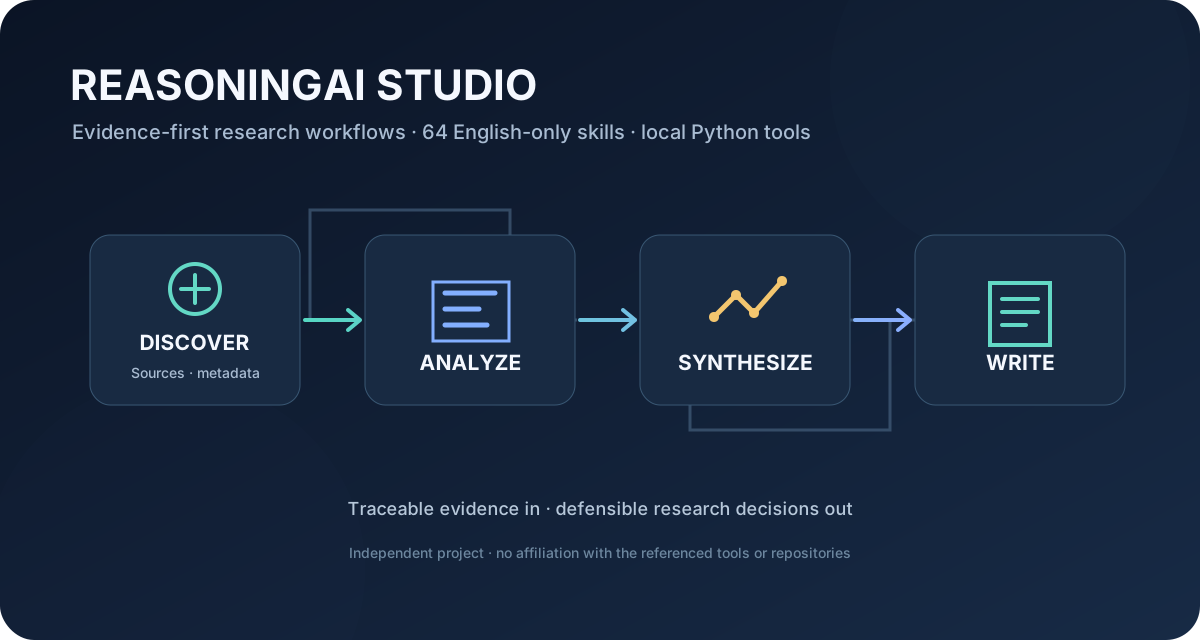
Turn research questions into defensible findings—with evidence you can trace at every step.
An evidence-first research toolkit for AI agents and human researchers.


64 focused skills covering literature discovery, critical reading, systematic reviews, experiment design, ML evaluation, statistics, reproducibility, scientific writing, and peer review—plus reusable prompts, templates, and local Python utilities.
Explore repository · Browse skill catalog · Read architecture
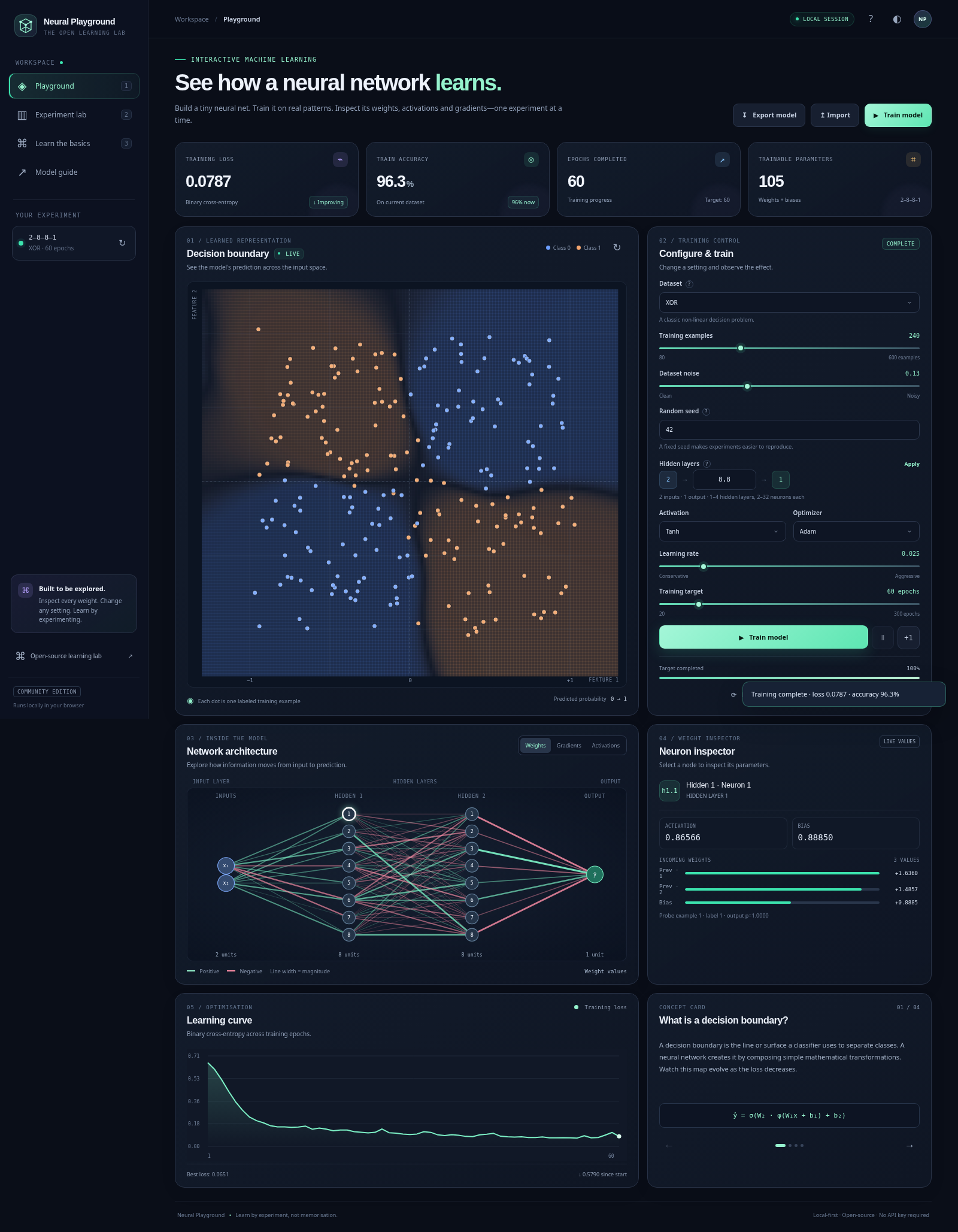
Learn by seeing the network learn. An interactive lab for building, training, and inspecting small neural networks.
|
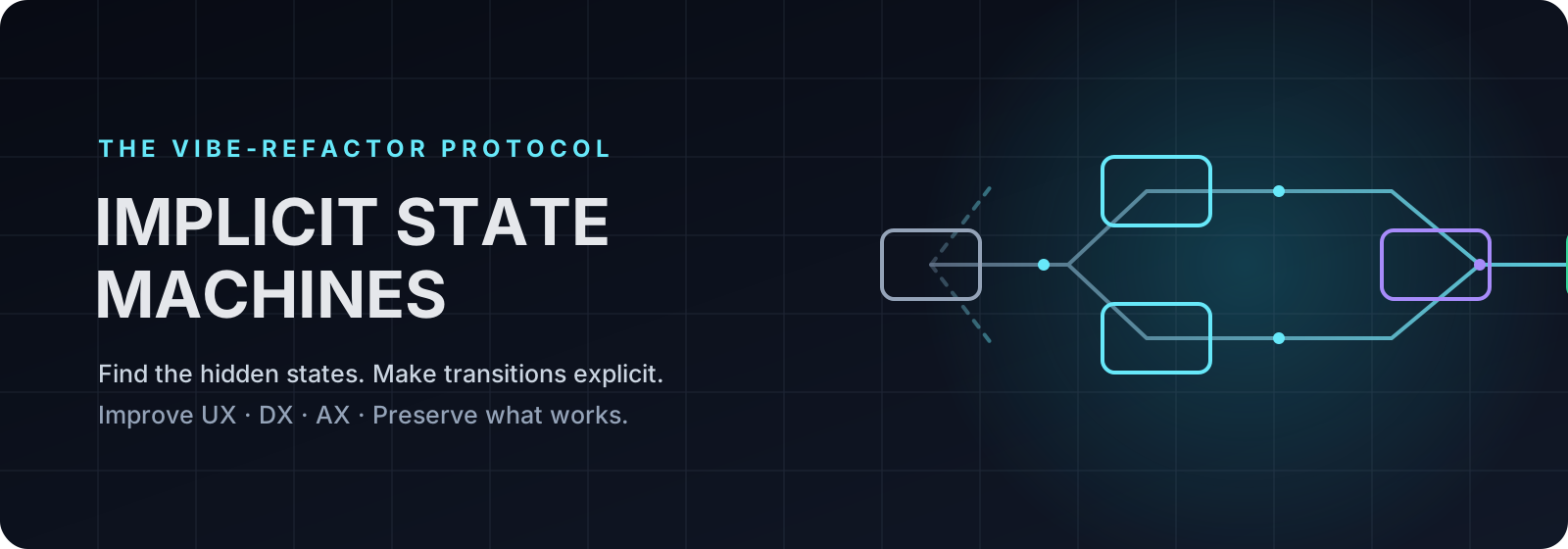
The Vibe-Refactor Protocol — hidden state, made explicit. A repeatable workflow for finding implicit state machines and making fragile application lifecycles explicit—while preserving what works.
|
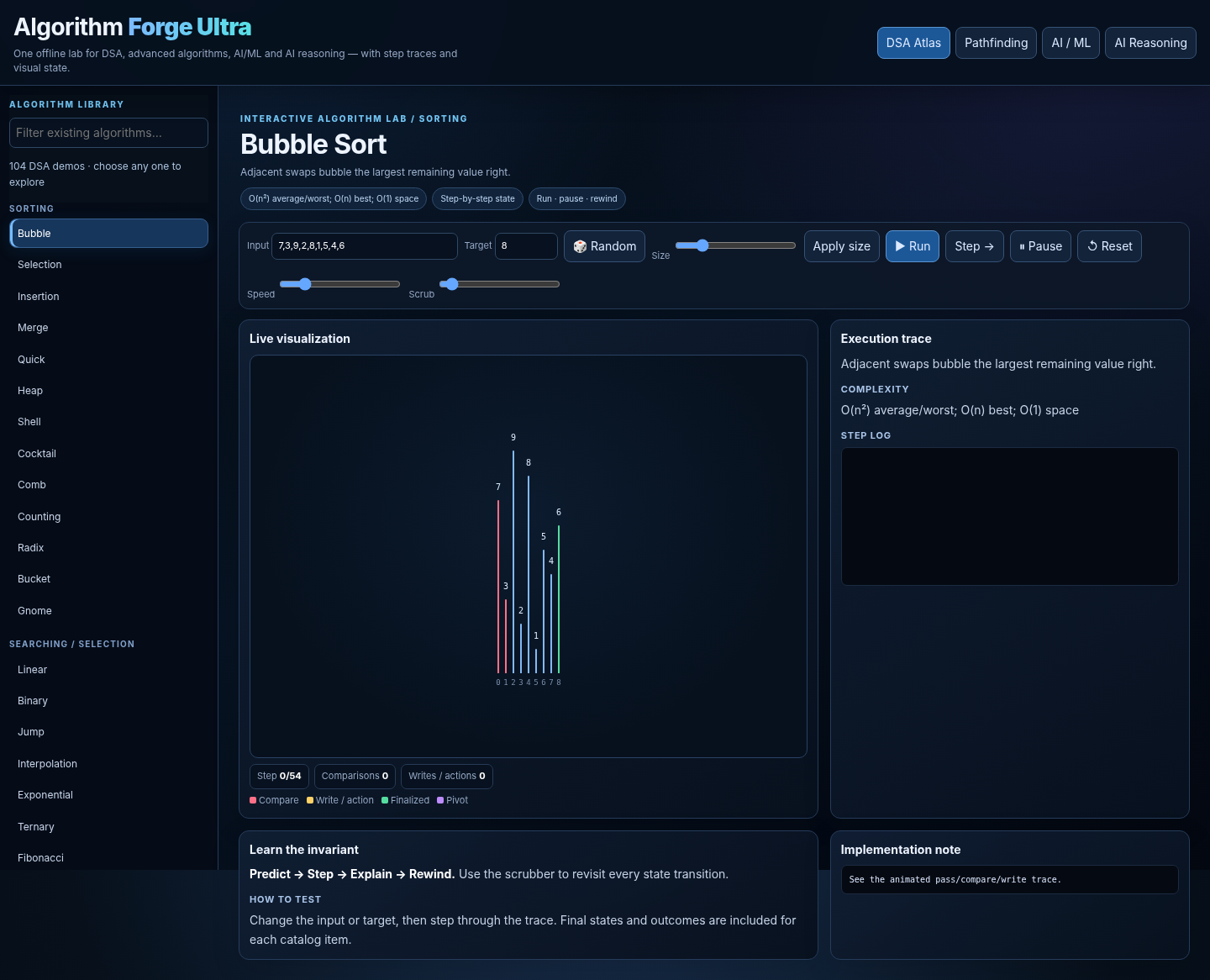
Don't just study algorithms. Watch them work. An interactive browser-based learning environment with 129 demonstrations across data structures and algorithms, pathfinding, AI/ML, and reasoning.
|
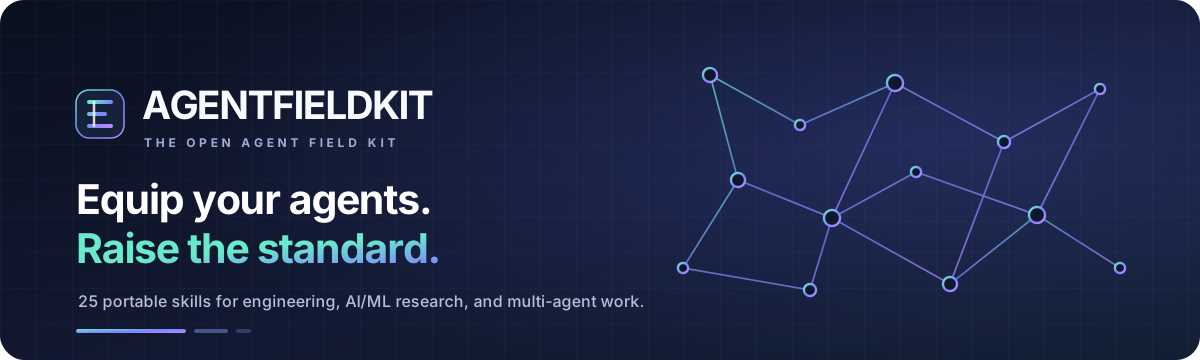
Equip your agents. Raise the standard. An open-source field kit of 25 evidence-first workflows for software engineering, security, AI/ML research, and multi-agent collaboration.
|
Explore more public builds — agent systems, specialist tools, and applications
|
Think clearly. Build deliberately. Ship with confidence. A curated, portable skill library for AI coding agents, spanning everyday engineering, software delivery, research, and specialist agent workflows.
|
Creative production workflows for AI agents. A portable library of 219 agent skills backed by a local-first Python toolkit for references, creative assets, connected tools, and deliverable validation across image, video, audio, 3D, and game-art workflows.
|
|
Give your AI coding workflow a crew. Not more chaos. A spec-first development toolkit for Codex CLI, with portable skill workflows for ChatGPT. It brings together discovery, specification, implementation, testing, and review.
|
Specialist workflows for quantitative and low-latency systems. An independent collection of reusable agent skills for quantitative trading, market microstructure, HFT research, electronic trading systems, mathematics, software development, and technical learning. |


|
Detect the tells. Fix the design. A focused skill library that helps AI agents identify generic or inconsistent interfaces and improve visual hierarchy, typography, layouts, responsive behavior, accessibility, and design systems. |
Make machines explorable. Make every claim testable. An offline-first collection of AI-agent skills for interactive 3D machine explainers, mechanical simulation, physics validation, CAD, and engineering visualization.
|
|
From market discovery to risk review. A cross-model trading research toolkit combining 17 agent skills with a Python engine for market scans, news and filings, risk checks, scenario replay, walk-forward testing, journaling, and portfolio review.
|
Your idea doesn't need applause. It needs five independent lines of attack. A model-agnostic multi-agent startup evaluation framework. Five specialist agents pressure-test business models, numbers, market gaps, and assumptions, then turn findings into experiments.
|
|
Catch the red flags before they leave your machine. A local-first pre-commit security scanner for leaked secrets, suspicious outbound endpoints, and risky code patterns.
|
🎞️ KinoquenceDirect the story. Orchestrate the short. A local-first, model-agnostic workflow for AI-assisted animated shorts, with structured storyboards, reusable assets, procedural audio, captions, credits, and technical QA. |
|
Orchestrate every step. Keep every decision auditable. An independent JavaScript workbench for authorized SheerID REST API integrations, coordinating OAuth, verification lifecycles, organization lookup, provider-directed document uploads, status polling, retries, and auditable queues. Live mode is intended for authorized programs and API applications; independent of SheerID, Inc. |
A startup crew for Claude Code. A Claude Code plugin with specialist agents and structured development workflows for pitching, planning, parallel building, breaking, auditing, and shipping. |


📚 StudyOSA local-first study workspace for planning, focus sessions, revision, notes, and analytics—with no account, backend, or remote AI required. |
A student-built attendance prototype with rotating QR check-ins, a live dashboard, duplicate check-in prevention, SQLite storage, and CSV reports. Demonstration only; uses fictional sample students, not real college records. |
Languages, libraries, and tools
Languages


AI/ML and data


Development


|
Understand before optimizing. Establish the problem, assumptions, and baseline first. |
Measure, don't assume. Prefer reproducible experiments and meaningful evaluation over impressive demos. |
|
Build in small, verifiable steps. Keep projects understandable, testable, and maintainable. |
Be precise about evidence. Distinguish working prototypes, experiments, and established results. |
|
Share useful work. Document decisions and make tools accessible to others. |
|
Open live GitHub statistics
Stats are generated by third-party services and may occasionally be unavailable or rate-limited.
I'm interested in thoughtful discussions around AI reasoning, hierarchical approaches, model evaluation, AI/ML experimentation, and open-source engineering.
The best way to connect through this profile is to explore a repository, open an issue with a concrete question, or start a discussion around an idea.

