
Did my migration change how the site renders? A visual-parity check for coding agents.
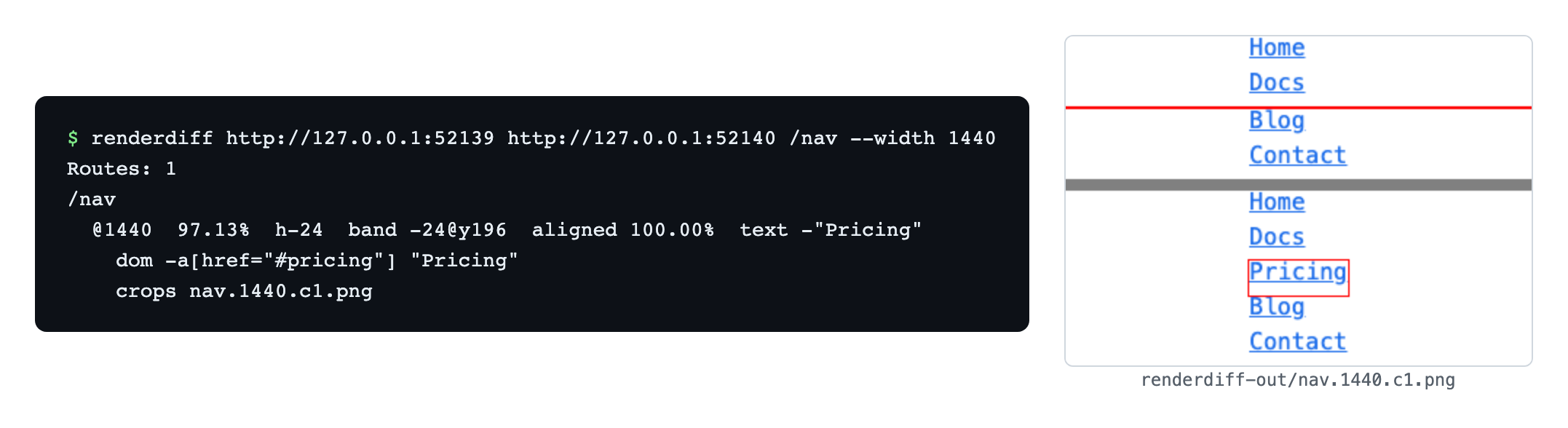
renderdiff screenshots the same routes on two running copies of a site (your branch on localhost, and production) at five viewport widths and pixel-diffs each pair. For every change it tells you where on the page it is, which DOM element and CSS property is behind it, and what text differs. It also writes small crops sized for an LLM's context. It refuses to score what it can't trust: blank pages, error pages, pages still moving. A clean result means the pixels really matched.
Developers who hand a large website migration to a coding agent (Claude Code, Codex,
Cursor), and the agents themselves. The goal of such a migration is no visible change, and
the agent needs a cheap, trustworthy loop: change → renderdiff → explain every difference
→ repeat.
Use it for:
- framework migrations (e.g. Gatsby → Next.js, Vue 2 → 3, jQuery templates → React)
- CSS or design-system refactors (Sass → Tailwind, BEM → CSS modules, a token swap)
- template or component rewrites, CMS moves, static-site-generator swaps
- dependency and build upgrades (bundler, PostCSS, font loading)
- pages that moved during the migration (
/pricing::/plans), and one component at a time (--selector)
Don't use it for:
- intentional redesigns: when everything is meant to change, the score says nothing
- cross-browser testing (Chromium only) or stored-baseline snapshot tests (both origins must be live)
- discovering routes: you list them; there is no crawler
- component libraries in isolation; Storybook-based tools fit that better
npx playwright install chromium            # once per machine
npx renderdiff@latest http://localhost:3000 https://example.com / /about /pricing
Left (first origin) is your change; right (second) is the reference. Piped, which is what an agent sees, renderdiff prints only what differs:
Routes: 3
clean: / /pricing
/about  clean @1152,896,704,375
  @1440  97.41%  h-24  band -24@y196  aligned 100.00%  text -"Pricing"
    dom -nav > a[href="/pricing"] "Pricing"
    crops about.1440.c1.png
renderdiff: 1 of 3 routes differ (1 of 15 shots), 0 errors, worst 97.41% /about@1440 — ./renderdiff-out/results.json
Read as: on /about at 1440px, your change is 24px shorter (h-24) because 24 rows that
only the reference has (band -24) are missing at y=196. With those rows cut out the page
matches exactly (aligned 100.00%). The missing rows are the "Pricing" nav link, which
exists only on the reference (-). Open renderdiff-out/about.1440.c1.png to see it.
Without --threshold, a diff still exits 0, so read the summary.
Install the skill so the agent runs the loop and reports a verdict, not a bare score:
/plugin marketplace add tmashara/renderdiff     # Claude Code
/plugin install renderdiff@renderdiff
npx skills add tmashara/renderdiff              # Codex, Cursor, others (skills.sh)
uses: tmashara/renderdiff@v0 checks a preview deployment or a build in the job against
production on every pull request, with the result in the job summary:
docs/github-action.md.
Node >= 22.18 and Chromium (npx playwright install chromium). npm install -g renderdiff
installs it globally. If the bundled Chromium won't launch, renderdiff falls back to an
installed Google Chrome on both sides and says so; meta.browser in results.json records
which ran.
renderdiff <left-origin> <right-origin> <route…> [options]
| Argument or flag | |
|---|---|
<origin> |
An argument starting with http:// or https://. The first is left (your change), the second right (the reference); a third is an error. |
<route> |
A literal path, e.g. /about, or a pair /pricing::/plans (see below). |
--left <url> |
Left origin, instead of the first positional one. Giving both is an error. |
--right <url> |
Right origin, instead of the second positional one. |
--width <n> |
Viewport width; repeatable. Replaces the defaults. |
--threshold <0..1> |
Exit non-zero if any comparison scores below this. |
--out <dir> |
Output directory, wiped at the start of a run. Default ./renderdiff-out. A directory holding files renderdiff didn't write is refused. |
--concurrency <n> |
Parallel workers. Default half the CPU cores, between 2 and 8. Lower it when one side is someone's live site. |
--config <path> |
Config file. Default: renderdiff.config.{ts,mts,js,mjs} in cwd. |
--selector <sel> |
Compare the one element this Playwright selector matches, on both sides, instead of the whole page. Applies to every route, over the config's per-route selector. |
--left-selector <sel>, --right-selector <sel> |
That side's selector, over --selector. One without the other side (or --selector) is an error. |
--storage-state <file> |
Start both sides with this Playwright storage state (cookies, localStorage), e.g. signed in. Relative to cwd. Over the config's storageState. |
--left-storage-state <file>, --right-storage-state <file> |
That side's storage state, over --storage-state. One side alone is fine. |
--accept <reason> |
Record this run's differences as accepted, with a reason. See Accepted differences and reruns. |
--rerun-failed |
Rerun only what the last run in --out didn't find clean or accepted, keeping the rest. |
--cache-right |
Replay the right side's network traffic from the last --cache-right run in --out, when it's under an hour old and covers every shot; otherwise load it live and record it. Keeps <out>/.cache/ when the out dir is wiped. See Accepted differences and reruns. |
--dry-run |
Print the URL pairs and exit. No browser. |
--open |
Open the report when the run finishes. |
--progress |
A line per shot as it finishes, then the worst scores. The default on a terminal; piped, renderdiff prints one compact summary at the end. |
--no-progress |
The compact summary even on a terminal. |
-h, --help / -v, --version |
Routes are literal paths: there is no route discovery and globs are rejected. Each route is loaded on both origins, unless it's a pair.
Default widths are 1440, 1152, 896, 704, 375: each sits mid-way inside a common breakpoint
range rather than on a boundary, so a layout switch never flaps between runs.
| Exit | Meaning |
|---|---|
0 |
No route errored and none scored below --threshold. Without one, a diff still exits 0. |
1 |
A route scored below --threshold. Wins over 3 when both happen. |
2 |
Bad arguments, bad config, or an origin that isn't responding. |
3 |
A route errored, so it went unmeasured, or the run crashed (e.g. no Chromium). |
renderdiff http://localhost:3000 https://example.com /pricing::/plans
renderdiff http://localhost:3000 https://example.com /pricing --selector "[data-test=plans]"
A pair left::right loads /pricing on the left and /plans on the right. --selector
compares one element, which must match exactly once per side (--left-selector /
--right-selector when the markup differs). A state behind a click takes a config before
hook. For pages behind a login:
npx playwright codegen --save-storage=auth.json https://example.com/login
renderdiff http://localhost:3000 https://example.com /account --storage-state auth.json
auth.json holds live session tokens: never commit it, and keep the out dir (signed-in
screenshots and text) out of git too. Details: docs/scoping.md.
Flags cover a one-off run. A renderdiff.config.{ts,mts,js,mjs} in the working directory
covers a repo you diff repeatedly, and expresses what flags can't: masks for content
that legitimately drifts, extra selectors to hide, extra URLs to block, before hooks.
export default {
  left: "http://localhost:3000",   // your change
  right: "https://example.com",    // the reference
  routes: ["/", "/about", "/pricing::/plans", { left: "/pricing", selector: "[data-test=plans]" }],
  widths: [1440, 896, 375],
  threshold: 0.97,
  hideSelectors: [".site-cookie-banner"],
  blockUrlPatterns: ["**://*.my-tracker.example/**"],
  masks: [{ selector: "[data-star-count]", reason: "live star count", urlPath: "/pricing" }],
};
Precedence: CLI flag > config file > built-in default. Every field is annotated in
renderdiff.config.example.ts. export default { … }
needs no import; import type { RenderdiffConfig } from "renderdiff" is for editor types
only.
Signs always point at your change: + = only in or more in the left (your change);
- = only in or more in the right (the reference).
| Token | Meaning |
|---|---|
97.41% |
Share of measured pixels that match. A range (99.12%–99.87%) when one row covers several widths. A triage signal, not a verdict. |
@1440,1152 |
The widths a row covers. They agree on height and width delta, bands, aligned score and text; score and region count are ranges. |
h-24 / w+8 |
Height / width delta, left − right. The smaller image is padded with magenta, and the padding counts against the score on purpose. |
band -24@y196 |
24 rows only the reference has, at y=196 (+: only your change has them). @y~196: the row's widths put it at different y; the first width's is shown. |
aligned 100.00% |
The score with the bands cut out. 100% means the band is the whole difference. |
unaligned |
Heights differ but too few rows match to find bands. Use the height delta and regions. |
3 reg |
Regions: connected patches of differing pixels. A missing link barely moves the score, but it is still a region. |
unstable 1,204px |
Pixels that kept changing between shots of the same load (a ticker, a carousel). Excluded from the score, so the route is never clean. |
failed left: font Inter 700 |
A stylesheet or font face that side failed to load (blocked URLs aside). Fix that first: a fallback font changes every line of text. |
text -"Pricing" |
A line of visible text only the reference has (+: only your change). Up to three, then (+N more). |
dom sel prop a→b |
Element on both sides whose computed prop differs, left value first. |
dom +sel / -sel |
Element only on the left / only on the right. |
dom sel x+8 |
It moved without its own style changing; the neighbour or parent listed after it is the cause. |
dom sel |
On both sides and unchanged in style or position, so its own pixels changed (an image or canvas). |
crops … |
Up to 3 PNGs per comparison, bands first, relative to results.json. Left is on top or on the left, and the change is boxed in red. |
ERROR … |
Unmeasured, which is neither a pass nor a fail. Exits 3. |
accepted: / stale accepted: |
Shots whose every difference was accepted, and accepted entries the run no longer saw. See below. |
rerun: |
With --rerun-failed: how many shots were rerun and how many reused. |
right: |
With --cache-right: whether the right side was replayed, and from when, or loaded live and recorded. |
Read text first, then dom, then the crops for anything dom doesn't explain. Full
detail, including the --progress and report forms: docs/output.md.
A migration starts with differences that already exist between the untouched local build and production. Record them once, then change code and re-check only what's red:
renderdiff http://localhost:3000 https://example.com / /about --accept "differs before the migration"
# …change code…
renderdiff http://localhost:3000 https://example.com / /about --rerun-failed
--accept "<reason>" writes every difference the run saw to renderdiff.accepted.json (next
to the config, or in cwd); commit it. Later, a shot whose every difference matches an entry is
listed on an accepted: line and counts neither as differing nor toward --threshold;
anything new on the same page still shows. --rerun-failed reruns only what the last run in
--out didn't find clean or accepted and merges it back; it exits 2 if the run differs from
the previous one. Matching rules, what can still hide, and stale entries:
docs/accepted.md.
Against a slow reference, add --cache-right while iterating: it records the right side's
network traffic in <out>/.cache/ and replays it for up to an hour. The page still renders
and is shot fresh, so only the round trips are skipped. A replay can't see a deploy, so the run
says right: replayed from …; drop the flag for the final run. With --rerun-failed, a new
recording covers only the rerun shots. It holds a signed-in session's responses: keep the out
dir out of git.
Everything lands in the out dir (./renderdiff-out by default):
report.html: the scored report.{slug}.{width}.{left,right,diff}.png: full-page shots and the diff./slugs toindex,/blog/footoblog-foo, other characters to_, a pair/a::/btoa~b; a clash gets a-2suffix.{slug}.{width}.c{n}.png: up to three crops per comparison, left on top or on the left, change boxed in red.results.json: everything above as data, written on every run, errors included, one result per line, scores rounded down to four decimals (so a shot that differs never reads as1). Its types (Resultsand friends) are exported from the package.
Paths are relative to the out dir. Results are in route-then-width order.
- Refuses to start unless both origins answer: two error pages would score ~100%.
- Refuses a shot with an HTTP status ≥ 400, or where both sides look blank.
- Blocks analytics, consent and A/B tooling at the network layer, on both sides.
- Pins what varies between loads: clock,
Math.random, timezone, locale, colour scheme, reduced motion, video frames. - Kills animation, transitions and caret blink, and hides common consent banners and dev toolbars.
- Settles the page: lazy images, fonts and network idle before the shot.
- Shoots until stable, and excludes pixels still moving as
unstable. - Isolates state per origin, retries once per shot, and stitches tall pages past 16,384px.
Each run's report ends with a "What was neutralized" section listing what was in effect. Full detail: docs/how-it-works.md.
Development and tests: CONTRIBUTING.md.
MIT
{
  "meta": {
    "tool": "renderdiff", "version": "0.3.2", "generatedAt": "…",
    "left": "http://localhost:3000", "right": "https://example.com",
    "widths": [1440, 375], "threshold": null,
    "clock": "…",                // the instant both sides' clocks start at
    "blockUrlPatterns": ["…"], "hideSelectors": ["…"],
    "masks": [{ "urlPath": "/pricing", "reason": "live star count" }],   // no urlPath: every route
    "browser": { "name": "chromium", "version": "…" },   // "chrome" when it fell back
    "storageState": { "left": "auth.json", "right": null },   // file names only
    "rightReplayedFrom": null   // --cache-right: when the replayed recording was made
  },
  "results": [
    {
      "url": "/about", "left": "/about", "right": "/about",   // a pair: "/a::/b", "/a", "/b"
      "selector": null, "hook": false,                         // hook: a before hook ran
      "width": 1440, "status": "compared",
      "score": 0.9714,           // share of measured pixels that match
      "alignedScore": 1,         // score over the aligned rows; null unless there are bands
      "diffPixels": 33120, "totalPixels": 1158000, "unstablePixels": 0,
      "heightDelta": -24, "widthDelta": 0,          // left − right
      "regions": [],             // left-page px; with bands, from the realigned rows
      "bands": [{ "side": "right", "y": 196, "h": 24,      // null: too different to align
        "elements": [{                                     // regions have them too; absent: not looked at
          "selector": "nav > a[href=\"/pricing\"]", "side": "right",   // or "left", "both"
          "left": null, "right": { "x": 256, "y": 192, "w": 928, "h": 24 },
          "changed": {},         // "margin-left": ["24px", "16px"], left first; "text" too
          "text": "Pricing"      // "rightSelector" when the right one differs
        }]
      }],
      "text": { "added": [], "removed": ["Pricing"] },   // added: left only; removed: right only
      "failed": { "left": [], "right": [] },   // stylesheets and font faces that didn't load: "font Inter 700", "stylesheet https://…"
      "images": { "left": "about.1440.left.png", "right": "about.1440.right.png", "diff": "about.1440.diff.png" },
      "crops": [{
        "path": "about.1440.c1.png", "kind": "band",          // or "region"
        "left": { "x": 256, "y": 196, "w": 68, "h": 0 },      // h 0: where the rows would go
        "right": { "x": 256, "y": 196, "w": 68, "h": 24 },
        "layout": "stacked", "scale": 1, "clipped": false     // left on top, or on the left ("side")
      }]
    },
    { "url": "/blank", "left": "/blank", "right": "/blank", "width": 1440, "status": "error", "error": "page did not render …" }
  ],
  "summary": {
    "compared": 1, "errors": 1, "mean": 0.9714,
    "worst": { "url": "/about", "width": 1440, "score": 0.9714 },
    "belowThreshold": 0,          // accepted shots aside
    "accepted": 0,                // shots whose every difference was accepted
    "stale": []                   // accepted entries the run measured but didn't see
  }
}