







Pre-inference tool routing for MCP and tool-rich LLM agents. Reduce what the model sees before function calling.
100+ permitted tools → route before inference → up to 8 model-visible tools by default → validate → authorize → execute
AgentWeave is a provider-neutral LLM tool-routing and policy-aware function-calling and execution boundary for MCP, A2A, LangGraph, AutoGen, and custom tool catalogs. Deterministic scope comes first; task-aware routing operates only on the permitted remainder, and model-selected calls still pass schema validation and authorization before execution.
PyPI: agentweave-router · Python import: agentweave
Frozen BFCL-derived v6: 6/48 native task successes vs 0/48 for matched baselines · 70.18% fewer tools exposed · 61.70% fewer input tokens · 50.95% lower mean local-model latency
Routing-pressure experiment on a pinned local model; not an official full BFCL leaderboard score.
Quick links: 30-second install · Local routing demo · MCP · Results · Documentation · Contribute · Road to 1.0 · Hugging Face Dataset · Live Space · Paper
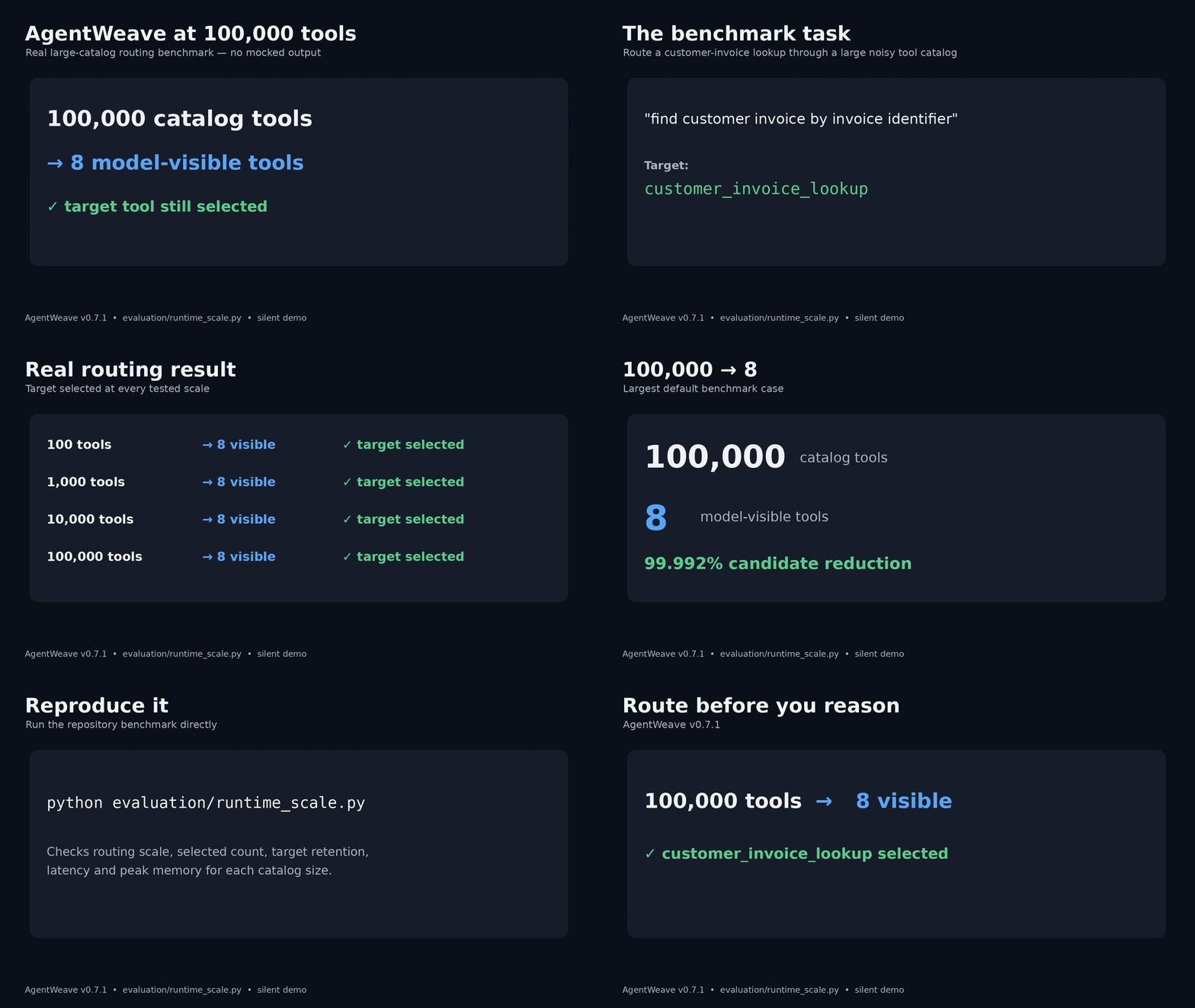
Synthetic engineering-scale demonstration; not a production latency, memory, or capacity guarantee.
catalog
  ↓
deterministic scope / permissions
  ↓
pre-inference routing
  ↓
small model-visible action space
  ↓
model tool selection
  ↓
schema validation
  ↓
argument-aware authorization
  ↓
replay / idempotency guard
  ↓
execution
  ↓
bounded recovery / rediscovery
AgentWeave does not replace MCP, LangGraph, AutoGen, A2A, or your model. It provides a provider-neutral routing and execution boundary around them.
Install the base package from PyPI (Python 3.11+), then verify the CLI:
python -m pip install agentweave-router
agentweave version
agentweave doctor
The PyPI distribution is agentweave-router; Python imports use agentweave. The base install does not require MCP, LangGraph, AutoGen, or provider credentials.
The repository includes a deterministic local example that exercises the real AgentWeaveRuntime routing, validation, authorization, and execution path with three tools and a scripted model:
git clone https://github.com/sauravsingla/agentweave.git
cd agentweave
python -m pip install -e .
python examples/local_runtime.py
It routes an addition request to add_numbers, prints the catalog, routed set, and model-visible tools, then executes the selected function and returns 42. No external model, MCP server, API key, or network service is required after installation.
⭐ If AgentWeave is useful in your tool-routing or MCP work, a GitHub star helps other developers discover the project.
Install the MCP extra:
python -m pip install 'agentweave-router[mcp]'Connect your model endpoint and MCP server. base_url is the OpenAI-compatible API root; AgentWeave appends /chat/completions:
import asyncio

from agentweave import AgentWeaveApplication
from agentweave_byom import OpenAICompatibleModelAdapter


async def main() -> None:
    model = OpenAICompatibleModelAdapter(
        model="my-model",
        base_url="https://model.example/v1",
        api_key="...",
    )

    app = AgentWeaveApplication.from_mcp(
        "https://tools.example/mcp",
        model=model,
        max_tools=8,
    )

    result = await app.run("Find invoice INV-7")
    print(result.status)


if __name__ == "__main__":
    asyncio.run(main())
AgentWeaveApplication owns the MCP/runtime/plugin lifecycle. AgentWeave handles discovery, scope policy, routing, schema validation, argument-aware authorization, execution, bounded recovery, provenance, and telemetry. A one-shot app.run(...) manages startup and shutdown automatically; for repeated calls, keep the lifecycle open with async with app:.
Several MCP servers can be composed without silently collapsing same-name tools:
app = AgentWeaveApplication.from_mcps(
    {
        "billing": "https://billing.example/mcp",
        "crm": "https://crm.example/mcp",
    },
    model=model,
)
If both servers expose native search, the model sees collision-safe names such as billing__search and crm__search, while execution is dispatched by canonical tool identity and each MCP server still receives its native tool name.
A self-contained multi-MCP collision example is included in the repository:
python -m pip install -e '.[mcp]'
python examples/multi_mcp_collision.py
It starts two in-process MCP servers and verifies one native search call reaches each provider. No external model or network service is required.
Use AgentWeave when a model or agent can access a large heterogeneous catalog of tools or specialist agents and the model-visible action space should be reduced before inference.
- Route before inference: reduce the set of tools the model has to reason over.
- Scope before routing: role, tenant, permission, and policy constraints are applied before task-aware selection.
- Validate and authorize after selection: routing a tool does not grant permission to execute it.
- Keep tool identity explicit: provider/source identity is separate from the name shown to the model.
- Stay provider-neutral: use MCP, LangGraph, AutoGen, A2A, custom catalogs, or custom model adapters without making routing provider-specific.
Typical use cases include large MCP catalogs, enterprise capability catalogs, multi-agent specialist pools, A2A ecosystems, LangGraph workflows, AutoGen teams, marketplaces, cloud agents, and edge runtimes.
If deterministic scope already reduces the catalog sufficiently, apply that first. AgentWeave's task-aware routing operates only on the permitted remainder.
AgentWeaveRuntime is the primary 0.7+ execution surface:
catalog → scope → route → model → validate arguments → authorize → replay guard → execute → recover
Key normalized contracts are ToolSpec, ToolCall, ToolResult, ModelResponse, RunContext, and RuntimeResult.
The canonical runtime enforces the following boundaries:
- model-visible aliases cannot silently collapse distinct provider/source identities;
- model-generated arguments are validated against
ToolSpec.input_schemabefore authorization or execution; - calls outside the routed/model-visible set fail closed;
- authorization policies receive resolved tool identity, arguments, provider/source metadata, and runtime security context;
- replay/idempotency protection runs after authorization and caches only successful executions;
- executor-returned identity cannot override the canonical tool identity that passed routing, validation, and authorization;
- per-stage telemetry records catalog, scope/routing, model, validation, authorization, replay, execution, and recovery timing/provenance.
ToolSpec.idempotency supports auto, none, call_id, and arguments; auto uses argument-signature protection for high/critical-risk tools and call-ID protection for other tools.
For AgentWeave-owned HTTP traffic, SafeHttpTransport provides endpoint validation, DNS pinning/rebinding checks, guarded redirects, Host/SNI preservation, and cross-origin credential stripping. For MCP connections, the MCP SDK still owns the protocol wire transport unless the application supplies a custom client factory; AgentWeave validates the target before connection establishment rather than claiming ownership of the MCP SDK's transport.
These are runtime controls and tested boundaries, not a formal security, compliance, or hardware-attestation certification.
AgentWeaveApplication owns runtime and plugin startup/shutdown as one async boundary. Plugin startup is version-checked and transactional, so a partial startup failure is rolled back.
JSON configuration works with the base package. YAML configuration requires the optional YAML extra:
python -m pip install 'agentweave-router[yaml]'import asyncio
from agentweave import AgentWeaveApplication
async def main() -> None:
app = AgentWeaveApplication.from_file("agentweave.yaml")
result = await app.run("Find the invoice and verify it")
print(result.status)
if __name__ == "__main__":
asyncio.run(main())| Stack | AgentWeave boundary |
|---|---|
| MCP | AgentWeaveApplication.from_mcp() / .from_mcps() or lower-level MCPToolCatalog + MCPExecutor + shared MCPConnection |
| LangGraph | AgentWeaveLangGraphNode / langgraph_node() backed by runtime.preview_route() |
| AutoGen | AgentWeaveAutoGenSelector backed by the public runtime API |
| A2A | discovery/communication substrate + AgentWeave selection/execution |
| Custom Python | StaticToolCatalog + CallableExecutor or custom protocol implementations |
Optional integration installs:
python -m pip install 'agentweave-router[mcp]'
python -m pip install 'agentweave-router[langgraph]'
python -m pip install 'agentweave-router[autogen]'
python -m pip install 'agentweave-router[all-integrations]'
Real upstream MCP, LangGraph, and AutoGen packages are installed in a dedicated compatibility CI matrix. MCP compatibility additionally executes an in-process real MCP server/client end-to-end path, including duplicate native tool names across servers. Built-wheel smoke tests separately verify that base and integration extras install correctly outside the source checkout.
The base AgentWeave CLI image is published to GitHub Container Registry:
docker pull ghcr.io/sauravsingla/agentweave:latest
docker run --rm ghcr.io/sauravsingla/agentweave:latest version
The image runs as an unprivileged user and uses /workspace as its writable working directory. The agentweave CLI is the image entry point, so subcommands can be passed directly:
docker run --rm ghcr.io/sauravsingla/agentweave:latest plugins
docker run --rm ghcr.io/sauravsingla/agentweave:latest doctor
For reproducible use, prefer an immutable digest or a release tag rather than latest. See docs/CONTAINER.md for persistent volumes, configuration mounts, published tags, and image design.
The headline BFCL result is a BFCL-derived routing-pressure experiment, not an official full BFCL leaderboard score.
| Evidence | Verified result |
|---|---|
| BFCL routing-pressure v6 | 6/48 = 12.5% native task success vs 0/48 for matched all-tools, random top-8, and semantic top-8 baselines; exact McNemar p = 0.03125 |
| BFCL efficiency vs all-tools | 70.18% fewer tools exposed, 61.70% fewer input tokens, 50.95% lower mean local-model latency |
| AgentBench | 52.0% Hit@1; 89.9% accuracy on committed routes at 46.3% coverage |
| ToolBench | 35.8% Hit@1; 47.5% Hit@3; 53.8% Hit@5; MRR 0.440 |
| AgencyBench | Up to 92.2% cumulative-context Hit@3 |
| AgentProcessBench | 55.88% step micro accuracy; 38.30% first-error accuracy across 1,000 trajectories / 8,509 steps |
| Executable team benchmark | 100% completion; 0.937 mean quality; 100% recovery in the preregistered repeated-seed study |
The BFCL-derived v6 study uses 48 fresh BFCL V4 multiple tasks, 16-tool pressure, and a pinned local model. The absolute success rate is shown alongside the relative efficiency improvements rather than reporting the relative gains alone.
Reproduce the BFCL study · Frozen v6 results · Research paper · PAPER.md
AgentWeave keeps routing, process-verification, executable-outcome, BFCL-derived, controlled-proxy, and provider-backed evidence separate rather than combining unlike metrics into one score.
- Scored studies are frozen after scoring; weak and negative results are retained.
- New router versions use newly introduced untouched holdouts.
- Controlled synthetic execution is not described as production performance.
- Routing accuracy is not presented as native task completion.
- The controlled Issue #38 proxy and real-provider protocol remain separate; a validated protocol is not evidence that a credentialed provider run occurred.
- Host-specific scale measurements are engineering evidence, not universal latency or memory guarantees.
- Changes to model, sample, router, distractors, or protocol require a new study.
The paper-quality evaluation also retains the post-hoc result that simple zero-shot embedding baselines outperform the original frozen AgentWeave router on the already-observed General-AgentBench set.
See docs/ISSUE38_LIVE_PROVIDER.md, docs/ROAD_TO_1_0.md, and the frozen artifacts under evaluation/ for detailed protocols and holdout histories.
agentweave version
agentweave doctor
agentweave plugins
Runtime configuration commands require a config file. For YAML configs, install agentweave-router[yaml] first:
agentweave --config agentweave.yaml config-check
agentweave --config agentweave.yaml run "Research and verify this topic"
Legacy multi-agent orchestration remains available during the pre-1.0 migration, but new applications should start with AgentWeaveRuntime / AgentWeaveApplication. See docs/API_COMPATIBILITY.md.
| Area | Documentation |
|---|---|
| 0.7 quickstart | docs/QUICKSTART_0_7.md |
| Container image | docs/CONTAINER.md |
| MCP | docs/MCP_INTEGRATION.md |
| A2A interoperability | docs/A2A_COMPATIBILITY.md |
| LangGraph | docs/LANGGRAPH_INTEGRATION.md |
| AutoGen | docs/AUTOGEN_INTEGRATION.md |
| Issue #38 real-provider protocol | docs/ISSUE38_LIVE_PROVIDER.md |
| Road to 1.0 | docs/ROAD_TO_1_0.md |
| BFCL reproduction | docs/BFCL_REPRODUCE.md |
| API compatibility | docs/API_COMPATIBILITY.md |
| Research paper | PAPER.md · arXiv:2608.23078 |
| Evolving software project | Concept DOI: 10.5281/zenodo.22913459 |
| Archived v0.7.0 software | Zenodo v0.7.0 · Version DOI: 10.5281/zenodo.22913460 |
| Research citation | CITATION.cff |
AgentWeave is an active research and engineering project. APIs and evaluation protocols may evolve; pin a release or commit when using results in reproducible experiments.
The strongest current evidence is around pre-inference routing, interoperability, recovery, and reproducible evaluation. Published benchmark claims remain scoped to their documented models, datasets, protocols, and test environments. The proposed pre-1.0 freeze discipline and evidence gates are in docs/ROAD_TO_1_0.md.
External reproductions are especially valuable. If you test AgentWeave on your own MCP server, tool catalog, agent framework, or benchmark, please open an issue or PR with what worked, what failed, and the catalog size.
See CONTRIBUTING.md, SECURITY.md, CHANGELOG.md, and CITATION.cff.
Research paper:
AgentWeave: Routing Before Reasoning for Efficient Function Calling in Tool-Rich Language Models
arXiv:2608.23078 · PAPER.md
Evolving software project:
AgentWeave — Concept DOI: 10.5281/zenodo.22913459
Archived software release:
AgentWeave v0.7.0 · Version DOI: 10.5281/zenodo.22913460 · Zenodo record
Use the arXiv paper for the research contribution, the Concept DOI for the evolving AgentWeave software project, and the version DOI when citing or reproducing the archived v0.7.0 release.
Apache-2.0