
Is it you, or is it them? Status from cloud and SaaS vendors, read from the official machine-readable feeds they publish about themselves, about every 10 minutes.
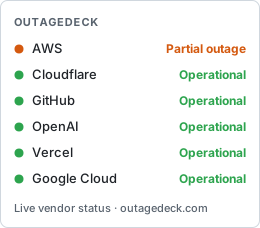
That wall is not a screenshot. It is the same embed you can drop into your own README, rendering from those six vendors' published feeds. Click it for the full board.
- Answer "is it us or them" in one click with no account. Pick your vendors, or paste a
package.jsonand let it match your dependencies in the browser. Nothing is uploaded, and the result is a shareable link. - Free outage alerts on email for up to 5 providers, no card. Paid plans add Slack, Teams, Discord, and your own webhook, across your whole stack.
- A GitHub Action that checks AWS, Cloudflare, GitHub, OpenAI, and the rest of your vendor stack before a deployment proceeds. Add
uses: outagedeck/status-check@v1; public checks are free and keyless. - A cross-platform CLI for status checks in a terminal or any CI system, with JSON output and configurable failure thresholds. Install it on Windows with
winget install --id OutageDeck.CLI --exact, or use Homebrew, MacPorts, Hermit, binenv, Scoop, Nix, mise, orgo install; run it asghcr.io/outagedeck/cli:latest; or addghcr.io/devcontainers-extra/features/outagedeck:1to a Dev Container or Codespace. - A native GitHub CLI extension that detects common cloud and SaaS dependencies from repository manifests, infrastructure files, and workflows, then checks the status those vendors publish. Install it with
gh extension install outagedeck/gh-outagedeck, then rungh outagedeck stack. It shows which files caused each match and gives you an alert setup link with the detected stack already filled in. - A ready-to-import Open WebUI tool for provider search, service health, active incidents, and incident timelines. It is read-only, needs no account or API key, and keeps source links in the result so answers can be checked.
- A TRMNL e-ink dashboard for watching up to eight cloud and SaaS providers on one screen. It is free, keyless, and renders unavailable feeds as unknown instead of falsely healthy.
- Copy-ready cloud-status dashboards for Glance and Homepage that show provider rollups, active incidents, service counts, and official-feed freshness. Both use the keyless public API, include safe refresh intervals, and can be customized by swapping provider slugs.
- A JSON API with an OpenAPI 3.1 spec, open CORS, and anonymous access allowed.
- An MCP server so a coding agent checks whether the cloud is down before it starts rewriting your code. Works in ChatGPT, Claude, Cursor, VS Code, and any MCP client, with no install and no key. Listed in the official MCP registry as
com.outagedeck/outagedeck-status; the prebuilt Cloud and SaaS Outage Triage agent is published in GitHub Awesome Copilot and can be installed in VS Code with one click. - An installable Codex and Claude Code plugin that bundles the MCP server with a dependency-outage triage skill. Add the public marketplace with
codex plugin marketplace add outagedeck/codex-pluginsorclaude plugin marketplace add outagedeck/codex-plugins; both clients install version 0.1.1 successfully, and the package is validated against the current public MCP contract. The portable skill is also listed with a passing security audit on skills.sh. - A dependency-free OpenClaw outage-triage skill that checks public vendor evidence before an agent changes code. Install the pinned release with
openclaw skills install git:outagedeck/[email protected]; it needs no OutageDeck account, API key, executable, or environment variable. - Kubernetes workload dependency checks through
kubectl outagedeck, with explicit provider checks or read-only discovery from Deployment, StatefulSet, and DaemonSet annotations. Install the macOS, Linux, or Windows build from Krew's official index withkubectl krew install outagedeck; the indexed package is also discoverable on Artifact Hub. - Prometheus and Grafana monitoring with a production exporter, six-alert monitoring mixin, and nine-panel dashboard; plus ready integrations for Home Assistant and Zabbix.
- Observed uptime history based on the status vendors published, kept linkable after the banner comes down.
- RSS feeds, global and per provider.
Pick your vendors on the embed builder and copy the snippet. It is an image inside a link, so it works in a README where iframes and scripts are stripped.
[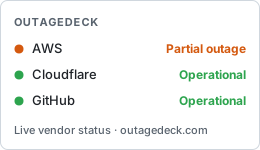](https://outagedeck.com/stack?p=aws,cloudflare,github)Add &theme=light or &theme=dark to pin the theme. Without it the wall follows the reader's own.
[](https://outagedeck.com/providers/aws)Swap aws for any provider in the current catalog. Badges are deliberately outside auth and rate limiting, so they can be hotlinked freely.
The same normalized provider status is now available as a standard Shields.io badge:
[](https://outagedeck.com/providers/github)Swap github for another provider slug. Shields.io caches the result for 10 minutes, matching OutageDeck's provider refresh interval.
We read what vendors publish. We do not probe them, so we are never earlier than a vendor's own status page, and anyone who needs detection before the vendor admits it needs synthetic monitoring instead. That constraint is the point: nothing here is crowd-reported or guessed, but a vendor feed can still be delayed, incomplete, or wrong. The reasoning behind every number is on our methodology page, and OutageDeck publishes its own status in the same vocabulary it uses for everyone else.
OutageDeck is an independent project and is not affiliated with any of the providers it tracks. Provider names and logos are trademarks of their respective owners.