Bring the profile URLs, get back name, job title, city, skills, languages, and the full role history as clean JSON. Python and MCP examples in this repo.
Actor page: apify.com/johnvc/xing-profile-api Input schema: apify.com/johnvc/xing-profile-api/input-schema
This repo is a working example of the Xing API on Apify. You pass a list of member profile URLs (a bare handle such as Jane_Doe works too) and each profile comes back as one JSON row holding whatever that member published: identity, current role, city and country, listed skills in German and English, spoken languages, employment history, education, groups, and interests. Xing is the professional network of the German-speaking world, so it holds people who are not on the global networks, which makes it a distinct source for DACH recruiting and market research rather than a substitute. There is no discovery endpoint, so this API reads profiles you already hold URLs for; it does not search for people by title, company, or city.
The Xing API takes exactly one input, profileUrls, an array of up to 1000 member profile URLs or bare handles per run. Every collected entry returns a row whose result_type is profile, carrying the fields that member published, drawn from fullName, jobTitle, city, countryCode, membership, skills, languages, experience, education, groups, and interests, plus a one-line summary an agent can read without post-processing. An input that cannot be collected returns a row with result_type of error and a plain-language error_message, so nothing disappears quietly. A concrete use: you have shortlisted twenty candidates in Munich from a job board and hold their profile links, so you run them through the API in one batch and get each person's role history, tenure, and listed skills in a single table you can sort. The same call powers a Kandidatensuche follow-up step, enriching a German-market shortlist that you built somewhere else. Skills come back exactly as the member typed them, which in practice means German and English mixed in the same list. No email addresses or phone numbers are returned, because profiles do not publish them.
- Python 3.11 or higher
- An Apify account and API key (get a free key here)
-
Clone the repository
git clone https://github.com/johnisanerd/Apify-Xing-Profile-API.git cd Apify-Xing-Profile-API -
Install dependencies with UV
# Install UV if you do not have it:
curl -LsSf https://astral.sh/uv/install.sh | sh

# Install project dependencies:
uv sync
-
Configure your API key
cp .env.example .env
# Edit .env and add your Apify API key
# Get your free API key at: https://apify.com?fpr=9n7kx3
-
Run the example
uv run python xing-profile-api-example.py

# Role and education history for a small batch:
uv run python xing-profile-api-example.py --example career
export APIFY_API_TOKEN="your_api_key_here"
uv run python xing-profile-api-example.py
The default run asks for a single profile on purpose. Billing is per profile returned, so one URL keeps the first run to a fraction of a cent. Raise the list size once you know your budget.
It covers people the global networks miss. The German-speaking market keeps a large share of its professional presence here, and a DACH shortlist assembled anywhere else will have gaps that these profiles fill.
One input, no configuration. There is a single parameter. You send URLs or handles, you get rows. Nothing to tune, no pagination to manage, no session to keep alive.
Career history arrives structured. experience is an array of employers with the job title and dates the member published, and education is an array of institutions and qualifications. You do not parse a resume blob; you read fields.
Batches are honest about failures. A URL that returns nothing produces an error row rather than a silent gap, and it is not billed, so a 200-URL batch reconciles cleanly against what you paid for.
Agents can read it directly. Each row carries a summary string that states who the person is in one sentence, which saves an LLM round trip when the API is wired in over MCP.
- Collect up to 1000 Xing profiles per run from URLs or bare handles
- Identity fields:
fullName,givenName,familyName,honorificPrefix,profileId,imageUrl - Current position:
jobTitle,city,countryCode,membership - Full employment history in
experienceand schooling ineducation skillsandlanguagesas listed by the member, German and English as entered- Community context:
groupsandinterests, plussimilarProfiles - Two ready-made dataset views on the Store, Profile overview and Career history, plus JSON, CSV, and Excel export
- Every row is tagged
result_typeofprofileorerror, so batches reconcile - Fields a member did not publish are omitted rather than returned empty, so a sparse profile reads as sparse instead of broken
fetched_atcarries the UTC timestamp of collection on every row- Skills and languages are returned verbatim, not translated or normalised
- No contact details are returned: profiles carry role and history, not email addresses or phone numbers
The three sections below are the field reference: what you send, what the parameters mean, and what comes back. The output sample is a real row from a run of this repo's quick-start, with the similarProfiles list trimmed for length.
{
  "profileUrls": [
    "https://www.xing.com/profile/Chuck_Coulson"
  ]
}{
"profileUrls": [
"https://www.xing.com/profile/Chuck_Coulson",
"Andreas_Lappano",
"https://www.xing.com/profile/Jane_Doe"
]
}Full URLs and bare handles can be mixed in one call. Duplicates are removed before collection.
| Parameter | Type | Required | Default | Description |
|---|---|---|---|---|
profileUrls |
list[str] |
YES | - | Member profile URLs, for example https://www.xing.com/profile/Jane_Doe. A bare handle such as Jane_Doe also works. Up to 1000 per run. |
That is the whole input. There is no query, city, or skill filter, because the source offers no discovery endpoint.
{
  "result_type": "profile",
  "profileId": "19268017.0f55c9",
  "fullName": "Chuck Coulson",
  "givenName": "Chuck",
  "familyName": "Coulson",
  "profileUrl": "https://www.xing.com/profile/Chuck_Coulson",
  "jobTitle": "VP, Business Development & Alliances",
  "city": "Cupertino",
  "countryCode": "US",
  "membership": "BASIC",
  "imageUrl": "https://profile-images.xing.com/images/1e7192e2ce7fa1a7252ac390a9d379fb-1/chuck-coulson.1024x1024.jpg",
  "skills": [
    "Business Development",
    "Alliances",
    "Strategic Partners",
    "SaaS",
    "CRM",
    "International Business"
  ],
  "languages": ["Englisch"],
  "experience": [
    { "company": "Helpshift" },
    { "company": "Google" },
    { "company": "SugarCRM" },
    { "company": "Parature" },
    { "company": "SAP America" },
    { "company": "salesforce.com" },
    { "company": "Oracle" }
  ],
  "education": [
    { "qualification": "Information Systems" }
  ],
  "similarProfiles": [
    "https://www.xing.com/profile/Eugen_Racovita",
    "https://www.xing.com/profile/Gunnar_Habitz"
  ],
  "summary": "Chuck Coulson, VP, Business Development & Alliances, based in Cupertino. 7 role(s) on record, 6 listed skill(s).",
  "fetched_at": "2026-08-07T17:44:47.742034+00:00"
}
experience entries carry company plus title, startDate, and endDate when the member published them. education entries carry institution, qualification, and dates on the same terms. An input that returned nothing looks like this instead:
{
  "result_type": "error",
  "sourceUrl": "https://www.xing.com/profile/Not_A_Real_Handle",
  "error_message": "No profile was returned.",
  "error_type": "CollectionError",
  "fetched_at": "2026-08-07T17:44:47.742034+00:00"
}Dieser Actor durchsucht Xing nicht. Er liest Profile aus, deren URL oder Handle Sie bereits haben. Der uebliche Ablauf fuer eine Kandidatensuche im DACH-Raum: Sie sammeln Kandidaten in einer Jobboerse, einem ATS oder einer Empfehlungsliste, uebergeben die Profil-URLs hier in einem Lauf und erhalten pro Person aktuellen Job, Werdegang, Ausbildung, Kenntnisse und Sprachen als strukturierte Zeile. Danach filtern Sie das Ergebnis nach skills, city oder jobTitle, ganz wie es Ihr Prozess braucht. Kontaktdaten sind nicht enthalten.
This repo teaches the Xing API on Apify. People search for scraping tools when what they want is structured profile data, and this Actor covers that need: send URLs, get JSON you can call from Python or from an MCP client.
Ein Xing Profil ist die berufliche Profilseite eines Mitglieds im deutschsprachigen Karrierenetzwerk: aktueller Job, Werdegang, Ausbildung, Kenntnisse und Sprachen. Diese API liefert genau diese Angaben als strukturiertes JSON.
Das entscheidet das Mitglied selbst ueber seine Sichtbarkeitseinstellungen. Diese API liest ausschliesslich, was ein Profil oeffentlich zeigt, und gibt Felder ohne Wert gar nicht erst aus.
Nicht mit dieser API. Sie hat keinen Suchmodus, weil die Quelle keinen anbietet. Starten Sie die Kandidatensuche an anderer Stelle und uebergeben Sie die gefundenen Profil-URLs hier zur Anreicherung.
Run the Actor with your profile URLs, then export the dataset as JSON, CSV, or Excel from the Output tab, or read it from Python as this repo's example does. Every profile is one row, and the Career history view puts roles and education side by side.
Clone this repo, set APIFY_API_TOKEN, and run uv run python xing-profile-api-example.py. See Quick Start above. The example uses apify-client 3.x, where .call() returns a run object and the dataset is read from run.default_dataset_id.
Yes. Use the install sections below to add the Actor as an MCP tool in Claude Code (free trial), Claude Cowork (free trial), Claude.ai, Cursor, or ChatGPT.
Not with this API, because the source has no discovery endpoint. Once profiles are collected you can of course filter the rows by skills, city, or jobTitle.
Yes. The network is strongest in Germany, Austria, and Switzerland, but members list locations worldwide and the API returns whatever the profile holds.
Schedule tip: Save your input as an Apify Task and schedule it on the Actor page to run weekly or monthly, so a tracked list of profiles refreshes itself and you notice job changes without running anything by hand.
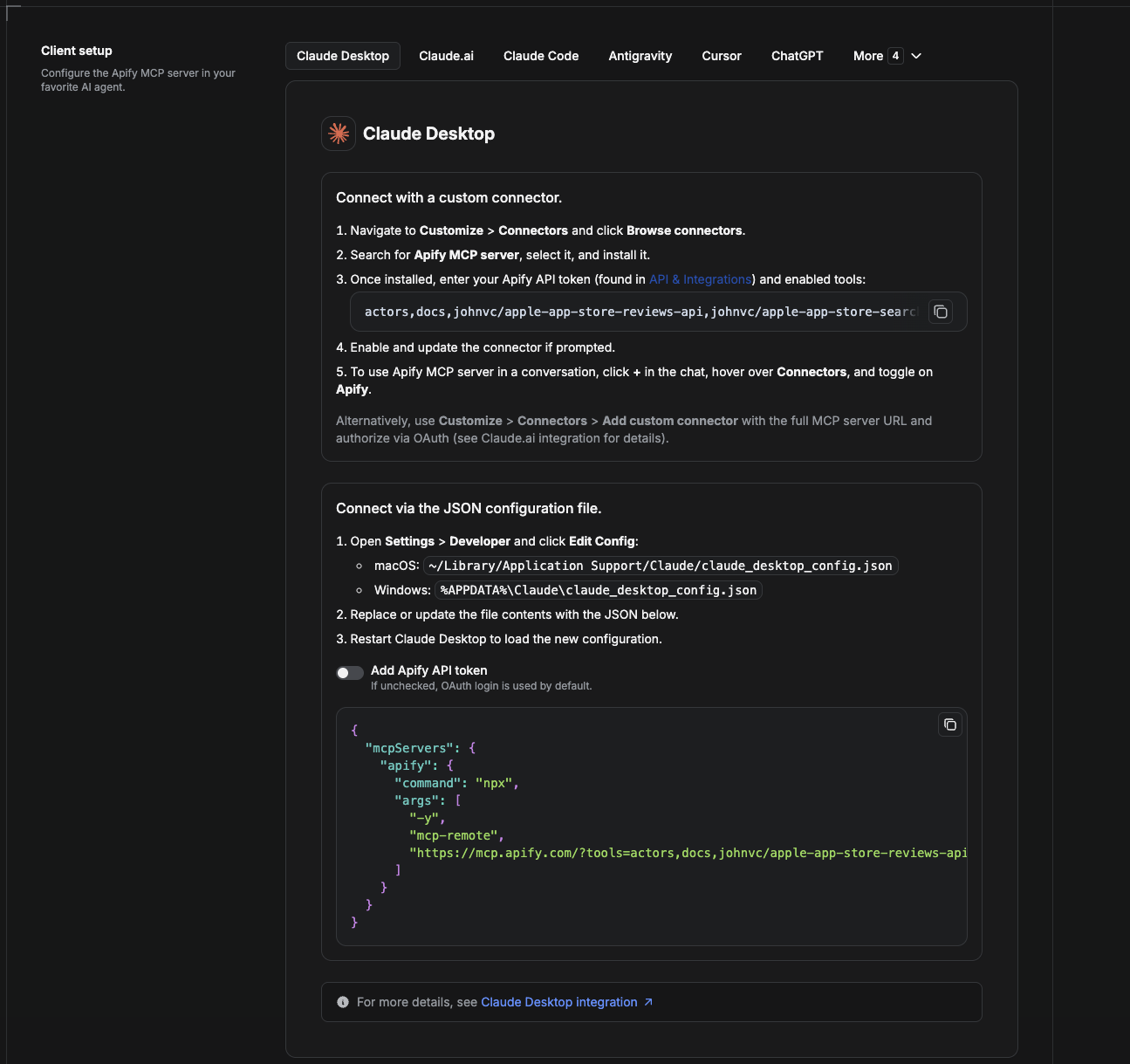
Cowork is the desktop app's automation mode. To give it the Xing API as a tool, add the Apify MCP server as a connector.
- Open the Claude desktop app and go to Settings → Connectors (or Settings → Developer → Edit Config to edit
claude_desktop_config.jsondirectly).- macOS:
~/Library/Application Support/Claude/claude_desktop_config.json - Windows:
%APPDATA%\Claude\claude_desktop_config.json
- macOS:
- Add the Apify MCP server, preloaded with only this Actor:
{
  "mcpServers": {
    "apify": {
      "command": "npx",
      "args": [
        "-y",
        "mcp-remote",
        "https://mcp.apify.com/?tools=actors,docs,johnvc/xing-profile-api"
      ]
    }
  }
}- Restart the app. When Cowork first calls the tool, complete the OAuth prompt in your browser, or add your Apify API token in the connector settings to skip OAuth.
- In a Cowork chat, confirm the tool is available and ask it to run the Xing API.
Download the desktop app and start a free trial: https://claude.ai/referral/uIlpa7nPLg More help: https://docs.apify.com/platform/integrations/claude-desktop
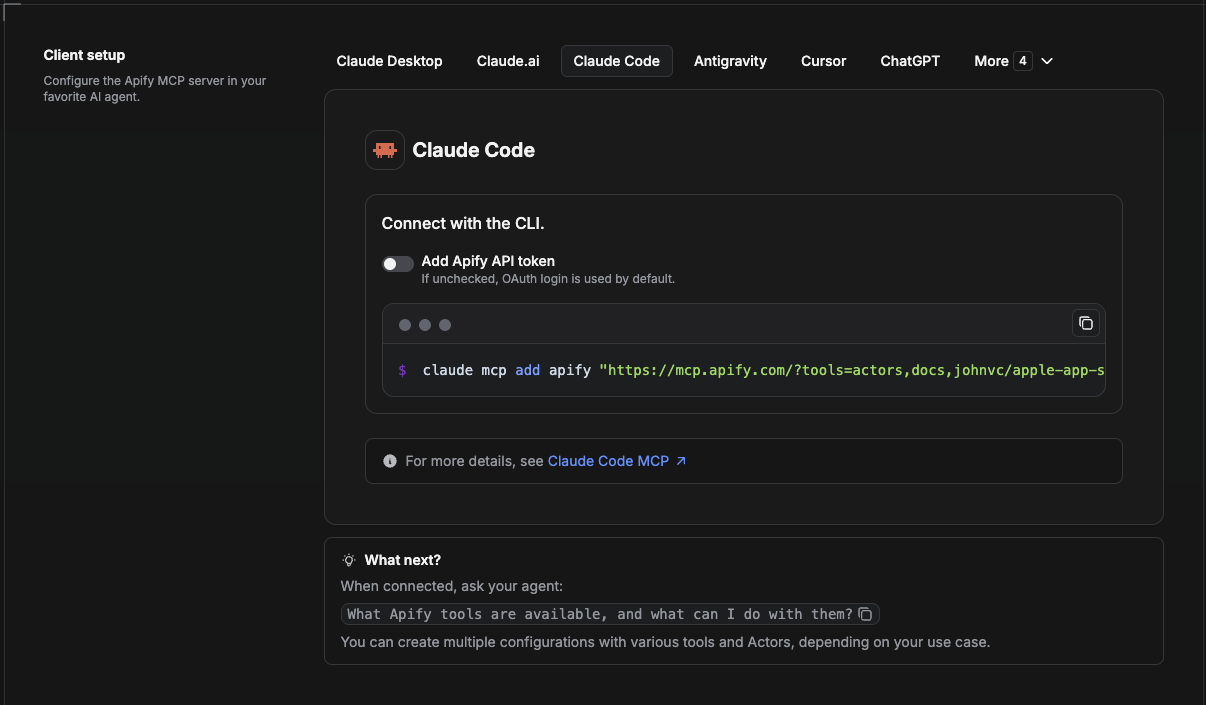
Claude Code is the command-line tool. Add the Actor's MCP server with one command:
claude mcp add --transport http apify \
  "https://mcp.apify.com/?tools=actors,docs,johnvc/xing-profile-api"
To use a token instead of browser OAuth:
claude mcp add --transport http apify \
  "https://mcp.apify.com/?tools=actors,docs,johnvc/xing-profile-api" \
  --header "Authorization: Bearer YOUR_APIFY_TOKEN"
Then verify with claude mcp list, or run /mcp inside a session. Ask Claude Code to call the Xing API.
Try Claude Code free: https://claude.ai/referral/uIlpa7nPLg Claude Code MCP docs: https://code.claude.com/docs/en/mcp
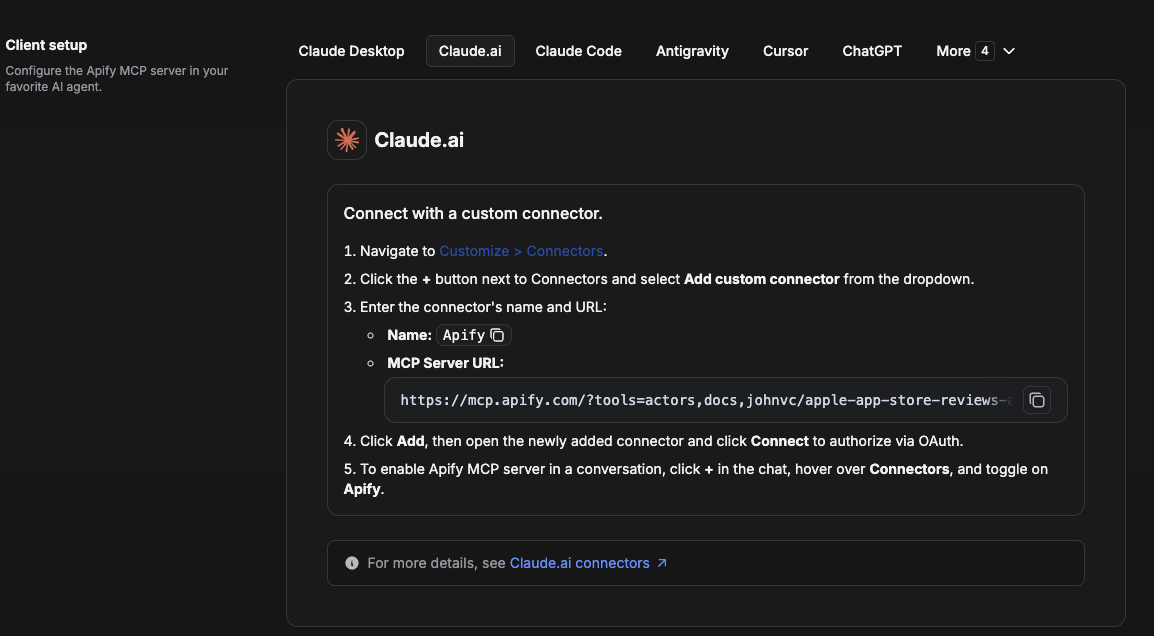
On claude.ai you add Apify as a connector, then enable just this Actor's tool.
- Go to Settings → Connectors → Browse connectors and search for Apify MCP server. Install it (enable or update if prompted).
- When connecting, authenticate with your Apify API token, and enable the tool
johnvc/xing-profile-api. - In any chat, open + → Connectors and turn on Apify.
- Alternatively, choose Add custom connector and paste the full MCP URL
https://mcp.apify.com/?tools=actors,docs,johnvc/xing-profile-api, using OAuth when prompted. - Ask Claude to run the Xing API.
Open Claude on the web: https://claude.ai
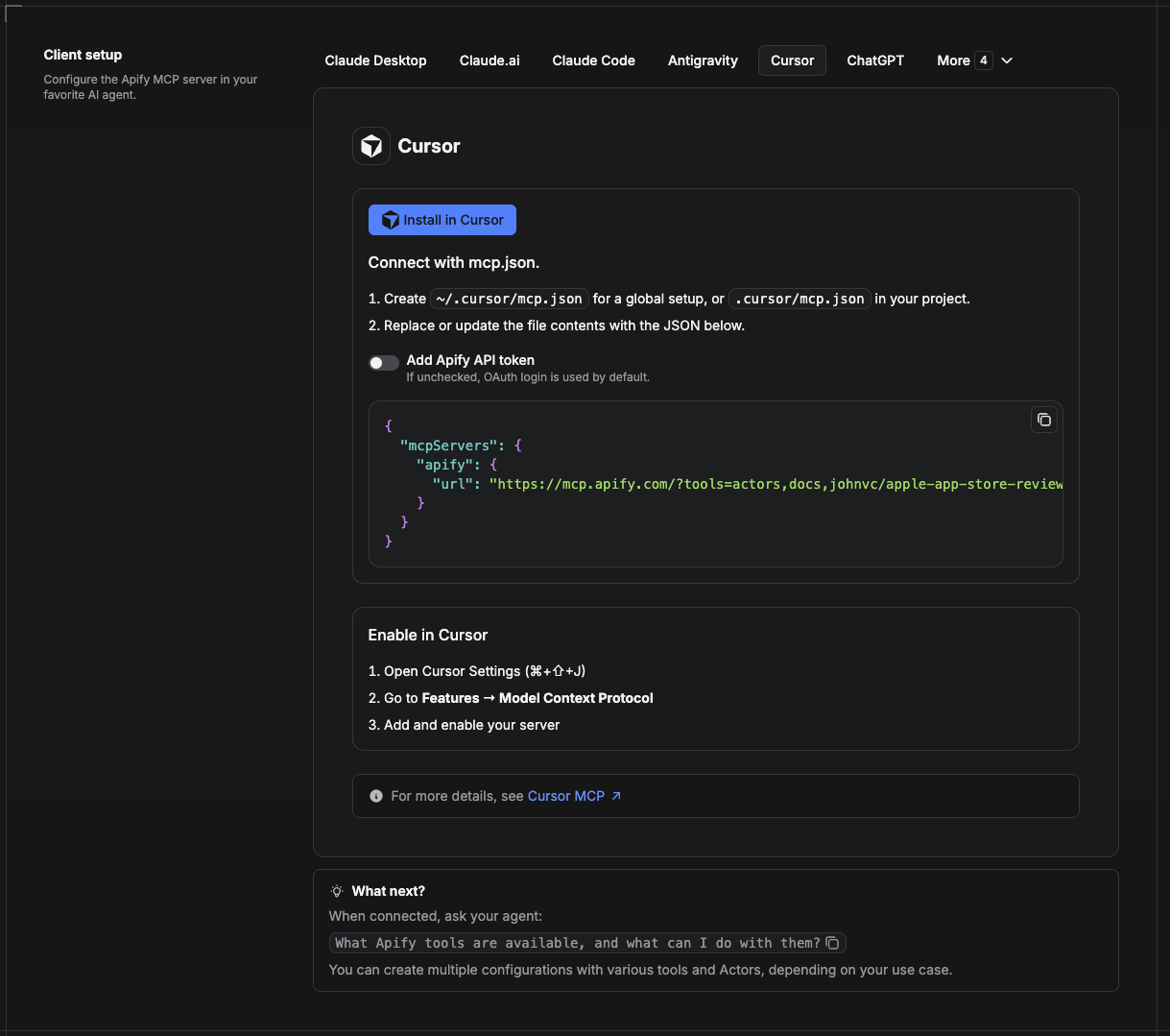
Cursor reads MCP servers from a project file at .cursor/mcp.json.
- In your project, create
.cursor/mcp.json:
{
  "mcpServers": {
    "apify": {
      "url": "https://mcp.apify.com/?tools=actors,docs,johnvc/xing-profile-api"
    }
  }
}- If you prefer token auth over browser OAuth, add a header:
{
  "mcpServers": {
    "apify": {
      "url": "https://mcp.apify.com/?tools=actors,docs,johnvc/xing-profile-api",
      "headers": { "Authorization": "Bearer YOUR_APIFY_TOKEN" }
    }
  }
}- Open Cursor → Settings → MCP and confirm the apify server is connected (green dot).
- In Composer or Chat, ask Cursor to call the Xing API.
New to Cursor? Get it here: https://cursor.com/referral?code=XQP4VBLI3NNX
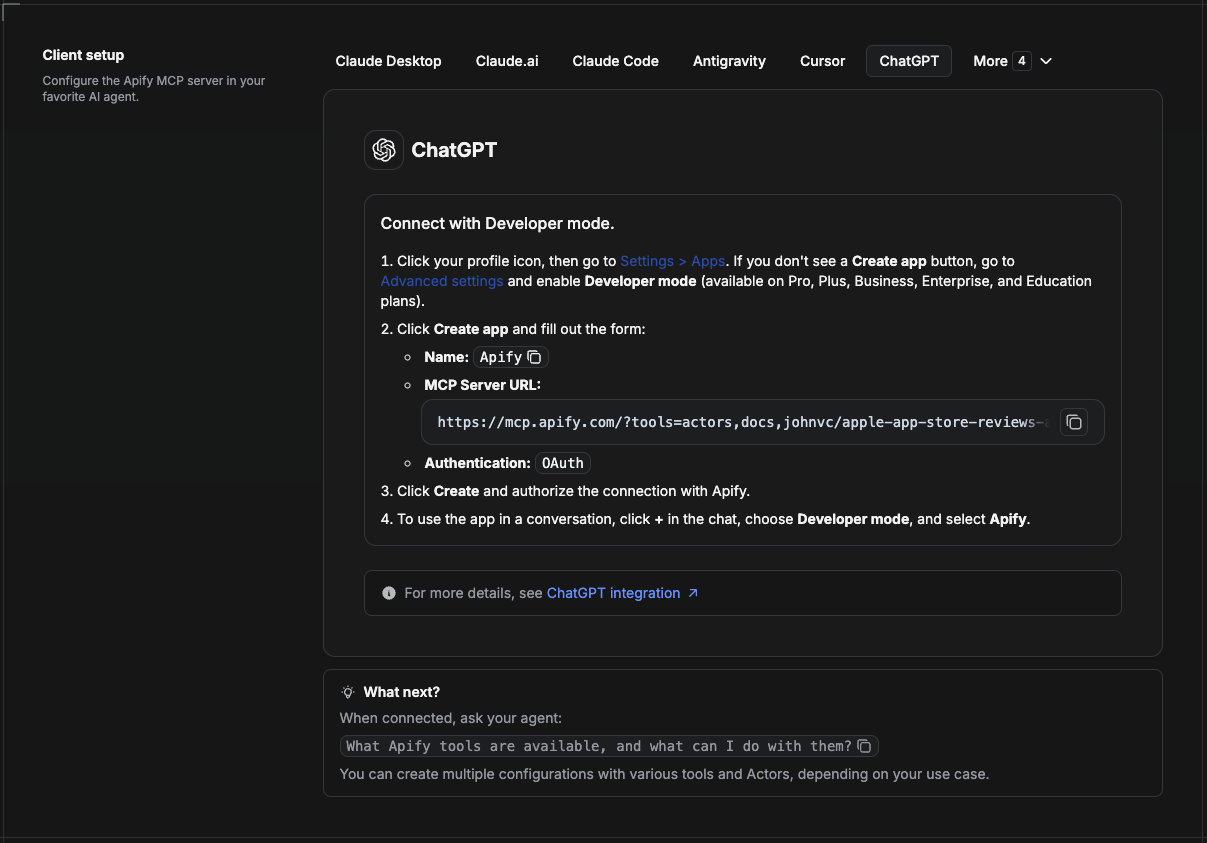
ChatGPT connects to the Apify MCP server through Developer mode (available on ChatGPT Pro, Plus, Business, Enterprise, and Education plans).
- Click your profile icon, then go to Settings > Apps. If you do not see a Create app button, open Advanced settings and enable Developer mode.
- Click Create app and fill out the form:
- Name: Apify
- MCP Server URL:
https://mcp.apify.com/?tools=actors,docs,johnvc/xing-profile-api - Authentication: OAuth
- Click Create and authorize the connection with Apify.
- To use the app in a conversation, click + in the chat, choose Developer mode, and select Apify.
More help: https://docs.apify.com/platform/integrations/mcp
- LinkedIn Profile API for the same shape of data on the global network
- LinkedIn Jobs API for open roles
- Workday Careers API for employer-side job listings
- Glassdoor Reviews API for employer reputation
This example repo is part of Alpha OSINT, toolset of financial and operations data sources and APIs. For support or requests for this actor, please start a ticket directly on our support page.
Use the Xing API to power your DACH talent and market research workflows with reliable, structured results.
Last Updated: 2026.08.09