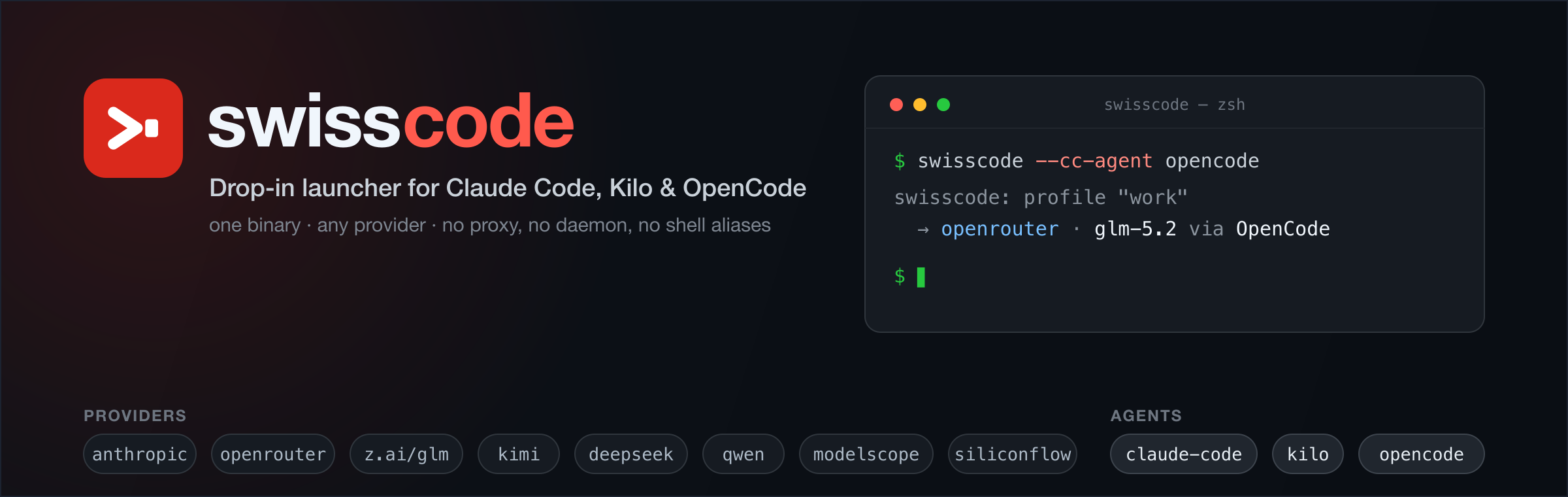


swisscode is a drop-in launcher for Claude Code
and other coding CLIs (Kilo, OpenCode).
Pick a provider, models and permission flags once — then swisscode behaves
exactly like claude, only pointed at OpenRouter,
z.ai / GLM, Kimi, DeepSeek, Qwen, ModelScope, SiliconFlow,
Ollama running on your own machine, or any other
Anthropic-compatible endpoint.
Unlike a router/proxy or a desktop GUI, swisscode is a launcher: it sets the
right environment and execs the real CLI, so there is no proxy, no daemon, no
background process — and it fixes third-party correctness bugs (like the
silent 200K → 1M context downgrade) that a log-reader or
proxy structurally cannot.
- Any provider — OpenRouter, z.ai/GLM, Kimi, DeepSeek, Qwen, ModelScope, SiliconFlow, or a custom Anthropic-compatible endpoint.
- Local models, no key — Ollama speaks the Anthropic Messages API natively, so
swisscodepoints Claude Code atlocalhostwith no proxy and nothing to sign up for. - Any agent — Claude Code (default), Kilo or OpenCode, selectable per profile or per run.
- Named profiles & per-directory bindings — the right backend per repo, automatically.
- Correctness fixes — real 1M context (
[1m]), catalog-driven auto-compaction, gateway compatibility flags. - A preflight
doctor— binary, endpoint, credential, models, real tool-calling probe, and the context window your local server actually loaded. - No proxy, no daemon, no GUI — a single binary that
execs the real CLI, so nothing sits between you and your agent.
It replaces shell aliases like this:
alias claudeor='ANTHROPIC_AUTH_TOKEN=sk-or-... ANTHROPIC_BASE_URL=https://openrouter.ai/api \
ANTHROPIC_DEFAULT_OPUS_MODEL=openrouter/fusion ... claude --dangerously-skip-permissions'npx swisscode # first run opens setup, then launches
npx swisscode # every run after: launches straight into Claude CodeFor daily use install it globally — npx re-checks the registry on every
invocation, which you'll feel on a tool you launch dozens of times a day:
npm install -g swisscodeBun works too, both as a runner and as the runtime:
bunx swisscode@latest    # the @latest matters — see below
bun install -g swisscode
bunx swisscodecan run a stale cached version. Measured, not assumed: with 0.4.0 published,npx swisscoderesolved 0.4.0 while plainbunx swisscodekept serving a cached 0.3.0 — which cannot read a config the newer version has migrated, so it reportsprovider undefined. Your config is safe (an older build refuses to write over a newer file), but the tool looks broken.bunx swisscode@latestforces a fresh resolve, and a global install avoids the question entirely.
Nothing special was needed for this: swisscode is plain ESM with no native
addons, and process.execve — the call that makes handoff free — exists on Bun
as well as Node. Verified by resolving a full launch plan under both and
diffing: same profile, same agent, same provider, and a byte-identical set of
ANTHROPIC_* / CLAUDE_CODE_* variables. Deno is untested.
swisscode --cc-version     # which swisscode is this?
swisscode config upgrade # check npm, and install a newer one--cc-version, not --version: --version belongs to the agent and has always
printed its version, so scripts depend on it. swisscode answers on the
reserved --cc- prefix instead of taking a flag it does not own.
When a newer release exists, a launch prints one line telling you. That notice
comes from a cached answer, never from a live request — the launch path is
structurally forbidden from touching the network, which is a property this tool
sells rather than an implementation detail. swisscode config …, the doctor and
the web UI refresh that cache (at most once a day) as a side errand. The honest
consequence: if you only ever launch and never run a config command, you will
not see the notice. A launcher that phoned home on every run would be a
different and worse tool.
Every argument that isn't listed below is forwarded to claude untouched:
swisscode "fix the failing test"
swisscode --resume --model opus
swisscode -p "summarise this diff" < diff.txt| Command / flag | Effect |
|---|---|
swisscode config |
Reopen the settings UI |
swisscode <profile> |
Use that profile for this run (see Profiles) |
swisscode --safe |
Force permission prompts on for this run |
swisscode --yolo |
Force --dangerously-skip-permissions on for this run |
swisscode --cc-… |
Per-run overrides (see Per-run overrides) |
swisscode -- … |
Everything after -- goes to claude verbatim |
config, setup, --safe, --yolo and the --cc- prefix are the only
reserved things. Everything else — including every subcommand below — lives
under config, so no ordinary English word is ever taken away from you. If you
need to pass a reserved token through literally, put it after --:
swisscode -- --cc-profile # claude receives "--cc-profile"Four concepts, and only the last one is a thing you launch.
| What it is | Optional? | |
|---|---|---|
| Provider | An endpoint dialect — base URL, which credential variable, default models, compatibility flags. Eight ship built in | No. Every account names one. Adding your own is the optional part |
| Account | Who pays. One provider plus one credential: an API key, an env var, or a Claude subscription login | No |
| Setup | What runs. Which CLI (claude-code, kilo, opencode), which model per tier, permissions, env |
No. Every profile names one |
| Profile | The pairing. One setup + one or more accounts + how to choose between them | No — this is what swisscode <name> launches |
swisscode work
  └── profile "work"
       ├── setup "cc"                        claude-code, opus/sonnet/haiku
       └── accounts ["personal", "team"]     strategy: usage
            └── account "personal"  →  provider "anthropic"  →  subscription login
Why split at all: they vary independently. One setup ("Claude Code, yolo, GLM on every tier") can be pointed at several accounts, and one account can back several setups. A profile naming more than one account is how rotation works.
Two mistakes the tool now catches for you, because both used to fail silently:
an account with no profile cannot be launched (swisscode <account-name>
selects a profile, so the name would go to the agent as a prompt), and two
accounts that are the same subscription share one quota while looking like two.
Name one after each account, client or experiment.
swisscode config work           # create or edit the "work" profile
swisscode config list           # every profile (keys are never printed)
swisscode config setups         # what runs, and which profiles share each
swisscode config accounts       # who pays, and which profiles use each
swisscode config default work   # used when nothing else applies
swisscode config rm old         # deletes it, and any bindings to it
Once a profile exists, its name is usable in argv[0]:
swisscode work --resumeIf the first word isn't a profile name it's passed straight to claude, so
swisscode fix the login bug still works. To be explicit either way, use
--cc-profile work — an unknown name there is an error rather than a prompt.
One exception to that fallthrough: a first word that names an account or an setup is refused rather than sent as a prompt, because it is far likelier to be a mis-aimed selection than the start of a sentence.
$ swisscode personal
swisscode: "personal" is an account, not a profile — accounts say who pays, and
a profile is the pairing you launch. Known profiles: work. Make one that uses it
with `swisscode config <name>`, or send this word to the agent as a prompt with
`swisscode -- personal …`.
It only fires on an exact match against a name in your own config, so ordinary
prompts are untouched — and swisscode -- personal … sends it through verbatim.
Profile names must start with a letter or digit and contain only letters,
digits, ., _ or -. Names that would collide with a subcommand, or with a
word you're likely to start a prompt with (fix, test, run, …), are
refused at creation time.
Bind a directory to a profile and every launch from it — or from anything underneath it — uses that profile.
cd ~/clients/acme
swisscode config use acme       # bind this directory
swisscode config use --show     # which profile applies here, and why
swisscode config use --clear    # remove this directory's binding
swisscode config bindings       # list all of them
swisscode config bindings --prune   # drop ones whose dir or profile is gone
The nearest ancestor wins, so a binding deeper in the tree overrides a shallower
one. --show prints the exact path the binding came from, which is the thing
you need when a directory picks a profile you didn't expect.
Bindings live in ~/.config/swisscode/config.json, keyed by absolute path.
Nothing is written into your project, so nothing leaks into a commit — the
tradeoff is that bindings don't travel with a clone. They're keyed by the
physical path (process.cwd()), so a symlinked route to the same directory is
a different key.
Resolution costs no syscalls: the binding map is already in the config file
being read, and the "walk" is string arithmetic bounded by the shallowest
binding you have. A binding to a directory you've since deleted is inert until
you --prune it.
Every --cc- flag applies to exactly one launch and is never written to
disk. All of them are stripped before claude is executed.
| Flag | Effect |
|---|---|
--cc-profile <name> |
Use this profile. Unknown name → exit 2 |
--cc-provider <id> |
Switch provider (see the credential rule below) |
--cc-agent <id> |
Launch a different coding CLI (see Agents). Unknown id → exit 2 |
--cc-base-url <url> |
Point at a different endpoint |
--cc-model <id> |
Set all four tiers |
--cc-model <tier>=<id> |
Set one tier; repeatable; applied left to right |
--cc-env KEY=VALUE |
Set an env var. KEY= unsets it |
swisscode --cc-model kimi-k3 --cc-model haiku=glm-4.6 -p "..."
swisscode --cc-base-url http://localhost:8080 --cc-env API_TIMEOUT_MS=600000
A bare --cc-model sets all four tiers on purpose. [1m] is read per
variable, so a one-tier override is exactly the shape of the bug where three
tiers get an extended context window and the fourth silently doesn't.
--cc-provider never sends a credential to a host it wasn't entered for.
In order: keep the key if the provider is unchanged; else borrow the key,
endpoint and models from another profile that already uses that provider;
else use one already in your environment; else exit 2. There is no "just send
the key we have" fallback — that's how a z.ai token ends up POSTed to
OpenRouter. Model ids are dropped for the same reason: glm-5.2 sent to
OpenRouter is a guaranteed 404 wearing the costume of a working config.
Any unrecognised --cc-* option is an error rather than a passthrough token,
because forwarding a typo'd --cc-porfile would put it in your prompt while
the launch quietly used the wrong account.
swisscode config doctor              # check everything
swisscode config doctor --offline    # skip the network probes
swisscode config doctor --json       # for scripts and CI
swisscode config doctor --fix        # apply the unambiguous repairs
Doctor verifies binary resolution, which profile is active and why, endpoint reachability, credential validity, model existence, tool-calling support, conflicting shell variables, and config file permissions.
Exit codes are meant for CI: 0 clean, 1 warnings, 2 errors.
Three things worth knowing:
- It never runs automatically. The probes are real inference requests
(
max_tokens: 1, at most one per distinct model plus one tool-calling probe). A launcher that quietly billed you a token on every start would be a worse bug than anything it detects. Use--offlineto skip them entirely. - It never prints your key — not masked, not truncated, not length-hinted. Anything a gateway echoes back is redacted before it's rendered, so a report is safe to paste into a bug thread. Note that it does print binding paths, which contain directory names.
- Probes are non-streaming, for every provider. ModelScope answers a bad
token with HTTP 200 followed by an SSE stream that dies silently — a
streaming probe there cannot tell a rejected credential from a slow model.
With
stream: falsethe same token has to produce a real status code.
Total runtime is bounded by a hard budget (--timeout <ms>, 20s by default);
checks that don't fit are reported as skipped rather than silently passing.
| Provider | Endpoint | Notes |
|---|---|---|
| Anthropic | default (keeps your existing login) | clears any gateway URL left in your shell |
| z.ai | https://api.z.ai/api/anthropic |
GLM; glm-5.2 runs at its extended 1M window |
| OpenRouter | https://openrouter.ai/api |
browsable catalog; pins CLAUDE_CODE_SUBAGENT_MODEL, which subagents need in order not to 404 |
| ModelScope | https://api-inference.modelscope.cn |
browsable catalog; keep the ms- prefix on your token |
| SiliconFlow | https://api.siliconflow.com |
use https://api.siliconflow.cn for mainland accounts; a Pro/ prefix selects the paid variant |
| Ollama | http://localhost:11434 |
local models, no key; browsable catalog of what you've pulled — see Ollama |
| Ollama Cloud | https://ollama.com |
Ollama's hosted models; needs an API key |
| Custom | any Anthropic-compatible endpoint |
Note the ModelScope, SiliconFlow and Ollama endpoints are bare hosts. The
/v1 that appears alongside them in the vendors' docs is the OpenAI-compatible
route; adding it here produces /v1/v1/messages and a 404.
Whichever provider you pick, swisscode removes ANTHROPIC_API_KEY from the
child environment unless that provider is the one that uses it. A stale key left
in your shell would otherwise make Claude Code fall back to Anthropic and bill
the wrong account.
Not shipped, deliberately: iFlow (keys expire after seven days and the route
is undocumented), Volcengine (the docs reportedly warn that driving these
endpoints from your own scripts risks account suspension), and DeepSeek
direct (api.deepseek.com/anthropic returns 400 unknown variant "system" on
Claude Code >= 2.1.154, with no verified workaround — DeepSeek weights through
OpenRouter are fine).
Ollama v0.14.0+ implements the Anthropic Messages API natively — this is a real endpoint, not an OpenAI shim being translated — so a local model is just another provider. No proxy, and no key:
swisscode config local        # pick Ollama, leave the key blank
swisscode local               # launches Claude Code against localhost:11434
The picker browses the models you have actually pulled, and marks which of them
support tool calling — Claude Code cannot function without it, and plenty of
local models lack it. qwen3-coder and gpt-oss are the usual choices.
Doctor also probes tool calling for real, which catches the case a capability flag cannot: a model that advertises tools but is too small to reliably emit one.
The one thing that will bite you: context. The window Ollama serves is a property of how you started the server —
OLLAMA_CONTEXT_LENGTH, or a ModelfilePARAMETER num_ctxthat overrides it — not of the model id. Claude Code assumes 200K regardless, and nothing errors when they disagree: the model just silently forgets the beginning of the conversation.So
swisscode config doctormeasures it and warns below 32K:✓ context window qwen3:0.6b loaded with a 32K window (model ceiling 40K) ! context window qwen3:0.6b is loaded with a 4K window; Claude Code assumes 200K and will not be told otherwise, so it silently forgets the start of long conversations ↳ Restart Ollama with OLLAMA_CONTEXT_LENGTH=65536 (64K). A Modelfile `PARAMETER num_ctx` overrides that variable, so check it tooThose are two different numbers on purpose: the loaded window is what governs, while the model's ceiling is only an upper bound. swisscode does not guess either one at launch — a window set too large means the conversation overflows instead of compacting.
http:// is correct for the local endpoint and is exempt from the
cleartext-credential warning, which applies to non-loopback hosts only — point
a profile at a remote Ollama over http:// and swisscode will tell you.
Ollama Cloud is a separate preset because it authenticates for real, and
currently accepts only Authorization: Bearer rather than Anthropic's
x-api-key (ollama/ollama#16922).
swisscode already sends the bearer spelling, so it works today.
If Ollama becomes unresponsive, you have hit
ollama/ollama#13949: Claude
Code polls /v1/messages/count_tokens?beta=true, which Ollama does not
implement. It did not reproduce here on 0.32.0, but if it happens to you:
swisscode --cc-env CLAUDE_CODE_DISABLE_NONESSENTIAL_TRAFFIC=1or set "compat": {"disableNonessentialTraffic": true} on the profile. That
switch also disables gateway model discovery, so swisscode says so on
stderr when it is on — it is not shipped on by default, because a preset that
quietly removed a feature to dodge an upstream bug would be the kind of silent
behaviour this tool exists to avoid.
Everything above assumes an API key. A Claude Pro or Max subscription is not a
key — it is a login, stored by Claude Code in your keychain and pointed at by
CLAUDE_CONFIG_DIR. swisscode can hold several of them and pick between them.
An account is one or the other, never both; a config naming a key and a session directory is refused rather than resolved by precedence.
The terminal wizard covers this too — pick Anthropic (direct) in
swisscode config <name> and it asks how the account pays, offering a
subscription kept separate from your other logins, the login you already use, or
an API key. Or do it directly:
swisscode config accounts login work          # make a session dir, run /login inside
swisscode config accounts login personal --dir ~/.claude   # adopt the login you already have
swisscode config accounts                     # who each account is, no keychain prompt
login creates ~/.config/swisscode/accounts/<name> at 0700, mints a profile
of the same name so there is something to launch, then runs the agent there so
you can complete /login once.
The profile matters: an account says who pays, and swisscode <name> selects
a profile. Without one the account is unreachable — which is why config accounts and config doctor both flag an account no profile uses. Pass
--no-profile if you mean to wire it into an existing multi-account profile
yourself.
A new directory does not start logged out — it starts as a copy of the login you already have. Claude Code seeds a fresh
CLAUDE_CONFIG_DIRfrom your current session, so if you exit without running/loginas a different account, you end up with two names for one subscription: both report their own email and plan, both work, and neither adds any capacity.config accountsmarks themDUPLICATEandconfig doctorfails thedistinct accountscheck, because ausageprofile would otherwise count that single quota twice and rotate between two halves of the same thing.
Naming
~/.claudemeans unsettingCLAUDE_CONFIG_DIR, not setting it to that path. Claude Code chooses its keychain item on whether the variable is set, not on its value — soCLAUDE_CONFIG_DIR="$HOME/.claude"is a different, empty login from the one you use every day. swisscode handles this for you; it is documented because the failure is silent. Identity comes from a shared~/.claude.json, so a tool that gets this wrong reports the correct email for a session that cannot authenticate.
swisscode config accounts usageReads each subscription's real 5-hour and 7-day windows from Anthropic — the
same figures /usage shows you, for every account at once, without switching
into each one to look. It caches them, and a profile with
"strategy": "usage" then launches on whichever account has the most left:
{ "setup": "default", "accounts": ["personal", "work"], "strategy": "usage" }Ranking uses the tighter of the two windows, never their average. An account at 5% of its 5-hour window and 95% of its weekly one has almost nothing left, and averaging to 50% would send work straight at it. An account that cannot be measured is treated as unknown and passed over, never as full.
swisscode config doctor refreshes the same cache, and the Accounts screen in
the web UI has a button for it. Nothing measures on the launch path — a launch
resolves a directory and hands it to the agent without opening it, which is why
an ordinary swisscode never raises a keychain prompt.
swisscode config accounts swap --into work personal/login writes one global slot, and every running Claude Code re-reads it
within about 30 seconds — which is why switching accounts in one terminal
switches all of them, and why an artifact created just after a switch can land
on the wrong account. swap writes one directory's slot instead. Sessions
using any other directory are unaffected.
Three things to know:
- A session already running in that directory picks it up within ~30s, not instantly. swisscode cannot reach into a running process; the agent re-reads its credential on its own timer.
- Anything that session creates after that point belongs to the new account.
- Overwriting a different account's login needs
--yes.
Stated plainly, because you are entitled to decide for yourself:
- Rotating between subscriptions you pay for is fine. Sharing or reselling one
is not. swisscode is structurally incapable of the second: it never sits in
the request path, holds no server, and proxies nothing. It sets environment
variables and calls
execve. CLAUDE_CONFIG_DIRand the usage endpoint are undocumented. Both work, and per-directory isolation is the mechanism Claude Code itself implements, but neither is a contract. If Anthropic changes them, expect the measurement to degrade to "unknown" rather than to lie — every parse here fails to null.- Per-launch selection is the well-trodden part;
swapis not. Choosing an account before starting the agent is ordinary. Overwriting a live session's credential is doing programmatically what/loginalready does by hand — same official client, same accounts you pay for — but it is not something Anthropic has explicitly blessed. claude -pbills a credit pool, not the subscription window, so the 5-hour figure describes interactive sessions. No behaviour change; just don't read the number as covering headless runs.
The CLI is not the only way in. swisscode config web serves a local
configuration UI — profiles, providers, agents, model tiers, compatibility
flags and settings, everything the CLI can express:
swisscode config web              # prints a URL; Ctrl-C to stop
swisscode config web --port 7391
It is a singleton by construction: the port bind is the mutex, so a second
instance tells you one is already running rather than racing it. It binds
127.0.0.1 only, never 0.0.0.0.
Your keys never reach the browser. The page is told whether a key is set,
never what it is, and editing is write-only: leaving the field blank keeps the
stored key, and clearing one is a separate, explicit action. That is the same
rule config doctor follows.
Because a browser will talk to localhost on behalf of any page you have open,
the server checks the Host header against an exact allowlist (this is the
DNS-rebinding defence — the connection genuinely comes from loopback, so nothing
at the socket level can tell an attack apart), validates Origin, and requires a
per-run token in a custom header, which forces a CORS preflight it never answers.
Edits are checked against the revision they were based on, so a browser tab left
open while you run swisscode config work in a terminal gets a conflict rather
than silently overwriting it.
You can also define your own providers here — a gateway or local server
swisscode ships no preset for. They are validated on save with the same rules the
shipped presets are tested against: no /v1 suffix, no hand-typed [1m], real
compatibility flags. Shipped presets stay read-only, and a custom provider cannot
shadow one.
The provider is which model backend you talk to; the agent is which coding CLI you launch against it. They are orthogonal — any provider works with any agent, because every provider preset is an Anthropic-compatible endpoint and each agent is pointed at it.
| Agent | id | Binary | Install |
|---|---|---|---|
| Claude Code (default) | claude-code |
claude |
claude.com/claude-code |
| Kilo | kilo |
kilo |
npm i -g @kilocode/cli |
| OpenCode | opencode |
opencode |
npm i -g opencode-ai |
swisscode config agent                 # list agents and which profile uses each
swisscode config agent work opencode   # make the "work" profile launch OpenCode
swisscode --cc-agent kilo -p "…"        # one run, without changing the profile
A profile with no agent set launches Claude Code, so nothing changes for an
existing setup. swisscode resolves the agent's binary the same way it resolves
claude — PATH first, then the usual install locations — and each has its own
override: SWISSCODE_CLAUDE_BIN, SWISSCODE_KILO_BIN, SWISSCODE_OPENCODE_BIN.
How it reaches the provider. Claude Code reads ANTHROPIC_* variables
directly. Kilo and OpenCode instead take a full config inline
(KILO_CONFIG_CONTENT / OPENCODE_CONFIG_CONTENT) that swisscode generates on
the fly — an @ai-sdk/anthropic provider aimed at your endpoint and key. No
file is written to your disk.
Capability differences are surfaced, never silently dropped. Claude Code has
four model tiers; Kilo has one slot and OpenCode has a main plus a small model.
When a profile pins tiers an agent can't express, swisscode uses the opus-tier
model and prints which tiers it ignored. The [1m] extended-context suffix is a
Claude-Code-specific signal, so on Kilo/OpenCode you get a one-line warning that
a 1M-window provider is being reached at its standard window.
Kilo/OpenCode support is new. The generated config matches each CLI's documented schema, but the exact field names live behind single constants in
src/adapters/agents/{kilo,opencode}/index.ts— if a CLI update moves one, it's a one-line fix with a test to catch it.
Providers with a queryable catalog (currently OpenRouter) get a browsable picker instead of asking you to type model ids from memory:
model for opus  ·  search: claude▌
19/342 shown · tools only

› anthropic/claude-fable-5     Anthropic: Claude Fable 5
  anthropic/claude-opus-4.8    anthropic/claude-fable-5
  anthropic/claude-sonnet-5
  anthropic/claude-haiku-4.5   input        $10.00 / M tokens
                               output       $50.00 / M tokens
                               context      1M  (max out 128K)
                               ✓ tools ✓ reasoning

                               artificial analysis
                               intelligence ████████████░░░░░░░░ 59.9
                               coding       ███████████████░░░░░ 76.5
| Key | Action |
|---|---|
↑ ↓ |
move · PgUp/PgDn to jump |
| type | fuzzy search across id and name |
^T |
toggle the tools-only filter |
^F |
show only free models |
^R |
refetch the catalog |
⏎ / esc |
select / go back |
Tools filter. Claude Code cannot work without tool calling, and 71 of
OpenRouter's 342 models don't support it — so they're hidden by default rather
than left to fail at runtime. ^T reveals them, with a warning on the model.
Models are sorted best-coding-first using Artificial Analysis benchmark scores
where available. The catalog is cached for 24h at
~/.config/swisscode/models-<catalog>.json; if the fetch fails, a stale
cache is used and the header says so.
Note: tokens/sec is not shown. OpenRouter's public API exposes
throughput_last_30mandlatency_last_30mfields, but they arenullfor every model and provider — the figures on their website come from a source the API doesn't serve. The benchmark scores stand in for it.
Settings live in ~/.config/swisscode/config.json (honours
XDG_CONFIG_HOME), written 0600 inside a 0700 directory because the file
holds an API key in plaintext.
{
  "version": 4,
  "providerAccounts": {
    "openrouter": { "provider": "openrouter", "apiKey": "sk-or-…" },
    "personal":   { "provider": "anthropic", "configDir": "/Users/me/.claude" }
  },
  "setups": {
    "default": {
      "agent": "claude-code",
      "models": {
        "opus": "openrouter/fusion",
        "sonnet": "…",
        "haiku": "…",
        "fable": "…"
      },
      "skipPermissions": true,
      "compat": { "disableAdaptiveThinking": true },
      "contextWindows": { "openrouter/fusion": 1000000 },
      "env": { "ANY_EXTRA_VAR": "value" }
    }
  },
  "profiles": {
    "work": { "setup": "default", "accounts": ["openrouter"], "strategy": "single" }
  },
  "defaultProfile": "work",
  "bindings": { "/Users/me/clients/acme": "acme" },
  "settings": { "quiet": false, "bindingWalkDepth": 40 }
}
Three separate things, because they vary independently. A provider account
is who pays — a key, or a subscription login. A setup is what runs — which
CLI, which model per tier, which flags. A profile pairs them and says how to
choose when it names more than one account (single, round-robin, or
usage). One setup can be shared by several profiles that bill different
accounts, which is the arrangement the older flat shape could not express.
Setups were called
agentProfilesbefore v4. Two things one word apart — "agent profile" and "profile" — read backwards to almost everyone, so the one nobody types got the new name. Existing configs migrate on first read, andconfig agentsstill works as an alias forconfig setups.
bindings records absolute paths, which means client names and project layout.
That's new non-credential information in this file — worth remembering before
pasting it into a bug report.
Older configs migrate automatically the first time a newer version reads them —
v1's single flat object with a top-level provider, and v2's profiles that
carried credential and agent settings together. The original is kept beside it
as config.v1.bak.json, and a migration that cannot be written to disk is used
in memory rather than blocking the launch.
Claude Code has four model tiers. A tier you leave out inherits the
provider's default; a tier set to the empty string is explicitly unset. Setting
them from one table is deliberate — Claude Code reads the extended-context
[1m] marker per variable, so a tier that gets missed runs at the narrower
window with no error and no warning.
Instead of apiKey you can write "apiKeyFromEnv": "MY_TOKEN" to read the
credential from your environment at launch, which keeps the secret out of the
file.
The optional env block is applied last, so it can override anything the
provider sets. An empty string unsets a variable rather than setting it to
empty.
Claude Code assumes a 200K context window for any endpoint that is not
api.anthropic.com. The documented way to say otherwise is a [1m] suffix on
the model id — and it is read per ANTHROPIC_DEFAULT_*_MODEL variable, so
suffixing three tiers and forgetting the fourth leaves that tier at 200K
silently.
You never type the suffix. A provider declares which of its models genuinely support the wider window, and swisscode derives the suffix for every tier from that one list. Pin a tier to a model that is not on the list and swisscode tells you that tier is running narrow; write a suffix by hand for a provider that does not support it and swisscode strips it, because sending an id the endpoint does not recognise fails hard while a narrower window merely disappoints.
Configs written before this landed need no editing: normalisation happens on the
way out, so a stored glm-5.2 reaches Claude Code as glm-5.2[1m] without
anything on disk being rewritten.
When swisscode knows a model's real context length it sets
CLAUDE_CODE_AUTO_COMPACT_WINDOW, which is where Claude Code starts summarising
the conversation. This is in addition to [1m], not a substitute: the
suffix is what widens the window, this says where to compact inside it.
The number comes from measured data only — a catalog's published context length, recorded when you pick a model, or a window the provider documents. If any tier is running a model with no such data, swisscode sets nothing at all rather than guessing; a guessed window that is too large means the conversation overflows instead of compacting. It is skipped entirely for first-party Anthropic, which knows its own models better than we do.
Gateways disagree with Claude Code in specific, diagnosable ways. Each flag
below names the symptom it clears; set them per profile under compat:
"compat": { "disableAdaptiveThinking": true, "skipFastModeOrgCheck": false }| Flag | Clears |
|---|---|
disableExperimentalBetas |
400 Extra inputs are not permitted |
disableAdaptiveThinking |
400 Input tag 'adaptive' found |
skipFastModeOrgCheck |
fast mode reports "disabled by organization" |
enableToolSearch |
MCP tool search being off by default off-first-party |
forceIdleTimeoutOff |
long stalls on slow or locally hosted models |
dropAttributionHeader |
poor prompt-cache hit rate through a gateway |
disableNonessentialTraffic |
an endpoint wedged by background requests (Ollama) — has a cost, see below |
A profile's compat overrides the provider's defaults key by key. Setting one
to false actively clears the variable, so turning a flag off also defeats one
left set in your shell.
A flag that trades something away says so. disableNonessentialTraffic also
disables gateway model discovery, so swisscode prints what it costs rather than
letting it look like a free switch — loudly on stderr when a provider turns it
on for you, quietly (doctor-only) when you asked for it yourself. That
distinction is the rule: a compatibility flag may never remove a capability
silently.
Variables you exported once and forgot outrank nothing — the profile always wins. But winning silently looks identical to never having conflicted, so swisscode prints a line to stderr (never stdout, which belongs to Claude Code) when your environment and your profile disagree about something this launch touches.
A stale ANTHROPIC_API_KEY gets its own message, because it is the only failure
here that costs money: left in place it makes Claude Code fall back to Anthropic
and bill that account for traffic you meant to send to a gateway.
A clean environment produces no output. Set "quiet": true under settings, or
SWISSCODE_QUIET=1, to suppress the lot.
When a launch uses a profile you didn't get by default — because you named one,
a directory binding applied, or a --cc- flag changed something — one line goes
to stderr saying so:
swisscode: profile "acme" (binding: /Users/me/clients/acme) → openrouter · openrouter/fusion
The ordinary default-profile launch stays silent, which is what keeps that line
worth reading. swisscode config use --show answers the same question without
launching anything.
| Env var | Effect |
|---|---|
SWISSCODE_CLAUDE_BIN |
Use a specific claude binary |
SWISSCODE=1 |
Set by us in the child, so hooks can detect the wrapper |
SWISSCODE_QUIET=1 |
Suppress warnings and the profile banner |
swisscode resolves the real claude binary from PATH (skipping itself, so
alias claude=swisscode can't recurse), builds the environment, then calls
process.execve to replace its own process image. Claude Code inherits the
same pid, tty and process group, and no wrapper process is left behind — nothing
to relay exit codes through, no idle Node process for the length of your
session.
Where process.execve does not exist — Windows, IBM i, and Node older than
22.15 — it falls back to spawn with inherited stdio, relaying the child's exit
code and re-raising a killing signal rather than reporting a clean exit. It also
falls back if execve exists but fails (EACCES, ETXTBSY, a TOCTOU ENOENT):
dying there would be worse than spawning.
The Ink UI is loaded lazily, so the normal launch path never imports React.
swisscode is written in TypeScript and published as compiled JavaScript.
Nothing in the tarball relies on Node's native type stripping, which is not
reliably enabled across the whole >=22 engines range.
npm install
npm run typecheck   # tsc --noEmit over src/ and test/
npm run build       # tsc: src/ -> dist/   +   esbuild: the Ink UI -> dist/ui.js
npm test            # typecheck, build, then the full suite
npm run dev # build once, then tsc --watch on the launch pathNode runs .ts directly, so most tests need no build at all:
node --test "test/core/**/*.test.ts" # ~0.2s, no build stepThe exception is the three UI suites (ui, picker, profiles-ui), which
drive the wizard through the built bundle and therefore need npm run build
first. npm test always builds, so it is the safe default.
| path | what it is | shipped? |
|---|---|---|
bin/swisscode.js |
the published entry point. Plain JS on purpose, never compiled — it runs before anything is known about the environment, so it carries no dependencies and no syntax needing a build. Imports ../dist/cli.js. |
yes |
src/core/** |
pure domain logic. No I/O, no state, imports nothing outside core/ and node: builtins. |
as dist/core/** |
src/ports/** |
interfaces only. Every one of these files erases to export {}. |
as dist/ports/** |
src/adapters/** |
the implementations — providers, catalogs, fs, process, net, clock, doctor probe, and the Ink UI. | all but adapters/ui |
src/composition/** |
the composition roots that wire adapters into ports. | all but ui-root |
test/** |
.ts, run straight from source. Never compiled, never packed. |
no |
Two tsconfigs, because they do different jobs: tsconfig.json typechecks the
whole program (src + test) and emits nothing — it is what the editor loads
and what npm run typecheck runs. tsconfig.build.json emits src/ to dist/
and excludes the Ink UI, which esbuild bundles separately into
dist/ui.js. Emitting the UI twice would put React-importing modules inside a
package whose entire selling point is that the launch path never touches them.
A relative import names the file that actually exists on disk — write
'./format.ts', not './format.js'. Node's type stripper does not remap .js
to .ts, so the usual TypeScript-ESM convention would make the sources
unrunnable; rewriteRelativeImportExtensions converts the specifier on the way
out, so dist/ still says .js.
Nothing under src/ may name the UI, even in type space. A plain
import type is enough to pull the whole component tree into the build program
and ship a second, unbundled copy of React. src/cli.ts therefore declares the
bundle's shape structurally, and test/ports.conformance.ts — which is never
emitted — checks that declaration against the real module.
Contributions are very welcome, and the docs are written to make one cheap:
| docs/CONTRIBUTING.md | setup, the inner loop, recipes, review, sign-off |
| docs/ARCHITECTURE.md | the map, the layers, the agent seam, the invariants |
| docs/STYLE.md | the project's DNA — how code is written here, and why |
| docs/TESTING.md | the suite's structure and the 0.3s inner loop |
| docs/SECURITY.md | threat model, and how to report a vulnerability privately |
| AGENTS.md | the machine-readable brief for coding agents |
Coding agents are first-class contributors here. Plenty of projects are
working out how to say no to AI-written patches; this one says yes, and is
built for it — the invariants are enforced by test/architecture.test.ts rather
than left as norms to infer, the file headers carry the reasoning behind each
decision, and the core test loop runs in 0.3 seconds with no build. Point your
agent at AGENTS.md.
No disclosure is required, and human-written PRs are welcome on identical terms.
The only real standard: understand the change well enough to answer questions
about it. Sign your commits off with git commit -s
(DCO, not a CLA).
MIT