Repository navigation
Machine Learning
- Labels are the thing we're predicting.
- Features are the input variable.
- Models define the relationship between features and labels.
- Two phases of a model's life:
- Training means creating or learning the model.
- Inference means applying the trained model to unlabeled examples.
| Supervised | Unsupervised | Semi-Supervised | Reinforcement | |
|---|---|---|---|---|
| Overview | Majority of algorithms. The machine is trained using well-labeled data; inputs and outputs are matched. | Unlabeled data (inputs only) is analyzed. Learning happens without supervision | Some data is labeled, some not. The goal is to get better results than labeled data alone. Good for real-world data. | An agent interacts with its environment by performing an action and learning from errors or rewards. |
| Process | Mapping function takes inputs and matches to outputs, creating a target function. | Inputs are used to create a model of the data. | Combination of the supervised and unsupervised processes. | Follows trial-and-error method. |
| Subtypes | Classification, Regression | Clustering, Association, Dimension Reduction | Classification, Regression, Clustering, Association | Reward-based |
| Algorithms | Linear Regression, Random Forest, SVM | PCA, K-Means | Mixture models, Semi-supervised SVM | Q-Learning |
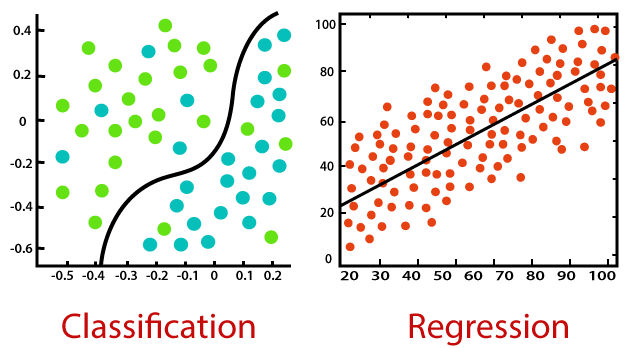
| Classification | Regression | |
|---|---|---|
| Overview | The task of predicting a discrete class label. | The task of predicting a continuous quantity. |
| Subtypes |
Binary Classification: The data is classified into two classes/labels. Multiclass Classification: The data is classified into more than 2 classes/labels. |
Single Regression: The data can have one dependent (y) variable with one independent (x) variables. Multivariate Regression: The data can have one independent (y) variable and two or more dependent (x) variables. |
| Algorithms | Naive Bayes, Logistic Regression | Linear Regression |
| Type of Output | Categorical | Continuous |
| Assessment of Model | Accuracy/Confusion Matrix | Root Mean Squared Error |
| Examples |
Binary Classification: detecting if given email is spam or not (classes - yes/no) Multiclass Classification: predicting what dog breed is presented to the model (classes - pug, labrador, golden retriever, etc.) |
Single Regression: predicting the price of a house (y) given the feature of square feet (x). Multivariate Regression: predicting the price of a house (y) given the features of square feet, number of rooms, schools in the area, etc. (x). |
| Clustering | Association | |
|---|---|---|
| Overview | Grouping a set of objects in such a manner that objects in the same group are more similar than to those object belonging to other groups. | Finding associations amongst items within large commercial databases. |
| Subtypes | There are 5 types of clustering methods: Partioning, Heirarchical, Fuzzy, Density-Based, Model-Based | f |
| Algorithms | K-Means, Agglomerative | Apiori |
| Examples | Split up similar clothing into stacks. | Find what clothes one often wears together. |