



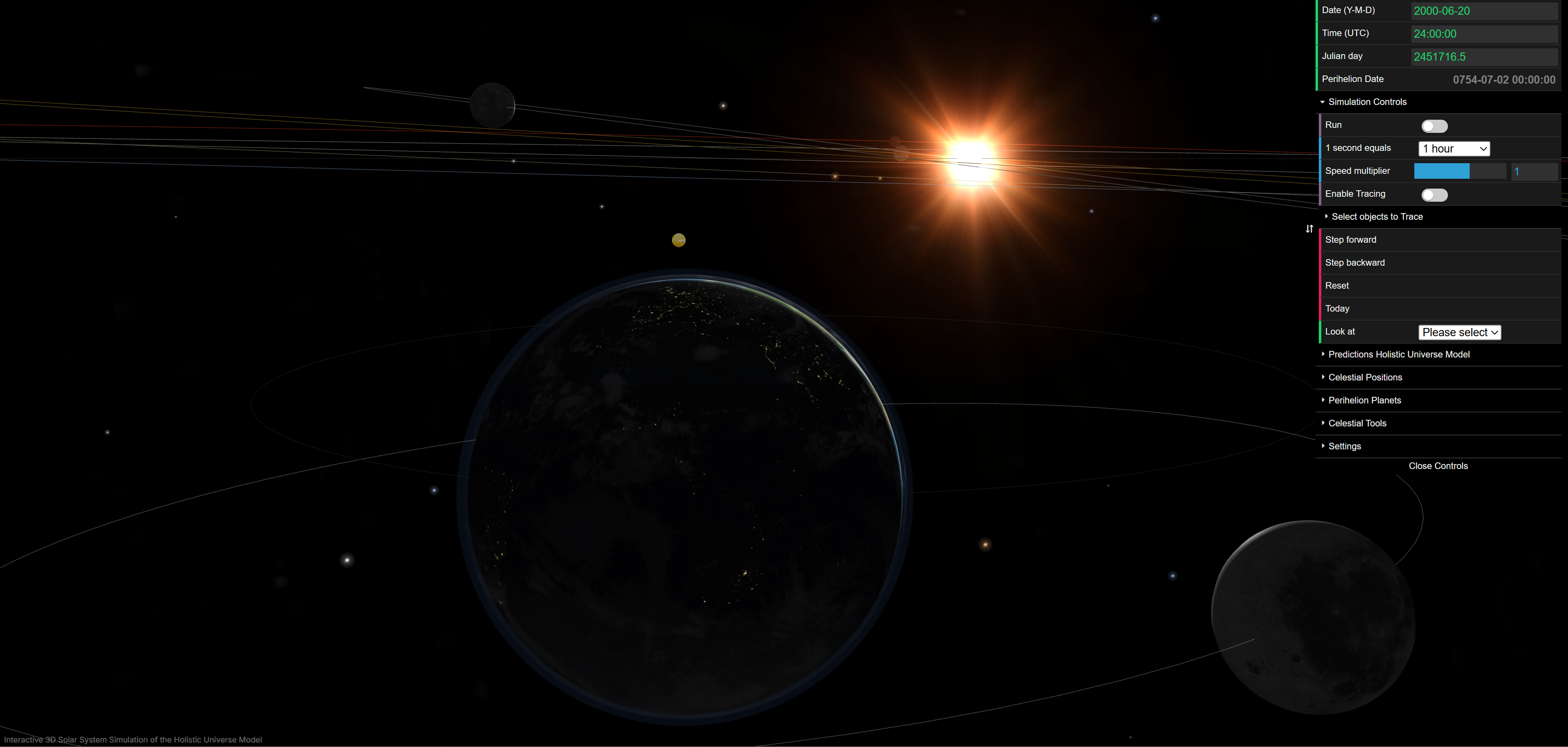
Live Demo — Experience the simulation in your browser (auto-deployed from every verified commit). Visits are counted with GoatCounter — cookieless, no personal data; see the privacy policy.
Preprint — Read the accompanying research paper
What if the orbits of all eight planets, the wobble of Earth's axis, and the rhythm of ice ages are all governed by the same mathematical structure?
This interactive 3D simulation implements the Expanding Solar System Resonance Theory (ESSRT) — a geocentric model built on a single timescale, running on two engines: an N-body Keplerian chain for the planets (derived from one cited J2000 state, zero free parameters) and the lunisolar precession channel for Earth's spin and time — the mean lunisolar precession period as the clock, with the correction combs as bounded harmonic bases on its fixed unit. The simulation accurately reproduces the geocentric positions of the Sun, Moon, and all seven planets — verified against JPL Horizons ephemeris data (~1800–2100 AD) and over 700 historical astronomical observations (~2000 BC to ~4000 AD). From the same geometric framework, it simultaneously produces obliquity, eccentricity, perihelion precession, and inclination oscillation for all planets.
The model starts from a single observation: two of Earth's precession motions rotate in opposite directions.
| Motion | Direction | Cycle |
|---|---|---|
| Axial Precession | Clockwise | ~25,771 years |
| Apsidal Precession | Counter-clockwise | ~111,635 years |
These two counter-rotating motions combine into the climatic precession — the perihelion-of-date cycle, 0.8124 of the axial precession period at J2000, because the two rates add. The apsidal period itself is 4.332 precession periods today and wanders between 1.08 and 9.81 across ±26 kyr — the simulator's Lunisolar Clock panel shows the live ratios. From this starting point, the model derives what is normally calculated separately: precession of the equinoxes, obliquity oscillation, eccentricity cycles, Milankovitch beat frequencies, the length of days and years, and the orbital-forcing component of climate (the timing of glacial-interglacial cycles).
Everything comes together in one clock: the mean lunisolar precession period, 25,771.4 years at J2000 — the period of the composed torque rate, which evolves on geological timescales with Earth's spin and the Moon's recession (see the deep-time section below). Earth's other long cycles are read against it as ratios of periods, and the obliquity band is the beat of that precession against the orbit's inclination mode (41.2 kyr today) — and this simulation visualizes it all in one interactive view.
The clock is not fixed. Earth's spin tier expands with the tidal evolution of the Earth–Moon system: the day lengthens, the Moon recedes, and the mean lunisolar precession period follows the composed torque rate — Earth's spin carrying the solar and lunar torques, the lunar torque growing as the Moon was closer. The paleoclimate work (docs 90–92) fits the climate record with the engine's own orbital lines — 28 lines, the beats of the N-body chain's secular modes together with the 405.6-kyr eccentricity family — and the two pre-registered tests in plan 06 (T1, T5) retired the former integer-label framing of those lines. The planets' long-term orbital dynamics is standard secular theory, which the model's own N-body engine reproduces (Doc 109 is the typing record). Since the P5 flip the simulator renders the seven planets — positions, perihelion markers and panels — directly from that N-body engine's governed element chain (anchors, secular modes and derived periodic terms in data/nbody-secular-frequencies.json, regenerated from the constants: change a planet's mass and the rendered system responds), with Mercury's relativistic perihelion share emerging as derived physics inside the measured 572″/cy.
The unifying theory is the Expanding Solar System Resonance Theory (ESSRT) (Doc 99):
- The L1 lines are the 28 beats of the engine's own secular modes and precession clock. Their periods are what the model commits to; the integer labels earlier versions attached to them were retired by the pre-registered T1/T5 tests, which found they carry no information beyond the periods they name.
- The periods evolve with the tidal history: the axial precession period was 21,699 yr in the Devonian, is ~25,771 yr today and reaches 28,208 yr in 200 Myr; the obliquity band follows the beat of that precession against the orbit's inclination mode, and the long-eccentricity band stays at its modern class, scaled only by the solar-mass history.
- Two physically independent drivers stretch the clocks: Driver 1 is Earth-Moon tidal evolution (Moon recedes 3.82 cm/yr at J2000, Earth's length-of-day grows, the precession period lengthens); Driver 2 is solar mass loss (every planet's orbit slowly expands via Kepler's 3rd law). Both act simultaneously; the model's day-count near-invariant couples them at the per-planet observational level.
ESSRT therefore unifies the modern-era climate formula (docs 90–92), the deep-time predictions (see deep-time section below), and the future projections (tidal-lock asymptote at ~87.1 R_⊕) into a single coherent framework with the same parameter accounting throughout (two engines, three ledgers — Constants Reference).
The model runs on two engines with one clean division of labor:
- The orbital dynamics engine — the planets. An N-body Keplerian chain derived from one cited J2000 heliocentric state (JPL Horizons vectors) + DE440 mass ratios + 1PN. Zero free parameters: every planetary element chain, secular mode table, and the 405.6-kyr eccentricity metronome derives from that seed.
- The lunisolar precession channel — Earth's spin and time. The mean lunisolar precession period is the clock: the composed torque rate — Earth's spin carrying the solar and lunar torques — sets it, and the tidal history moves it. Earth's other spin-tier cycles are stated as periods and ratios against that clock (the Lunisolar Clock panel shows them live); the correction combs that hold the historical-era fits are bounded harmonic bases; the climate formula rides the engine's own orbital lines. Four named continuous constants: the fitted precession anchor, the mean obliquity, the inclination amplitude, the 21.77° anchor. The full accounting is the three-ledger section of the Constants Reference.
Earlier versions presented Earth's cycles as small-integer divisions of one master cycle, and the divisors as laws. That framing is retired: the integers were readings at the anchor epoch of ratios that wander — the apsidal-to-axial ratio alone runs from 1.08 to 9.81 across ±26 kyr — so the model now speaks in periods and ratios of the mean lunisolar precession period. The mirror-symmetric configuration search that once selected them is kept only as the record of how they were found (its uniqueness claim did not survive dynamical inputs — Doc 109 is the evidence record; the historical derivation and its verification scripts are archived).
The model's falsifiability rests on three pre-registered legs — the deep-time scaling split (Earth's axial precession follows the composed lunisolar rate — spin from the recession history, lunar torque growing with the Moon's approach — and the obliquity band its beat against the orbital mode s₃, while the 405-kyr band does not scale; the precession side is gated against the published constants at 1.4 and 2.46 Ga, tested afresh by every newly dated Precambrian section), the fail-proven historical-era gate suite (eclipses, LOD/ΔT, cardinal points, 41 paleo anchors), and the two-expansions solar-mass consistency (μ(2.48 Ga) = 1.00 ± 0.07 measured from rock) — see CLAUDE.md §Verification.
The Sun is still the center of our solar system. The model uses a geo-heliocentric frame — viewing from Earth's perspective — to make the two counter-rotating precession motions visible:
- Earth's wobble center (the EARTH-WOBBLE-CENTER marker) circles Earth clockwise in ~25,771 years — this is axial precession
- Earth's perihelion point wobbles counter-clockwise around the Sun in ~111,635 years — this is apsidal precession
- These two motions meet every ~20,938 years — producing perihelion precession
- Earth orbits its perihelion point (close to the Sun) in 1 solar year; the seven planets follow their own N-body element chains (Kepler ellipses of date)
The result: obliquity, inclination and the precession movements all follow from these two counter-rotating motions read against one clock. They are reference points, not forces, and their periods happen to stand near 13:3 at J2000 — a reading of two different clocks that wanders either side of the epoch, not a gearing between them.
For more details see holisticuniverse.com.
- Node.js 20 or newer — for the simulation and optimization tools. The headless-browser tests pull in Playwright, which requires ≥20; CI runs Node 22
- Python 3 (optional) — needed for ML training (
tools/fit/python/) and statistical analysis (scripts/)
git clone https://github.com/dvansonsbeek/3d.git
cd 3d
npm install
npm start
The simulation will open in your browser at http://localhost:1234
The complete physics core — constants, fitted coefficients, every factory —
is published as @essrt/physics
(AGPL-3.0), and the 1,800+ rendered display values as
@essrt/model-values.
Every published version immutably ships one recorded model identity
(modelVersion + coefficient hashes), so any number you compute from a pinned
version is reproducible forever:
npm install @essrt/physics @essrt/model-valuesThe scripts/ directory contains statistical analysis and verification scripts (the historical integer-significance and exoplanet tests, eccentricity analysis, Milankovitch spectral analysis on LR04 + Cheng2016 paleoclimate records producing the climate formula, Planet Nine falsification). To use them:
pip install -r requirements.txt   # numpy, pandas, openpyxl, scipy, astropy
python3 scripts/fibonacci_significance.py
Most datasets these scripts need are committed under data/. Two are not ours to
redistribute and must be fetched separately — SILSO sunspot numbers and the
Snyder (2016) source data — so the scripts using them will report a missing file
until you do. data/PROVENANCE.md gives the download step
for each, and the source, citation and licence for every dataset in data/.
npm run buildnpm run check # the full gate chain (~9 min): lint, typecheck, boundaries,
# purity, layer identities, constants, counterfactual,
# planet model, createModel parity, fixtures, literals, python-physics pins,
# docs freshness, artifact freshness, data provenance,
# doc values, packaged model-values, model gates, pipeline
npm run check:docs # scoped tier (~20 s) for docs/registry/marker edits
npm run check:engine # scoped tier (~2 min) for tools/lib + packages/physics edits
npm run test:browser # golden masters in headless Chromium (builds first)
npm run test:verify:list # how the 31 tools/verify scripts classify
npm run values:package # packaged @essrt/model-values vs the live registry
npm run check:artifacts # campaign artifacts vs their recorded input hashesnpm run check is the gate that must stay green — CI runs the full chain on
every push, so the scoped tiers are a local convenience keyed to what a change
touches. Every check in it has been shown to fail on a deliberately planted
violation, not merely to pass on clean code — the golden masters detect a
change of one floating-point ULP, and the artifact-freshness gate fails naming
the exact regeneration command when any input of a generated data/*.json
moves without a re-run.
Two things worth knowing before you read a red result as breakage:
npm run test:transparency(referential transparency, 84 probes) is green and required in CI — a year's computed values do not depend on which epoch the scene happens to be set to, bit-exact on the round trip. Red there is a regression of a closed acceptance criterion, not a tracked state.- Of the 31 scripts in
tools/verify/, only the six gates can actually fail — the rest print analysis without asserting anything.test:verifyruns the real gates and deliberately skips the ten generators (balance-search.js, the four campaign-artifact generators, and the five engine-D artifact generators), which regenerate tracked data files rather than checking them. The suite fails on any unclassified script, so the inventory cannot silently drift again.
- Interactive 3D solar system with textured planets, rings, shadows, and starfield
- Equation of center (variable speed); the seven planets render from the model's own N-body element chain
- The Derived Sun (DST-1): the certified apparent solar longitude assembled from framework structure with zero fitted solar constants — the mean tropical rate plus the closed-form integral of the model's own year-length harmonics (amplitudes derived as A·cotε, scaled by the derived obliquity-torque factors) plus a Kepler equation of centre on the era device's epoch-local eccentricity chart, whose published successor at range is the engine's N-body series; 0.95″ RMS vs JPL (the Meeus Ch. 25 reference: 1.28″), and the same longitude drives the eclipse chain and the visible scene
- The Derived Moon (DLT-1): a framework-native lunar theory in Meeus Ch. 47's form with every constant derived, attributed, or anchored by design — periodic amplitudes reproduced from gravity alone (top-20 longitude at 100.0±0.1%, latitude family at 100.02%), the secular T²/T³ budget closed against primary sources with zero free parameters, no fitted correction and no aberration layer (the scene is an orrery — the Moon is the geometric series Moon, measured −1.0″ ± 1.5″ against JPL Horizons' apparent Moon over 1970–2049 and 0.4″ against MPP02 geometric at J2000; the astrometric star-chart convention lives in the comparison instruments; plan 06 R3), and a J2000-anchored 5-layer precession hierarchy; extended with five derived Delaunay tail terms to λ 2.96″ / β 0.65″ RMS vs JPL, RMS 0.0012° over 6,088 positions
- Time controls: play, pause, speed adjustment, and date navigation
- Click any planet to focus the camera and see its orbital data
- Planet info sidebar with per-planet data, charts, and precession analysis
- Earth Climate Analysis — Tools-menu modal plotting the canonical L1+L2+L3 formula over four proxy records across eight time-window tabs (CenCO2PIP 66 Myr → forward projection of the next natural glaciation)
- Console tests for year length, day length, and calibration verification
- Export functionality for solstice dates and object positions
- Built with Three.js and Tweakpane v4
The simulation is not limited to the modern era. The model's parameters (two engines, three ledgers — Constants Reference) apply at all epochs from the Hadean (4.5 Gyr ago, Moon at the rigid Roche limit) through J2000 and into the future tidal-lock asymptote at ~87 R_⊕. Deep-time mode is the shipped default: the time slider can be scrubbed across geological timescales and the entire 3D scene — Earth, Moon, all seven planets, plus the perihelion-ecliptic frames — updates in real time to the physically correct positions for the target epoch.
The framework is documented in Doc 99 — Expanding Solar System Resonance Theory (ESSRT): a canonical 9-step chain from t_Ma through length-of-day (LOD), the mean lunisolar precession period T_p(t), AU, solar mass loss, Kepler year, Moon distance, Moon synodic month, anomalistic year, stellar/sidereal days, and planet orbital + synodic periods. The chain is anchored to modern Lunar Laser Ranging and the Farhat 2022 lunar-distance evolution polynomial; deep-time outputs are then independently validated against three external anchors that the model was not fit against:
- Wells 1963 (Devonian coral growth bands at 380 Ma): the predicted 399.96 days per year matches Wells's paleontological day-count of 400 essentially exactly (−0.01 %)
- Wu et al. 2024 (650-Myr cyclostratigraphy from sedimentary records): the predicted day length and precession rate match Wu's reconstruction across the entire Phanerozoic to within ~1 %
- The Earth-Moon genesis epoch: the model places the Moon at the rigid Roche limit at 4.498 Gyr ago — between Patterson's 1956 Pb-Pb Earth age (4.55 Gyr) and the Hf-W giant-impact date (4.42 Gyr) — with no Hadean constraint used in the fit; the result emerges from the same proper-physics chain that produces the modern Moon distance
The full evidence — 41 published anchors, per-anchor tolerances, the documented deviations, and the gate that re-checks all of it on every CI run — is assembled in the Deep-Time Validation Dossier (Doc 106). Since 2026-08 the deep-time layer carries the regime-aware lunar-recession history (Driver 1½): the calibrated curve is bit-identical through the gated 0–1000 Ma era, and beyond it a fitted staircase (following Farhat 2022's resonant-crossing result) plus two explicit solar angular-momentum channels — the ocean solar-tide leak and the insolation-driven thermal-tide pump — match eleven published mid-Precambrian anchors within 1.3σ.
Because the model's parameters are fit against modern J2000 data and then projected backward and forward via the proper-physics chain, the deep-time match is a falsifiable prediction, not a fit. The same parameters that reproduce the modern solar system to JPL Horizons precision (~1800–2100 AD) also reproduce paleontological day-counts at Devonian, cyclostratigraphic precession at 650 Ma, and the Hadean Moon-distance constraint at Earth formation — internally consistent across the full 4.5-Gyr lifetime of the solar system.
The model's gravitational parameters (GM_Sun, GM_Earth, GM_Moon, GM_planet) are computed from a self-consistent chain rather than copied from a reference table. The chain re-parameterizes classical 19th–20th century perturbation results (Hill 1878, Brown 1908, Brouwer 1959) into compact closed forms and verifies the synthesis against JPL DE440 reference data. The physics is classical; the contribution is synthesis and presentation:
- Doc 24 — The Δa Mass Derivation — The full chain in one document. Part I re-parameterizes Hill-Brown's solar perturbation on the lunar orbit as
Δa = a_M·μ·m(barycentric wobble × phase-fraction), reproducing the textbook 384,748 km Kepler-effective Moon distance from the geometric LLR value and givingGM_Earthto 3.7 ppm vs DE440. Part II packages three classical terms (two-body Kepler + Hill-Brown solar perturbation + Brouwer J2 oblateness) as one closed-form mass-from-moon formula, verified against 22 moons of 7 planets to 3–340 ppm. Part III is the exact Sun-side identity: the symmetricΔa = a·(1 − ((μ_S+μ_E−μ_b)/(μ_S+μ_E))^(1/3))makes the elaborate two-body Kepler form algebraically identical to the simpleT = 2π·√(a³/(μ_S+μ_E))for every planet
These are calibration findings, not part of the model's structural claims, and not improvements on Newton. The physics is fully classical; the contribution is pedagogical — cleaner notation, a closed-form derivation of a textbook value, and a unified-formula demonstration across all moon-bearing planets in DE440. Suitable for an undergraduate astrodynamics or physics-education context.
Headline numbers: The model derives GM_Earth and GM_Moon to ~4 ppm and GM_Sun to 0.07 ppm against JPL DE440. These residuals sit at the precision floor of Kepler-from-Moon-orbit derivations (Hill-Brown m⁴-and-beyond terms), and fall inside the ~22 ppm uncertainty in G that bounds any mass-in-kg statement.
Detailed documentation is available in the /docs folder, organized by category:
| Range | Category | Start here |
|---|---|---|
| 00–09 | Getting Started & Overview | Introduction, User Guide, Glossary |
| 10–19 | Theory & Model | Day & Year Length Formulas, Perihelion Precession |
| 20–29 | Technical Reference | Constants Reference, Formulas |
| 40–49 | Architecture & Code | Architecture, Scene Graph |
| 90–99 | Climate Analysis | Climate Formula (Doc 92), Insolation Null Test (Doc 94), ESSRT (Doc 99) |
| 100–109 | ΔT, Historical Eclipse & Deep-Time Validation | GIA α(t) lunar validation (Doc 102), -135 Babylonian case study (Doc 103), Millennial rotation swing (Doc 104), ΔT stack flag audit (Doc 105), Deep-Time Validation Dossier (Doc 106) |
Investigation & Verification:
- Python Scripts — Statistical significance tests, the historical exoplanet integer tests, eccentricity analysis, Milankovitch paleoclimate tests
- Milankovitch & Climate (Doc 92) — Spectral analysis of five paleoclimate records (LR04, Cheng 2016, CENOGRID, EPICA CO₂, CenCO2PIP) the canonical climate formula on the engine's own orbital lines (28 lines, the beats of the N-body chain's secular modes together with the 405.6-kyr eccentricity family) with its in-app Explorer modal and reproducing pipeline; doc 94 is the insolation null test. The comb-era evidence ledger and the pre-registered tests that retired the former integer-label framing are archived.
- Historical Eclipse Validation (Docs 102–103) — The model's ΔT formula, with zero parameters fitted to eclipse data in the α(t) machinery, tested on two independent tracks: a 26-event solar-eclipse alignment audit spanning −762 BCE to 2026 CE (the framework agrees with the documented UT on every event; see the website's Solar Eclipse Validation), and a 267-event primary-source lunar timing test — 20.2-min mean |residual|, with 121/267 events (45.3%) falling closer to observation than NASA Espenak/Meeus's polynomial. Doc 103 is the −135 Babylonian case study: predicted UT within 9 minutes of the documented time, umbra centerline (BestGap) 169 km from Babylon within the scan window.
- The Derived Moon — Doc 66 technical record — the framework's lunar theory, "The Derived Moon" (DLT-1): Meeus Ch. 47 with every constant derived, attributed, or anchored by design — periodic amplitudes reproduced from gravity alone, the secular budget closed against primary sources with zero free parameters, and certified statistically indistinguishable from the pure-Meeus polynomials across the 12,064-event NASA lunar canon while remaining bounded at deep time.
- Fitting Pipeline — Pipeline: Earth perihelion harmonics, ML precession prediction, solar measurements, obliquity/cardinal-point/year-length harmonics
- Predictive Formula Guide — ~2421-term physical-beat ML system for planetary precession prediction (R² > 0.99999 per planet; superseded the earlier 429-term unified system)
The model's constants are stored as JSON under public/input/ — model-parameters.json, astro-reference.json, fitted-coefficients.json, meeus-lunar-tables.json and climate-formula-coefficients.json. When you change any model parameter (e.g., H, eccentricityBase, planet orbital elements), the fitting pipeline recalibrates all derived coefficients so the simulation matches JPL Horizons observations.
node tools/fit/run-pipeline.js --all           # full pipeline (~2.5 hrs)
node tools/fit/run-pipeline.js --phase1        # Steps 1-2 only (~2 min)
node tools/fit/run-pipeline.js --phase2        # Steps 4a-10 (~2.5 hrs, requires Step 3 data)
node tools/fit/run-pipeline.js --from 5a       # resume from Step 5a onwards
The pipeline runs in phases: Sun geometry → planet alignment → perihelion harmonics → ML training → solar measurements & harmonic fits → verify → regenerate the constants module src/script.js imports. Step 3 (browser data export) is always manual. Step 6a (solar measurements) exports all cardinal points, perihelion/aphelion, and world-angles in a single scene-graph pass; steps 6b–6d fit harmonics from that data. See tools/fit/README.md for the full reference.
The cardinal points (solstices/equinoxes) are derived, not independently fitted: their dates come from the tropical year-length model plus one shared braiding term (the braid law, doc 99), reaching 0.28–0.37 min RMS per event over ±270,000 years with the seasonal spread emerging from the geometry rather than from per-point fitting.
Safety: Step 8 (verify-pipeline.js) validates all results against IAU reference values before Step 9 regenerates the constants module. If any parameter change produces unrealistic values — e.g., year lengths that differ from IAU by more than 1 second, obliquity that doesn't match J2000 within 0.01", or planet baselines that regress — the pipeline stops and reports which checks failed. This prevents invalid parameter changes from propagating into the simulation.
- The clock: the mean lunisolar precession period, 25,771.4 years at J2000 (evolves under deep-time tidal evolution)
- Axial precession: ~25,771 years
- Apsidal precession: ~111,635 years
- Perihelion precession: ~20,938 years — the beat of the two, 1/T_peri = 1/T_p + 1/T_aps
- Model parameters: two engines, three ledgers — zero free parameters on the planetary side, four named constants on the spin-and-tides side, and a gated fitted-correction stack; everything else is derived or anchored to astronomical observations (the canonical accounting is in the Constants Reference)
If you use this software or the model's results, cite the
preprint — machine-readable
citation metadata is in CITATION.cff (GitHub's "Cite this
repository" button). When quoting computed numbers, cite them as
model vX.Y (package A.B.C): every published @essrt/* package version
immutably records the model identity it was built from, so any pinned
version reproduces its numbers forever.
Built on the work of others. Full attribution, licences and data provenance are in NOTICE — that is the authoritative list; this is the short version.
Incorporated under copyleft
- Tychosium — © 2018 Simon Shack, Patrik Holmqvist (GPL). The simulator began from this source.
- ytliu0/ElpMpp02 — © Y.-T. Liu (GPL-3.0).
tools/lib/elp-mpp02.jsis a port of its reference implementation, and the ELP/MPP02 series data came through it.
Libraries — Three.js (rendering) · Tweakpane (UI) · SheetJS (spreadsheets)
Data — Yale Bright Star Catalog (stars) · Solar System Scope (textures) · IMCCE and Chapront & Francou (ELP lunar series) · paleoclimate and historical eclipse records — per-dataset sources, citations and licences in data/PROVENANCE.md
This software is licensed under the GNU Affero General Public License v3.0 (AGPL-3.0). The full text is in LICENSE.
What this means for you
- You may use, study, modify and redistribute this software freely.
- Any derivative work must also be released under AGPL-3.0, with attribution.
- Network clause: if you run a modified version as a network service, you must make your modified source available to its users. This is the difference between AGPL and plain GPL, and it is deliberate.
The licence boundary is tagged. v9
is the final release under GPL-3.0; v10
is the first under AGPL-3.0. Anyone who received the project at or before v9
holds an irrevocable GPL-3.0 grant over it, which carries no network clause;
AGPL-3.0 applies from v10 onward.
Commercial licensing. If AGPL-3.0 does not suit your use — for example you wish to build on this model without the reciprocal source obligations — enquiries are welcome. Contact [email protected].
Why AGPL. The model is intended to be openly studied and independently reproducible — the accompanying preprint depends on that. Copyleft keeps derivative versions open and attributed rather than diverging into closed forks, and the network clause ensures the same holds for hosted services.
For questions about the model or if you want to help develop this further:
- Email: [email protected]
- Website: holisticuniverse.com
- GitHub Issues: Report a bug or request a feature