


Baseball AI Workbench is a distributed web application for exploring Decision Intelligence through baseball Hall of Fame analysis. It combines historical batting data, in-memory machine learning models, and AI agents to explore rules, probabilities, and what-if scenarios that support human judgment.
Try the live demo Note: The live demo site runs on Azure Container Apps and scales down to zero containers when idle. If it hasn’t been used recently, it may take a few seconds to start.
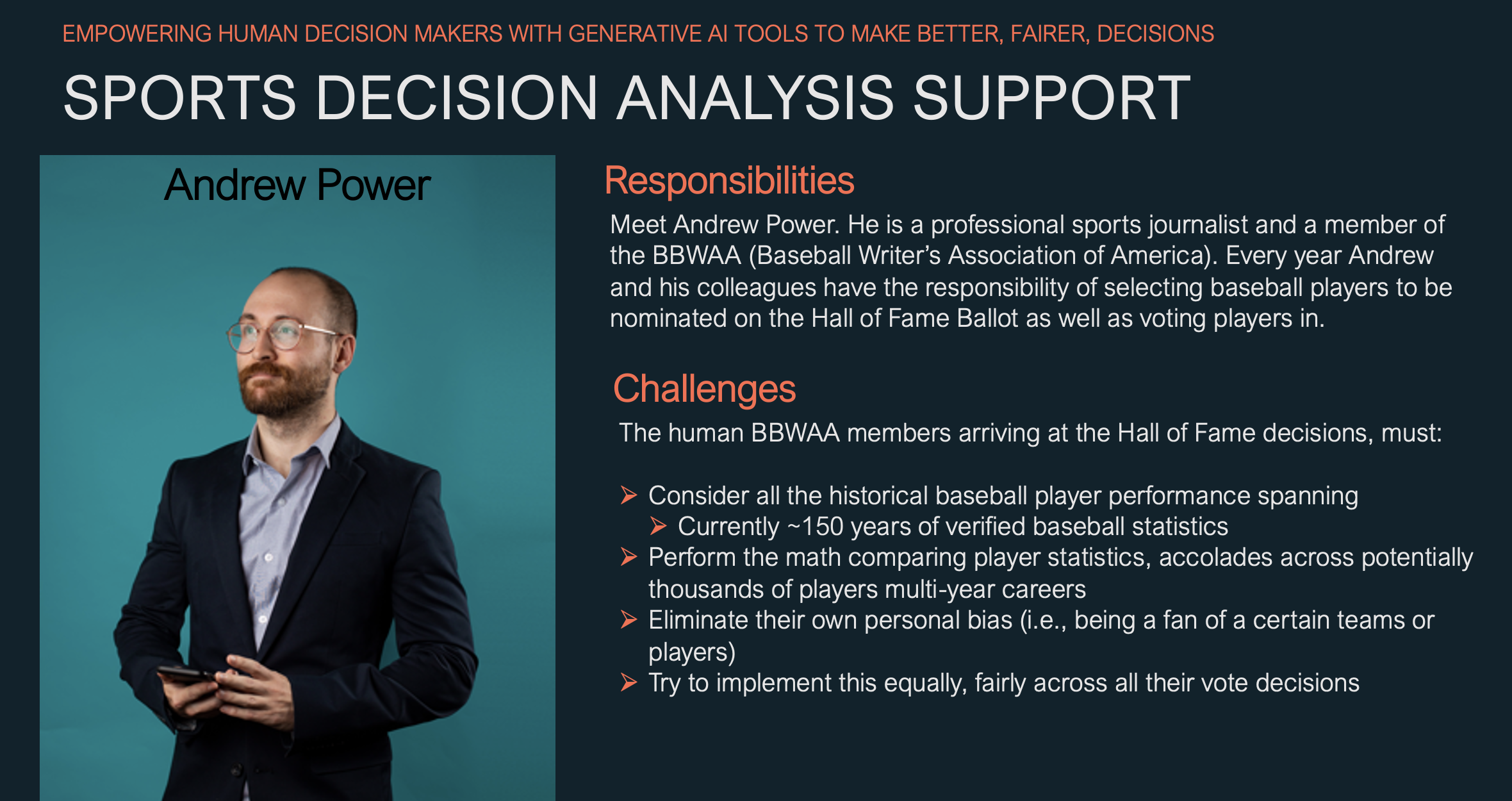
Decision Intelligence connects evidence and analysis to the choices people make. The workbench makes decision criteria explicit, shows uncertainty through probability estimates, and lets users explore how changing assumptions affects a conclusion. Its four scenarios progress from a simple rule to quantitative analysis informed by multiple AI agents.
A decision threshold connects an observation or probability estimate to a conclusion. A rule can set a threshold on career home runs, while a probability-based assessment can use a cutoff appropriate to the decision and its consequences. Thresholding is a concept across these scenarios; the application uses fixed probability bands to help interpret predictions.
The first scenario predicts Hall of Fame induction using one rule: career HR ≥ 500 returns True; otherwise, False. It produces a Boolean result without a machine learning model. Compare the player's actual career with a hypothetical career length: changing the seasons-played slider prorates career totals using season averages and can move the player across the 500-home-run threshold.
The second scenario uses a single ML.NET model to estimate the probability of Hall of Fame induction. Compare the estimate from actual career statistics with the estimate from a hypothetical career length. This shows how changing the evidence affects the probability used to inform a decision.
The third scenario examines two stages of the Hall of Fame process: appearing on the ballot, then being inducted. Separate machine learning models estimate each outcome, helping users distinguish a case for consideration from a case for election. The page displays both probabilities for actual and hypothetical career statistics; it does not calculate a conditional-probability chain.
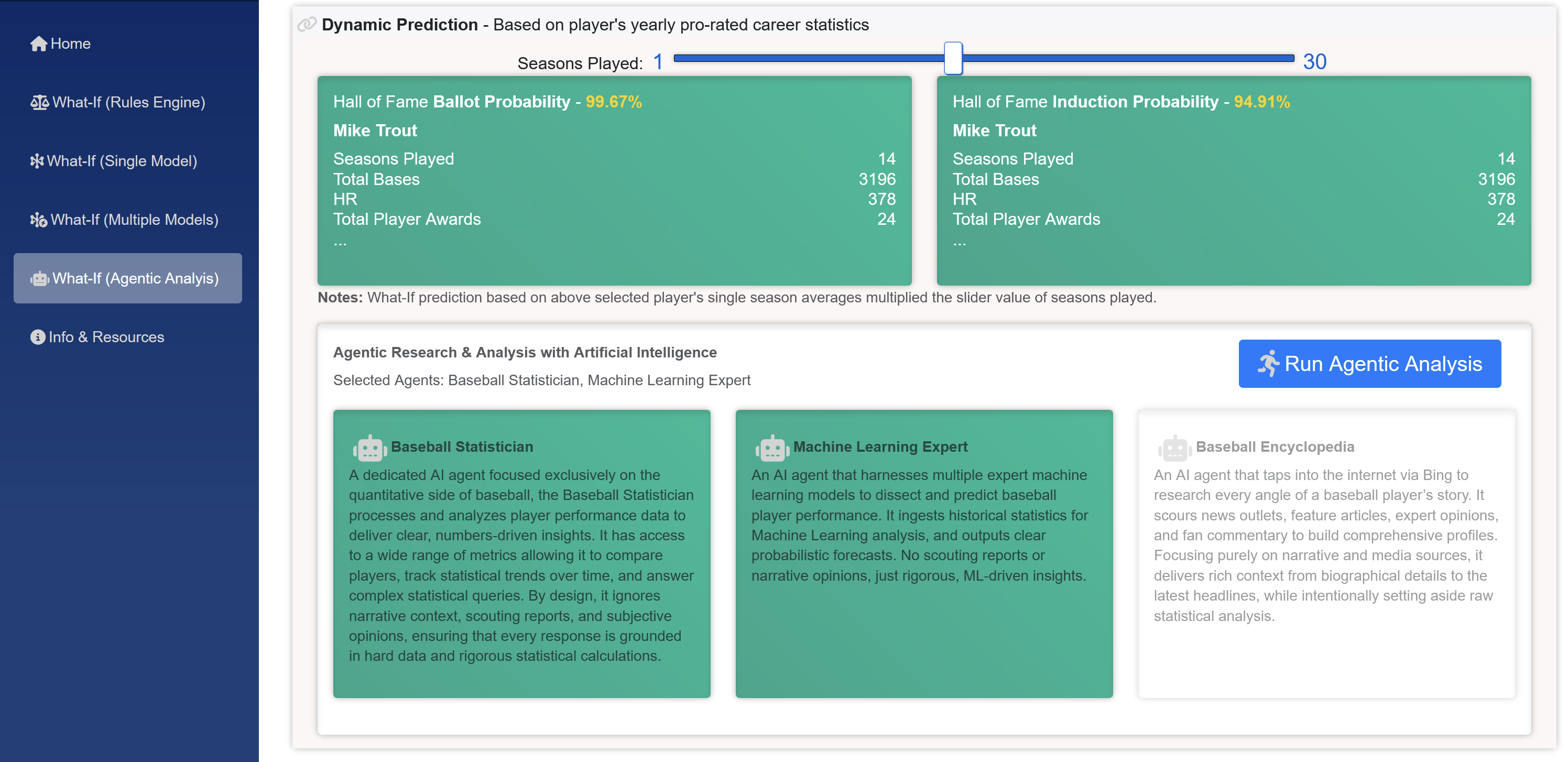
The fourth scenario brings together three AI agents with distinct evidence inputs. Run any agent individually, or select any pair or all three for independently produced analyses followed by Agent Q's quantitative synthesis.
| Agent | Evidence and role |
|---|---|
| Baseball Statistician | Assesses the selected player's batting statistics and awards to form a statistical perspective on ballot appearance and induction. |
| Machine Learning Expert | Interprets probabilities from multiple ML.NET models and their application-calculated averages for both outcomes. |
| Baseball Encyclopedia | Retrieves attributed professional commentary and voter opinions through Web IQ, examining agreement, disagreement, and evidence limitations. |
| Agent Q | Interprets the completed analyses and the combined probabilities and deterministic sensitivity ranges calculated by application code. |
flowchart TD
    S["Baseball Statistician<br/>Batting statistics and awards"]
    M["Machine Learning Expert<br/>ML model probabilities"]
    E["Baseball Encyclopedia<br/>Retrieved professional commentary"]

    S --> A["Collect completed analyses"]
    M --> A
    E --> A

    A -->|Analyses and evidence| Q["Agent Q<br/>Quantitative synthesis"]
    A -->|Available probability pairs| C["Application code<br/>Combine probabilities and calculate sensitivity ranges"]
    C -->|Calculated results| Q

    A -->|Typed individual estimates| R["Razor assessment<br/>Application-rendered numbers and AI explanation"]
    C -->|Typed aggregate, sensitivity and disagreement| R
    Q -->|Explanation only| R
All three agents are shown; selecting any pair also invokes Agent Q after all selected analyses complete. A single-agent run bypasses Agent Q. Application code performs the calculations, and Razor renders the numeric results directly from the API response. Agent Q supplies a separate explanation. If ML Expert or Agent Q prose generation fails after valid estimates are available, the results remain visible with an explanatory notice.
The three analysis agents form their conclusions without seeing one another's answers. Their evidence can overlap, so separate analyses do not establish statistical independence. Formula sensitivity and agent disagreement are displayed separately: estimates of 10% and 90% yield a 50%–50% formula sensitivity range but an 80-percentage-point agent spread. Neither measure is a statistical confidence interval. With only one contributing agent, disagreement is unavailable.
- Historical position-player batting data through the end of the 2025 season.
- Four what-if scenarios, with player search and comparisons of actual and hypothetical career statistics.
- Fast, in-memory predictions using ML.NET models.
- AI agent research and quantitative synthesis using Microsoft Agent Framework and Web IQ.
- Interactive server-side Blazor, orchestrated with Aspire and using SignalR for browser communication.
- Local execution with Docker support and Azure deployment integration.
The application combines a Blazor frontend, ML.NET predictions, AI agents, and Azure services.
flowchart TB
    Browser["User browser"]

    subgraph Azure["Azure Deployment"]
        FD["Azure Front Door"]
        SignalR["Azure SignalR"]
        AOAI["Azure OpenAI Model (GPT-6-Luna)"]

        subgraph ACA["Azure Container Apps"]
            Web["Web frontend<br/>Blazor Server + ML.NET"]
            API["Internal API service<br/>MAF agents + Agent Q<br/>ML.NET"]
            Dashboard["Aspire dashboard"]
        end

        Logs["Azure Log Analytics"]
    end

    WebIQ["Web IQ Intelligence (MCP)"]

    Browser -->|Web requests| FD
    FD -->|Web traffic| Web
    Browser <-->|Interactive connection| SignalR
    Web <-->|Interactive updates| SignalR
    Web -->|Analysis requests| API
    API -->|AI model calls| AOAI
    API -->|Research| WebIQ

    Web -.->|Telemetry| Dashboard
    API -.->|Telemetry| Dashboard
    ACA -->|Application and platform logs| Logs
- Development: Visual Studio 2026 or VS Code, .NET 10.x.
- User interface: Server-side Blazor and SignalR.
- Machine learning: ML.NET v5.x.
- Application orchestration: Aspire 13.6.
- AI agents and retrieval: Microsoft Agent Framework, Microsoft.Extensions.AI (MEAI), and Web IQ.
- Model hosting: Microsoft AI Foundry and Azure OpenAI.
- Azure delivery: Azure Container Apps, Azure SignalR, and Azure Front Door.
See the AppHost configuration and deployment decisions for AI telemetry, Container Apps sizing and scaling, and Front Door configuration and validation.
Both analysis endpoints (/BaseballPlayerAnalysisML and /BaseballPlayerAnalysisMultipleAgents) return the shared AgenticAnalysisResponse object with narrative Markdown, agent estimates, an optional aggregate, and notices. This replaces the former JSON-string response; deploy the API and web application together. Offline research checks and rendering checks cover the contract and presentation.
- Decision Intelligence
- Historical Baseball Statistics Database — model training and inference data.
- Microsoft Agent Framework
- Microsoft.Extensions.AI (MEAI)
- Aspire
- ML.NET
- Blazor
- Web IQ