

Spec-Driven Development that specs your UI too. Most SDD frameworks take you from user stories
straight to a technical plan and leave the interface to the model's imagination. AmbyKit adds a
first-class design phase — ui.md plus a real design-tokens.json — between the what and the
how, then emits native commands and rules for every AI coding assistant your team uses.
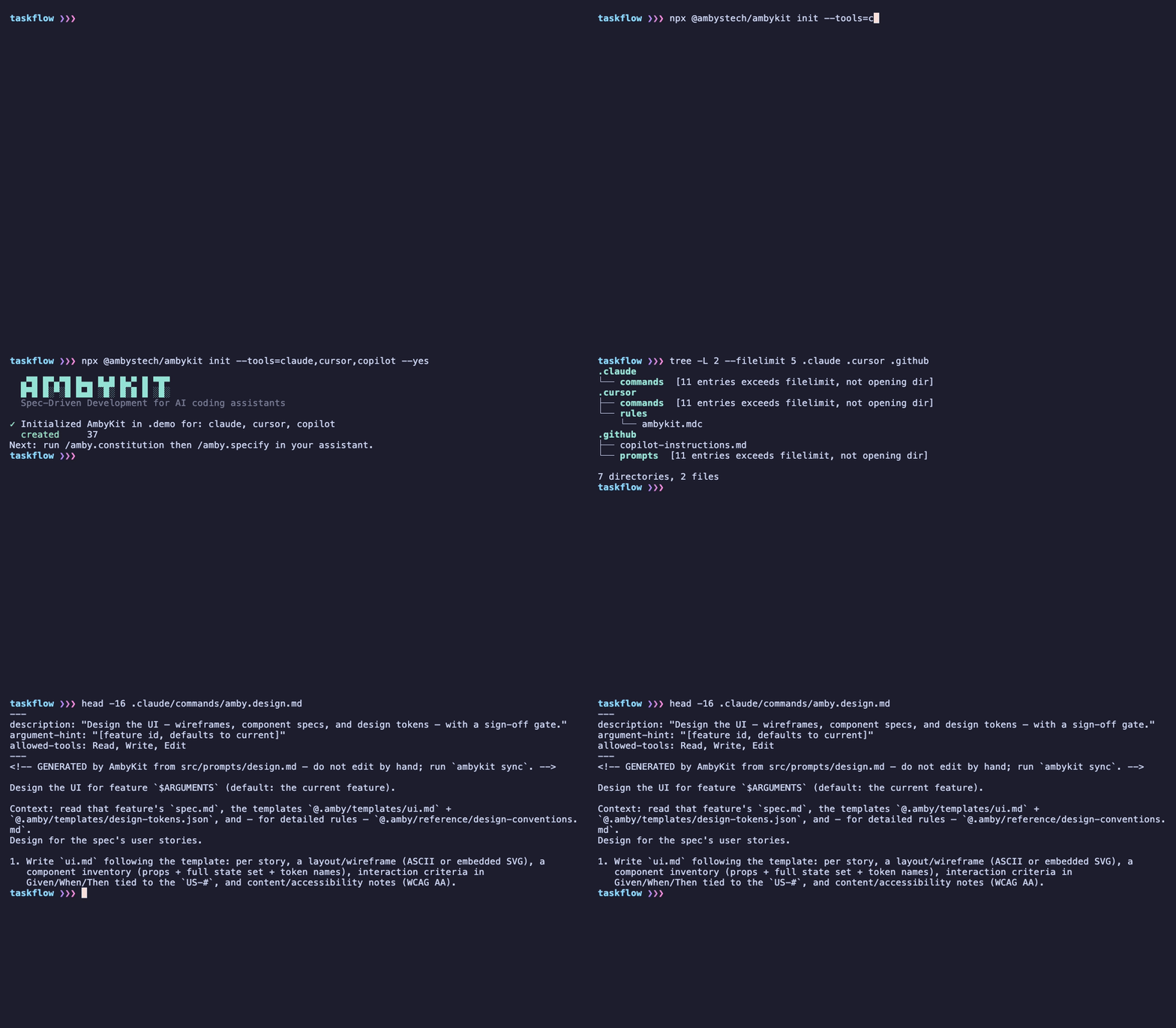
npx @ambystech/ambykit init     # scaffold .amby/ and pick your assistants
# — or install it —
npm install -g @ambystech/ambykit
ambykit init
Node ≥ 20. No Python toolchain, no separate installer — it's an npm package.
Already have a project? init is non-destructive — an existing CLAUDE.md/AGENTS.md is
preserved (and backed up); AmbyKit only adds/updates its own ### AmbyKit usage section. Re-run
ambykit sync any time to keep it current, or ambykit restore to roll a file back.
Then, inside your AI assistant, walk the workflow:
/amby.constitution   # one-time: set your project's guiding principles
/amby.specify        # describe a feature → spec.md (user stories + EARS requirements)
/amby.clarify        # resolve open questions
/amby.revise         # continue an existing spec — add and refine in place
/amby.design         # UI spec + design-tokens.json
/amby.plan           # technical plan
/amby.tasks          # ordered, dependency-aware task list
/amby.implement      # build it
/amby.converge       # verify the code against the spec; append gap tasks, repeat until converged
/amby.review         # have another role (QA, Architect, PM…) critique an artifact, findings by ID
Track progress from the terminal:
ambykit dashboard
ambykit dashboard 001:US-3   # story ids restart per feature — qualify with the feature ref
📖 Full documentation: ambykit.ambystech.io
AI coding assistants build better software when they start from good requirements. AmbyKit gives you a rigorous, tech-agnostic SDD workflow and a single source of truth that compiles to each tool's native format.
- UI is a first-class artifact.
/amby.designproduces a UI spec plus design tokens — the part every other spec framework skips. Your assistant builds the interface you described, not the one it guessed. - WHAT before HOW.
spec.mdcaptures user stories + testable requirements with no tech decisions;plan.mdcaptures the technical approach separately. - Parallel work is built in.
ambykit worktreegives each feature its own git worktree, so several features — or several assistants — run side by side without checkout switching. - Author once, emit per tool. One neutral source → Claude Code, OpenCode, GitHub Copilot (VS Code + CLI), Cursor (+ CLI), Antigravity (IDE + CLI), Codex CLI.
The honest version. GitHub Spec-Kit is the big one in this category and it is genuinely good — if you want the widest assistant coverage and the largest community, use it. AmbyKit is the choice when the UI matters and you live in the Node ecosystem.
| AmbyKit | GitHub Spec-Kit | Kiro | |
|---|---|---|---|
| UI design phase + design tokens | ✅ ui.md + design-tokens.json |
❌ | ❌ (design.md is architecture) |
| Native git worktree isolation | ✅ ambykit worktree |
❌ open issue; third-party forks | ❌ |
| Cross-role artifact review | ✅ /amby.review, findings by ID, --apply patches in place |
Role "bundles" for setup, no review phase | ❌ |
| Dependency-graph dashboard | ✅ ambykit dashboard / analyze |
❌ | ❌ |
| Code-vs-spec drift check | ✅ /amby.converge |
✅ /speckit.converge |
❌ |
| Brownfield / revise in place | ✅ /amby.revise |
✅ evolving-specs guide | ✅ |
| EARS requirements | ✅ | ✅ | ✅ |
| Assistants supported | 6 families / 10 targets | 37 integrations | self-contained |
| Runtime | Node ≥ 20, npx |
Python 3.11+, uv/pipx |
proprietary IDE + CLI |
| License | MIT | MIT | proprietary (Crew is Apache 2.0) |
| Maturity | young, v1.1 | very large community | AWS-backed, paid tiers |
Why not just Spec-Kit? If breadth of assistant support is your constraint, use Spec-Kit — it
covers far more tools. Pick AmbyKit if you want the design phase, per-feature worktrees, and an
install that's one npx away instead of a Python toolchain.
Comparison current as of AmbyKit v1.1.0; competitors move fast — corrections welcome via issue or PR.
| Phase | Command | Output |
|---|---|---|
| Governance (once) | /amby.constitution |
.amby/constitution.md |
| Specify (WHAT/WHY) | /amby.specify |
specs/NNN-feature/spec.md |
| Clarify | /amby.clarify |
resolves [NEEDS CLARIFICATION] markers |
| Revise | /amby.revise |
continues spec.md / ui.md in place |
| Design (UI) | /amby.design |
ui.md + design-tokens.json |
| Plan (HOW) | /amby.plan |
plan.md (+ data-model.md, contracts/) |
| Tasks | /amby.tasks |
tasks.md |
| Analyze | /amby.analyze |
cross-artifact consistency report |
| Implement | /amby.implement |
executes tasks.md |
| Converge | /amby.converge |
checks code vs spec/plan/tasks; appends gap tasks to tasks.md |
| Review | /amby.review |
cross-role critique of any artifact; --apply patches in place |
Requirements use user stories (US-#) + EARS functional requirements (FR-###) +
Given/When/Then acceptance criteria. Stories carry priority and depends-on/blocked-by so
work can be ordered and blocked; ambykit dashboard reports progress across the story/task graph.
Claude Code (CLI + VS Code), GitHub Copilot (VS Code + CLI), OpenCode, Cursor (+ CLI),
Antigravity (IDE + CLI), Codex CLI. See docs/tool-compatibility.md.
Missing yours? Open a request — a new
target is a thin BaseEmitter subclass.
| Command | Description |
|---|---|
ambykit init [dir] |
Scaffold .amby/, pick tools, emit their files + AGENTS.md/CLAUDE.md |
ambykit add <tool…> |
Add/refresh one tool's integration |
ambykit sync |
Re-emit all configured tools from the neutral source |
ambykit dashboard [story-id] |
Progress view over the story/task graph |
ambykit analyze |
Validate the dependency graph (cycles, blockers, orphans) |
ambykit check |
Doctor: verify integrations |
ambykit restore [file] |
Restore an agent-doc file from its .amby/backups/ backup |
ambykit update |
Update the CLI to the latest, then refresh this project's prompts |
ambykit worktree <feature> |
Isolated working copy per feature (list, remove) for parallel work |
AmbyKit is built with AmbyKit — see CONTRIBUTING.md,
AGENTS.md, and docs/contributing.md.
Changes are logged in CHANGELOG.md. MIT licensed.