
Metra is a local-first metadata toolkit and CLI for reading, validating, creating, comparing, and narrowly editing image, audio, document, and media containers. It gives Rust applications a typed metadata model and gives shell pipelines deterministic human or structured output.
Metra is an open-source alternative for bounded Rust metadata workflows. It is not a drop-in replacement for ExifTool and does not claim complete format or tag compatibility.


Website · Watch the 49-second demo · Roadmap · Architecture · Security · Changelog · Issues
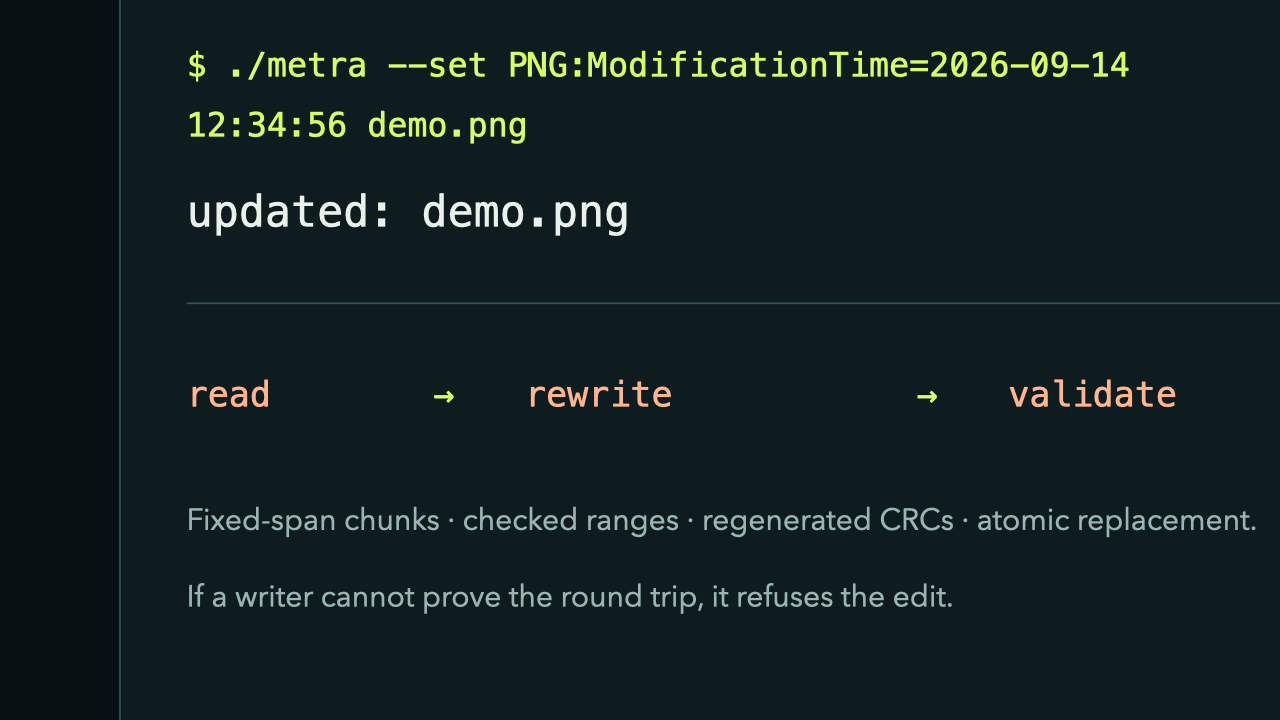
The demo is recorded from the current metra binary. It uses synthetic files
only and shows creation, targeted inspection, a validated PNG rewrite, JSON
Lines output, and the public capability matrix.
Metadata code sits on a difficult boundary: files are untrusted, containers are nested, and a useful tool must preserve evidence instead of flattening everything into strings. Metra focuses on a small set of dependable building blocks:
- parse with checked offsets, bounded allocations, typed values, and warnings;
- expose the same model through a Rust API and a scriptable CLI;
- make read, write, create, delete, lossless rewrite, and streaming status explicit for every registered format;
- refuse an edit when the writer cannot validate the result safely.
Metra detects containers from signatures rather than extensions, walks bounded metadata regions, retains raw values where useful, and keeps warnings separate from successfully parsed tags. Image pixels, audio samples, video frames, and large attachment payloads are not decoded by the metadata reader.
Use human-readable output for investigation or JSON, JSON Lines, CSV, TOML, and
YAML for tools. Recursive traversal is deterministic; --jobs N adds bounded
parallel inspection, and streaming modes apply bounded backpressure. The JSON
document schema is versioned at 1.
Supported writers read the source before writing, copy through a same-directory temporary file, validate the candidate output through the reader, and replace the source atomically. Fixed-span writers preserve container layout and reject growth when the existing storage cannot hold the new value.
The binary is a thin consumer of the public metra facade. Library users get
in-memory reading, configurable parse limits, deterministic batch helpers,
cooperative cancellation, stable tag identifiers, metadata diffs, a capability
registry, and format-specific creation/rewrite APIs.
The capability matrix is the source of truth for the current read/write/create
surface. partial is intentional: it means a format has a bounded, tested
seam, not that every tag or operation is supported.
| Workflow | Available today |
|---|---|
| Read | JPEG, TIFF/BigTIFF, PNG, WebP, GIF, SVG, PSD/PSB, DNG and TIFF-like RAW, CR3, RAF, MRW, CRW, X3F, AVI, MKV/WebM, Ogg/Vorbis/Opus, FLAC, WAV/RF64/BW64, MP3/ID3, PDF, XMP, ICC, HEIF/AVIF, MP4/MOV/M4A |
| Create | Bounded metadata seeds for TIFF/BigTIFF, DNG, JPEG, PNG, WebP, GIF, SVG, PSD, PDF, ICC, XMP, WAV/RF64/BW64, MP3, Ogg Opus, FLAC, AVI, Matroska/WebM, MP4/MOV/M4A, HEIF/AVIF |
| Edit | Tested narrow writers for existing fields in JPEG, TIFF/RAW, PNG, WebP, GIF, SVG, PSD, AVI, Matroska/WebM, ISO-BMFF/CR3, PDF, ICC, XMP, ID3, FLAC, Ogg, WAV/iXML/ID3/BWF |
| Operate | --set, --delete, --copy, --compare, --validate, --recursive, --jobs, cancellation on Ctrl-C, and configurable metadata/value budgets |
| Output | Text, JSON, JSON Lines, CSV, TOML, YAML, stable namespace/tag identifiers, structured warnings |
- bounded signature detection and typed metadata parsing across the registered image, audio, document, media, RAW, XMP, and ICC families;
- validated creation of small metadata-oriented seeds, with no-overwrite path helpers and output revalidation;
- lossless or fixed-span rewrites where the format contract supports them,
including EXIF/GPS, PNG
tIME/pHYs, XMP, IPTC, ID3, BWF, iXML, INFO, and selected container text fields; - a public capability registry and compatibility matrix checked by tests;
- deterministic batch APIs and CLI output with bounded worker concurrency.
- MakerNote interpretation is bounded to selected families and retains unknown values rather than guessing;
- proprietary RAW families such as RAF, MRW, CRW, and X3F are read-only;
- many writers require existing storage, equal packet length, or a fixed field;
- the differential corpus harness is opt-in; the checked-in corpus is synthetic and does not stand in for licensed real-world media;
- ExifTool compatibility is represented by a versioned bounded matrix, not a completeness claim.
The initial public roadmap is complete. Broader real-world corpus coverage,
deeper tag/catalog coverage, more complete MakerNote interpretation, broader
media structures, and additional creation or rewrite seams are documented as
future work in ROADMAP.md. The compatibility matrix remains
the source of truth for the actual bounded support of each format.
The real CLI walkthrough is available in the repository and on the project site:
The MP4 is intentionally a terminal demonstration because Metra is a CLI and library, not a graphical application. GitHub may sanitize embedded HTML video, so the poster, direct MP4 link, and site player are all provided.
To reproduce the source transcript and temporary synthetic files:
cargo build --release
./demo/record.sh
To rebuild the presentation asset on macOS with FFmpeg and Quick Look:
./demo/render.shMetra currently ships as a source release. Rust 1.95 or newer is required;
the repository pins that toolchain in rust-toolchain.toml.
git clone https://github.com/OthmaneBlial/Metra.git
cd Metra
cargo install --path .
metra --versionmetra photo.jpg
metra --json photo.jpg
metra --jsonl --jobs 4 -r photos/
metra --tag EXIF:Make --tag EXIF:DateTimeOriginal photo.jpg
metra --validate photo.jpg
metra --compare reference.jpg target.jpgmetra --create-png 'Comment=Metra demo' demo.png
metra --set 'PNG:ModificationTime=2026-09-14 12:34:56' demo.png
metra --tag PNG:ModificationTime demo.png
metra --create-tiff 'EXIF:Make=Metra' camera.tif
metra --create-wav 'Title=Metra' --create-wav 'Artist=Metra' take.wav
metra --create-xmp '<x:xmpmeta xmlns:x="adobe:ns:meta/"><rdf:RDF/></x:xmpmeta>' packet.xmpFor a complete list of creation flags and accepted canonical keys:
metra --help
metra --capabilities --jsonThe current public release is v0.1.1,
an experimental pre-1.0 source release. It includes the validated library and
CLI described above.
No prebuilt platform binaries are attached yet. Build from source with Cargo for Linux, macOS, or Windows. Platform CI is manual by design, so a push does not start a workflow; the same workflow can be deliberately dispatched for a release check.
The root crate exposes the same model used by the CLI:
let metadata = metra::read("photo.jpg")?;

if let Some(make) = metadata.find("EXIF:Make") {
    println!("camera = {}", make.display_value());
}

let changed = metadata.diff(&other_metadata);
println!("{} metadata differences", changed.changes.len());
For larger jobs, use read_from, read_with_limits, read_many, or
read_many_streaming. Use find_all for repeated datasets and
find_by_id(namespace, id) when a numeric tag identifier is available. The
public MetadataEdit, CreateRequest, FormatHandler, and format-specific
helpers expose validated creation and rewrite paths without requiring the CLI.
CLI (`src/main.rs`)       Rust API (`src/lib.rs`)
          \                      /
           v                    v
     detection + format handler registry
                       |
                       v
       bounded readers / typed metadata model
                       |
       set/delete/copy -> validate -> atomic replace
The workspace is split into small responsibilities:
metra-coreowns the typed model, tag catalog, schema version, capabilities, limits, warnings, and structured errors;metra-formatsowns signature detection, defensive readers, creators, and narrow format writers;- the root
metracrate provides the public facade and CLI consumer; compat/exiftool-compatibility.jsonrecords bounded compatibility evidence;tests/exercises parser safety, round trips, CLI behavior, registry contracts, and the opt-in corpus harness.
Metra is designed for local processing. Runtime readers do not invoke Perl, Python, Node, ExifTool, or another external metadata process, and they do not send files to a service. Untrusted input is handled with checked offsets, allocation budgets, recursion and entry limits, decompression limits, safe XML rules, and structured warnings.
Writes are conservative: the source is read before mutation, the candidate is written through a same-directory temporary file, the result is re-read and validated, and replacement happens only after that validation. A failed write removes its temporary output and leaves the source untouched. These guarantees reduce risk; they are not a substitute for backups or review of untrusted content.
Read the full policy in docs/SECURITY.md.
rustup show active-toolchain
cargo fmt --all -- --check
cargo test --workspace --all-targets --all-features
cargo clippy --workspace --all-targets --all-features -- -D warnings
cargo bench --bench throughput --no-run
cargo build --release
The differential test is intentionally ignored unless a reviewed local corpus and oracle are supplied. Passing the local suite does not establish complete ExifTool compatibility.
The repository also ships a deterministic synthetic corpus covering every
currently creatable container family. It is inspected by the normal test suite;
see fixtures/CORPUS_MANIFEST.json for
provenance and checksums.
Start with CONTRIBUTING.md, then open an issue for a new
format, tag family, writer seam, or safety concern. New format behavior should
include focused synthetic fixtures, malformed-input coverage, round-trip tests
for writes, capability-matrix updates, and documentation that distinguishes
working, experimental, and planned behavior.
The GitHub Actions workflow is manual-only. Run the local validation commands above before opening a pull request, and dispatch the workflow deliberately when a remote multi-platform check is useful.
Metra is distributed under the MIT License.