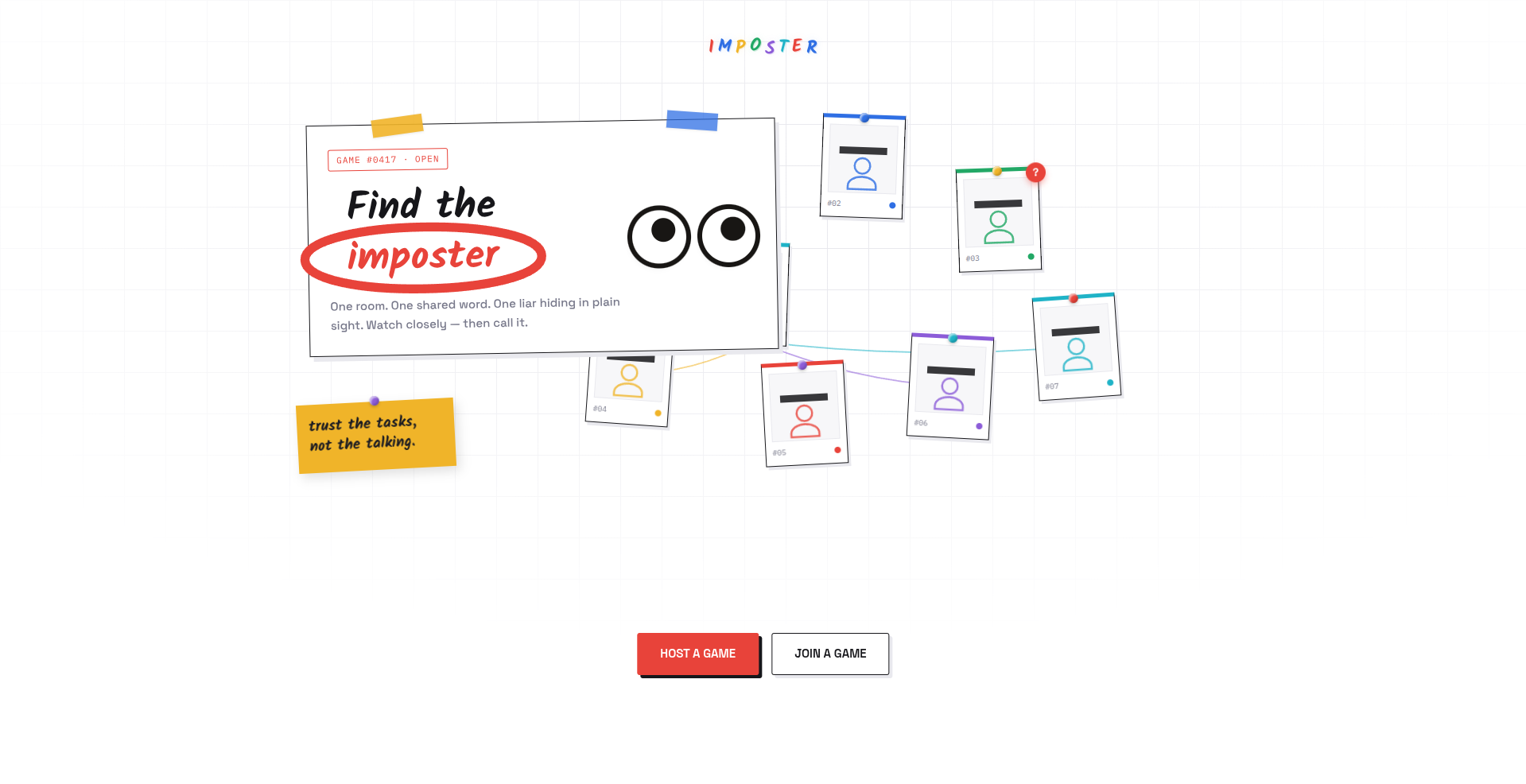
Imposter is a fast-paced, real-time multiplayer social deduction game. Eight suspects walk into a room. Seven are given the exact same secret word. One is given a fake word. Your goal? Find the liar.
Play live across multiple devices with your friends, or pass-and-play in "Hotseat" mode on a single device. Built around a beautiful, highly interactive "Detective Whiteboard" UI.

This project is decoupled into a lightning-fast React frontend and a powerful, low-latency Go backend.
- Frontend: Next.js 14+ (App Router), React, Vanilla CSS, TypeScript.
- Backend: Go (Golang), Gin-Gonic, Gorilla WebSockets.
- Database: PostgreSQL (with GORM).
- Deployment: Vercel (Frontend Edge) & Render (Backend Go).
Instead of flooding the main JavaScript thread with heavy animation libraries (like Framer Motion), almost all visual tracking and scaling behaviors (e.g., the suspect rendering, mobile tooltips, and the tracking coordinate eyes) are governed fluidly through pure CSS custom variables and media queries. This guarantees a locked 60FPS UI rendering, preventing the browser from stuttering on mobile hardware.
The backend dynamically processes a massive pool of over 200 interconnected word pairs (400 unique words). The database seed script handles injection collisions gracefully, tracking mapped IDs recursively so multiple backend instances boot up with zero memory overflows or duplicate primary key overrides.
Network instability is the enemy of multiplayer games. To circumvent typical websocket dropouts (like a phone going to sleep), the Next.js client mints an encrypted imposter_session key stored natively in localStorage. If the Gorilla WebSocket disconnects natively, the client aggressively attempts exponential backoff reconnection, silently restoring the player's real-time state back to the Go memory cache without resetting their game loop.
To prevent network manipulation or concurrent data corruption during intense "Voting phases", the backend employs aggressive safeguards:
- State Freezing (Mutex Locks): The Go backend isolates active game memories using
sync.Mutex. When 8 players vote sequentially on the exact same millisecond, the Go runtime completely locks the core state, processes them hierarchically without crashing or causing race condition desyncs, and dynamically unfreezes. - Strict Room Privacy: Hardcoded API routing logic forces
isPrivate: trueinstantiation. Game identifiers are pseudo-random HEX UUIDs. Bad actors cannot write scripts to brute-force scrape active public game rooms. - Aggressive Heartbeat Architecture: Because the Go engine runs on scaled architecture, inactivity triggers a sleep-mode. The backend features a unique
/healthheartbeat endpoint that does not mock execution; it forces a deep physicalsqlDB.Ping()against the Postgres cluster, instantly validating both the connection pool and the container runtime, allowing cron jobs to safely enforce uptime SLA.
Want to run the codebase locally? Follow these steps:
You must have a local PostgreSQL database running, or a connection string to a hosted database (e.g. Supabase, Neon).
- Navigate to
/backend. - Create a
.envfile containing:PORT=9999 FRONTEND_URL=http://localhost:3000 DATABASE_URL=postgres://user:pass@localhost:5432/imposter
- Run
go mod tidyto fetch dependencies. - (Optional) Run
go run scripts/seed_custom/main.goto populate the word database. - Boot the server:
go run main.go
- Navigate to
/frontend. - Create a
.env.localfile containing:NEXT_PUBLIC_API_URL=http://localhost:9999 NEXT_PUBLIC_WS_URL=ws://localhost:9999
- Run
npm installto load dependencies. - Boot the Next.js server:
npm run dev
Open http://localhost:3000 in your browser. The connection will automatically upgrade to WebSockets and sync with the Go runtime!