







| 💿 Use it | Install the desktop OS, point it at your files, add cartridges from the built-in store. Windows, macOS, Linux. | Download v1.6.0 · User guide |
| 🛠️ Build on it | The MnemoForge CLI, the developer SDKs, and seven cartridges whose full source sits in this organization. | The SDK · Packages |
| 🔬 Check the claim | 77.1% on LongMemEval-M questions the engine had never seen, official judge, protocol published before the run. Every answer and every verdict is published. | Open the verification kit |
Important
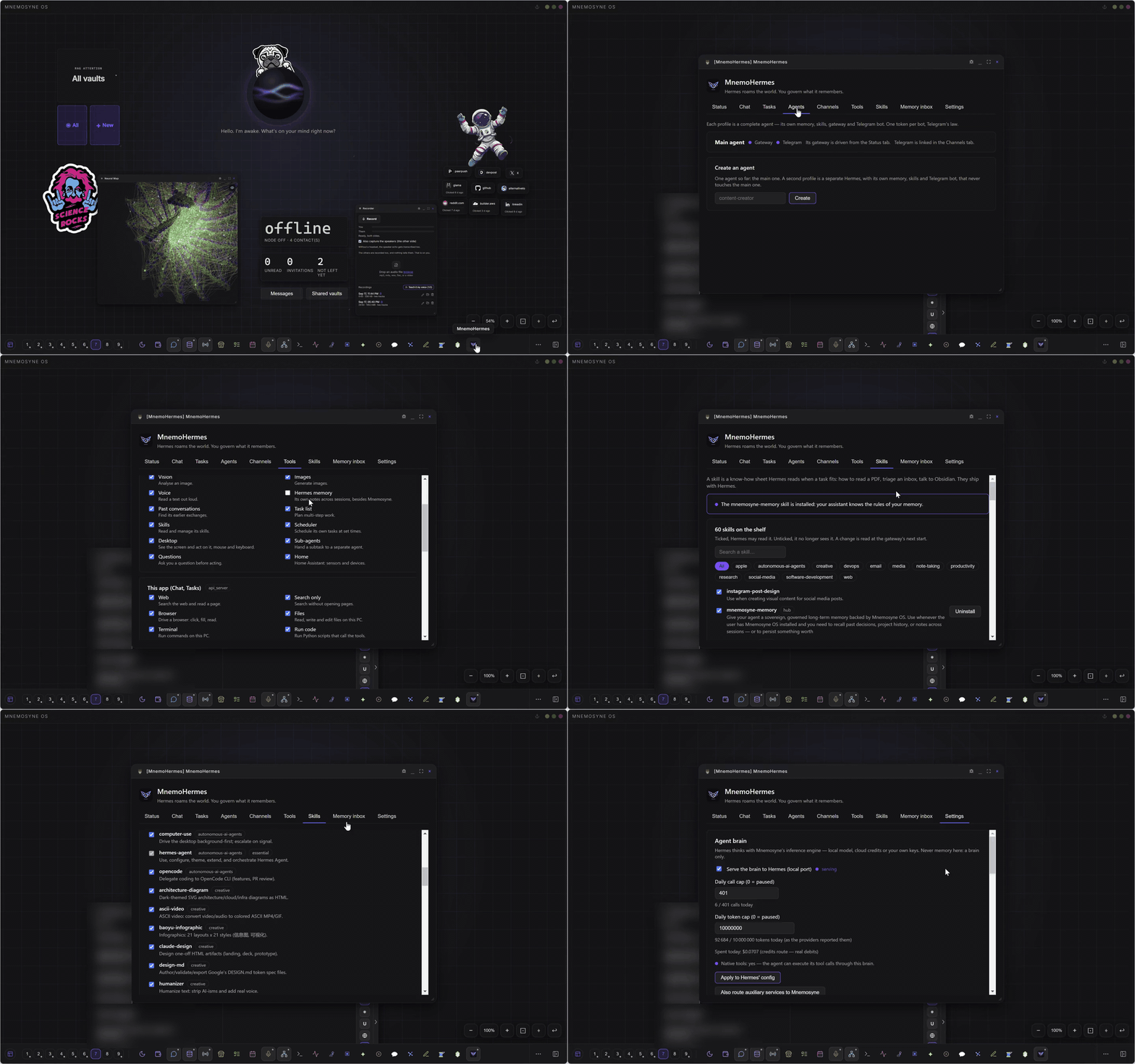
🤖 New in 1.6.0: MnemoHermes, your memory on Telegram and by voice (beta). MnemoHermes installs Hermes Agent with one button and connects it to your vaults. Create your own Telegram bot and ask your memory from your phone, typed or by voice note. In the app, say "ask Hermes to …" and the orb hands it the task.
→ See how it works: mnemosyne-os.io/hermes · The cartridge on GitHub


Mem0, Zep and Letta hand an agent a memory service you wire into a cloud stack. Mnemosyne OS is a desktop application, and the customer is you. It installs on your machine, reads the files and conversations you point it at, and keeps them as durable, searchable memory that any model you connect can draw on. Nothing is uploaded to run it. Vaults partition memory by domain so nothing bleeds between them, retrieval ranks your vault twice (by meaning and by exact words) and fuses the two rankings, a navigable neural map shows what connects to what, and a dream state revisits old material while you are away and writes down what it noticed. Encryption at rest is there, armed by you. A human decides what is remembered, what is surfaced, and what is forgotten.
→ The full tour, in the repository README


Claude Code, Cursor, Aider and Continue all keep what they learn in a folder whose name starts with a dot: the deployment step that bites, the claim that must never be made flat, the reason a library was picked over the obvious one. It is the half of a project that lives nowhere else. It is also usually gitignored, so no wiki, no search and no repository ever indexes it, and the next session starts without it.
Point a vault at that folder and it turns into memory any model you connect can retrieve. What that removes is the second derivation. A conclusion your agent can look up is one it never reaches twice, and a session that opens already knowing the project is a session that opens on the work. We put no figure on that. Install it and read your own sessions.
| 🧠 What your agent wrote down | A vault watches .claude, .cursor, .aider or .continue and keeps it searchable. Needs v1.4.3 or newer, the build where dot-directories stopped being skipped. |
Connect your agent's memory |
| 🔌 What your agent asks back | A Model Context Protocol server hands Claude Code, Cursor and Claude Desktop the vault tools, over a socket that never leaves your machine. | Connect Claude (MCP) |

| Repository | What lives there |
|---|---|
| 💿 Mnemosyne-Neural-OS | The desktop app: documentation, the MnemoForge CLI, the developer SDKs, and every signed release for the three platforms. |
| 🔬 MnemosyneOS---benchmarks | The benchmark campaigns published whole: methodology, per-question verdicts, raw run logs, and a kit that re-derives every score in front of you. CC BY 4.0. |
| 🌐 mnemosyne-os.github.io | The organization on GitHub Pages: the product, the documentation, the open packages. |
| 🧷 agent-memory-skill | A skill for Claude Code: it indexes your agent's own memory directory into a vault, so its notes come back by meaning instead of being loaded in full every session. MIT. |
| 📄 .github | This page, and the generator that draws it. |
The nine remaining repositories are the cartridges below.

Small apps that run inside the OS and share its memory. Most are one click from MnemoHub, the built-in store; Ariadne and MnemoHermes install from their own URL. Each one is a worked example of the SDK as much as a tool.


Oikos, MnemoReader, Translator, Ariadne and MnemoHermes are MIT. The other four carry the Mnemosyne cartridge licence: read the source, adapt it for yourself, run it inside the OS. The surfaces you extend are open, the memory engine is sealed.

Memory is half of the relationship. Psyche is the other half: a persistent personality for your AI, character, voice and identity, forged by you in a guided ritual and carried across conversations and across models. Change vendors, it comes with you.
Psyche ships inside Mnemosyne OS today. A standalone forge, for any agent anywhere, is next.

Mnemosyne OS scores 77.1% on LongMemEval-M, full-haystack, around 480 distractor sessions per question, on 48 questions the engine had never seen. The official LongMemEval judge graded it, and the protocol was published before the run. On the 48 questions used to tune the engine, the strict judge gives 85.4%.
These scores come from the hybrid mode: embeddings and search ran locally, and a cloud model, gemini-3.8-flash, wrote the answers. Mnemosyne OS also runs fully local, with a model on your machine.
In September an outside audit found a wrong verdict in our August result. The erratum corrects it to 72.9% under the strict judge, and we ran the whole benchmark again (every answer). The reader, the engine and the judges changed between these runs, so the figures sit side by side and never chain into a progression.
Anyone can publish a percentage. We publish the ledger underneath it: every question, every retrieved chunk, every judgement, plus a script that re-derives each score from those raw results.

Research is published whole, with permanent identifiers, including the hypotheses that failed.
| Publication | |
|---|---|
| The Resonance Engine: a multi-engine cognitive memory architecture for sovereign AI systems. Whitepaper v2.1, CC BY 4.0. |  |
| LongMemEval-M full-haystack verification kit: per-question ledgers and audit scripts. CC BY 4.0 and MIT. |  |
| Lab notes: what we measured, and what was wrong. |  |
| Author record: the ORCID behind the deposits. |  |

Published by XPACEGEMS LLC. These are its official addresses.
| Product | mnemosyne-os.io |
| Company, press and labs | mnemosyne-os.com |
| Documentation | docs.mnemosyne-os.io |
| Soul engine | psyche.mnemosyne-os.io |
| Source and releases | this organization |
| Packages | the npm scope @mnemosyne_os, the list |
| Contact | [email protected] |
The stories behind the numbers are on the blog: A multiplier cannot rescue a zero · 72.9% and the three questions we miss · We gave personality control of memory. It cost 31 points. · Present is not the same as loadable · The memory my brain kept asking for

Every figure on this page is one we published ourselves. That badge is the exception: GitHub counts it. A star also files the repository under your own account and reaches the people who follow you.

mnemosyne-os.io · psyche.mnemosyne-os.io · mnemosyne-os.com · docs.mnemosyne-os.io
