
One behavior. Many bodies. Every gap measured.
An open behavior layer between what a camera sees and what a body can do. Turn ordinary video into behavior data, train a model on it, run it on a humanoid, a robot or an avatar — and record the gap for each body: what that body could not do, as a number in its own units.



日本語 · VLA sample · The gap · Showcase · Experiments · Concept · Specification · Roadmap · Help wanted
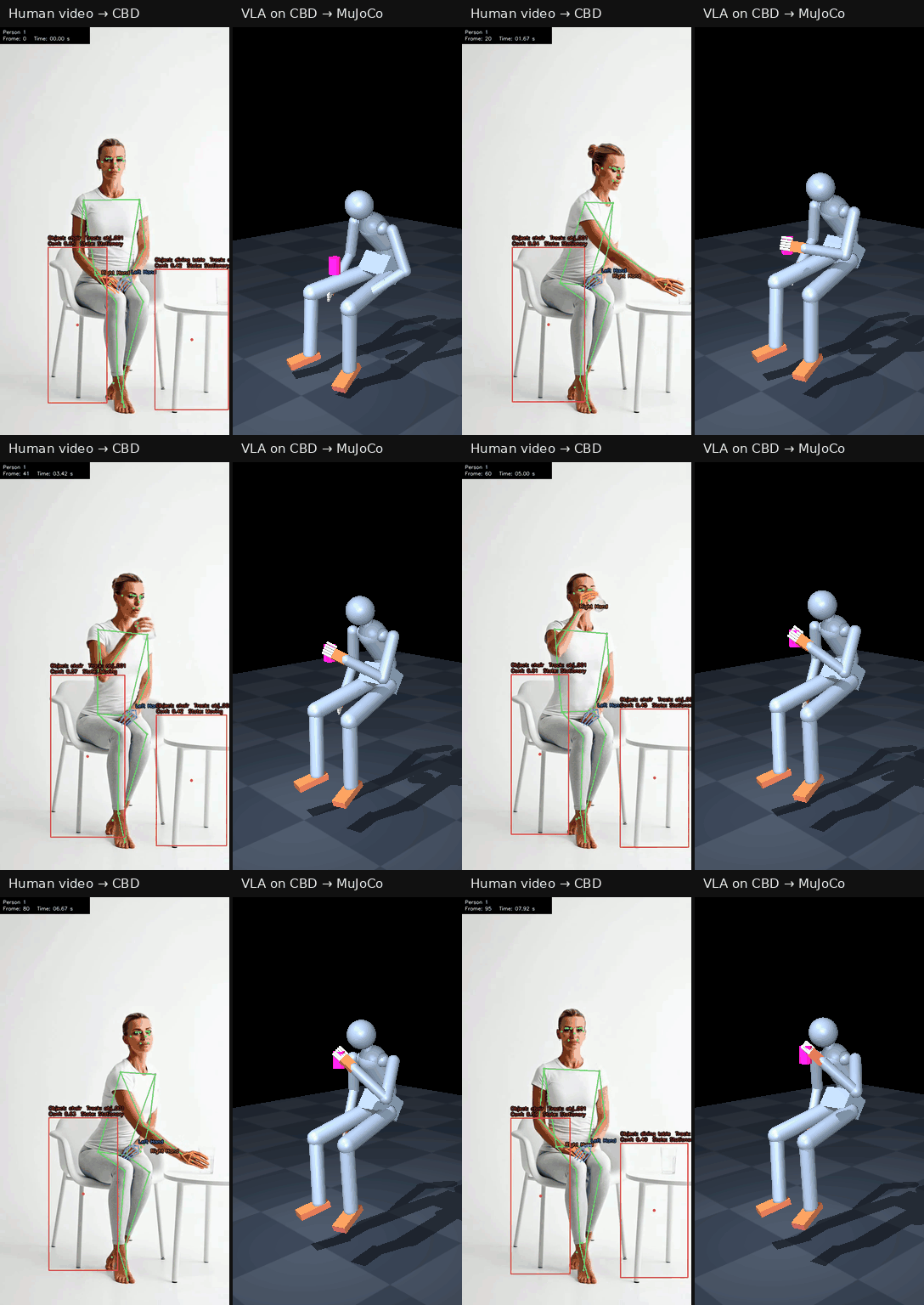
Left: an ordinary video, turned into CBD. Right: a VLA trained on CBD, told "a seated person picks up a glass from the table, drinks from it, and puts it back".
From vla-maker-from-cbd. The person on the left is not in the training data. The right is kinematic MuJoCo — poses in sequence, no forces. There are no fingers; the glass attaches once the hand reaches it. An outside planner guides the hand until it reaches the glass; the lift to the mouth comes from the model. This is one of 12 trials of this scene — in the other 11 the glass stops at chin height or below.
| If you want to… | Go to |
|---|---|
| See a VLA trained on CBD | A VLA trained on CBD, below → vla-maker-from-cbd |
| Understand the one idea that matters | The gap — data gaps, body gaps, and the numbers per body |
| See one behavior on four bodies | showcase/ — videos first, code later |
| Help | Help wanted — most items need no GPU |
| Run the smallest complete example | examples/ — two Colab notebooks |
| Run the current pipeline | generators/ → adapters/ |
| Read the data format | specification/ |
vla-maker-from-cbd is
the first experiment built on CBD at real scale. A VLA
(vision-language-action model) takes a camera image and a text instruction and
outputs body motion; this one is NVIDIA GR00T N1.7 (3B), fine-tuned on CBD.
video / mocap ──► CBD ──► VLA (GR00T N1.7, fine-tuned) ──► CBD ──► adapters ──► MuJoCo · Unitree G1 · VRM
                  └ this repository ┘   └ vla-maker-from-cbd ┘     └ this repository ┘
The model does not output any robot's joint angles. It outputs CBD — 19 bone rotations plus the hip position, 117 numbers per frame. Putting that motion on a MuJoCo humanoid, a Unitree G1 or a VRM avatar is the adapter's job, so no body needs its own retraining.
What it measured — held-out scenes, kinematic MuJoCo, every number from its results:
| Result | |
|---|---|
| Hand reaches the object, guided by an outside planner | 0.93 with the goal a VLM picked · 0.94 with the true goal |
| Same, the model alone | 0.51 — it turns toward the object, but reaches it about half as often |
| A VLM picks the requested object in the image | 378 / 378, including look-alike distractors |
| Instructions with no verbatim match in training | walks forward +3.06 m · crawls on the floor goes on all fours in 6 of 8 |
| Generated walking, retargeted to a Unitree G1 through CBD's adapter | median direction residual 0.96° (the teacher walks: 1.54°) |
What it does not claim: physics or a real robot (everything is kinematic), grasping with fingers, precise reaching without guidance, or beating "just hold the current pose" at predicting video motion (5.53° vs 5.05°). The code is Apache-2.0; the weights are non-commercial, because GR00T N1.7, AMASS and SMPL are. Its help-wanted list has eight open problems, from GPU research to translating log messages.
A model trained for one robot hides that robot's limits inside its weights. A model that emits CBD leaves them in the open — one body at a time, at the adapter, as a number. The VLA does not know whether it is driving a G1 or a VRM avatar. The adapter does, and what the adapter reports that body could not do is the body gap. Scale buys bigger models. It does not buy a per-body record of what each body could not do; that has to be measured, body by body.
The VLA ran straight into the gaps this repository records:
- A data gap, closed at a price. CBD's video generator does not measure four
bones (
chest,neck, both shoulders). To train on video clips, the VLA fitted the torso with SMPL (ROMP) — which closed the gap and brought SMPL's non-commercial, no-redistribution terms into the training data with it. - A body gap. The G1's waist (±30°) cannot follow the deep bends the generated motion asks for.
- Data gaps, still open. No finger bones — "held" means the hand came within
reach. No locomotion phase — so the G1 adapter cannot solve the VLA's walking
onto the floor. And no CBD bundle could state "AMASS-derived motion must
never be redistributed" about itself until
0.3.0added the field.
Each of these is a row in the gap register.
The most useful output of this project is not a video. It is the list of
places where behavior stopped being portable — the gap register, collected
with numbers in docs/compatibility_findings.md.
Every gap in it is one of two kinds, and the kind decides what you can do about it:
data gap    the record does not carry it      → closable upstream:
                                                a better generator, a sensor,
                                                a new schema channel

body gap    the two bodies genuinely          → not closable:
            disagree                            measure it and publish the
                                                number, in the target's units
A data gap is someone's bug. A body gap is a fact about a 1.32 m robot with no spine. And the two connect: a data gap becomes a body gap the moment the body changes.

One source video → one behavior dataset → four bodies, same timeline. The four adapters share no code; where the panes disagree is the gap.
| Body | Body gaps — measured, not closable | Data gaps it exposed |
|---|---|---|
| MediaPipe overlay — the source's own pixels | none: it is the camera's own frame | none visible — it draws what was measured |
| MuJoCo humanoid — built to the subject | contact is not resolved (kinematic replay) | absorbed almost all of them |
| Unity / VRM 1.0 — any avatar, nobody measured it | none found: retargeting from a T-pose rest cost nothing | absorbed almost all of them |
| Unitree G1 — Isaac Sim, 43 DoF, 1.32 m | motion is solved, not copied: 6.87° mean residual · the set is scaled to the robot, scale = 0.685 · both ankle pitch joints on their limit, 96 / 96 frames (retarget stage) · no neck · three fingers per hand |
four identity bones → 0.296 m between where the image puts the glass and where the hand goes · no support relation → a 110 mm pad instead of a chair · phase reads Idle for 96 / 96 frames · no force or contact |
| G1, driven by the VLA — generated motion | waist ±30° limits deep bends · walking direction residual 0.96° median | no locomotion phase → feet not solved to the floor · no finger bones |
The human-shaped bodies absorbed almost everything. The machine did not, and that is what made it worth doing. Scaling the robot instead of the furniture would have been a fabrication about hardware; the gap is published instead.
A new body is a new row in this table. That is the contribution this project compounds on — see Help wanted.
For a long time the data said none of this. Four bones read as a motionless
torso, 96 frames of Idle read as a clip where nothing happened, and
quality.json reported object_coverage: 1.0 for a clip in which one object
entry out of 173 carries a 3D position.
Since dataset version 0.3.0, the data declares its own data gaps. Every
channel carries a tier — measured / derived / estimated / prior /
degenerate / absent — in manifest.json and
quality/channel_provenance.json, measured from the series rather than
asserted. Body gaps live where they belong, in each adapter's report as
asked / got / error / tolerance, because they are a property of
(this behavior, this body), not of the record.
Two things are still open, and stated rather than hidden: no adapter reads the tiers yet, and the G1 adapter's own ledger grades about 30 % of its output and reports a pass over the whole of it:
stage_provenance, as shipped
  entries       4         the legs it solved, two object placements, one wrist repair
  total weight  1251      of 43 joints × 96 frames = 4128 joint-frames
  evidence      "measured+derived 99.8% >= floor 70%"  → passed
That is the same shape of defect this project caught once already — a single-point foot check reporting a pass with the toes 87 mm underground — and this one is in our own instrumentation. More in the concept and the roadmap.
Some corrections worth borrowing, as ideas rather than code: solve a sole as a contact polygon, not a point (penetration 0.118 m → 0.000 m); publish what the physics returned, not what you asked for; interpolate dropouts instead of holding the nearest value.
This is a one-person project so far, and it needs people. Every item below can be taken on by itself, and most need no GPU and no history of the repository. Each has an issue — comment on it to claim it, so two people do not build the same thing, or open a Discussion for an idea that is not on the list.
| Task | The gap it closes or measures | GPU? | |
|---|---|---|---|
| 🟢 | #1 Bring a new body. Load the sample bundle into a target we do not have — a robot from MuJoCo Menagerie, an SO-101 arm, Blender, Godot, ROS 2 — and file a gap report | a new row in the gap map | No |
| 🟢 | #2 Record a clip with objects and contribute it as CBD. Seated or standing, fixed camera, through the video generator | data is what the VLA lacks most — and only data you own leads to a model that can be used commercially | No |
| 🟠 | #3 Be the first reader of 0.3.0 provenance. Make the G1 adapter's phases.py trust the declared tier, keeping its own test as a fallback |
turns a declared data gap into a contract | No |
| 🟠 | #4 Write the validator — "does this bundle declare a tier for every channel it writes?" — in tools/ |
makes data gaps checkable | No |
| 🔴 | #5 Give the four torso bones a rotation — chest, neck, both shoulders |
the largest data gap: 0.296 m on the G1, and the reason the VLA had to bring in SMPL | No |
| 🟡 | #6 A locomotion phase, so the G1 adapter can put the VLA's generated walking on the floor | data gap → body gap | No |
| 🟡 | #7 Finger bone rotations — asked for by two consumers now, the G1 and the VLA | data gap | No |
| 🟡 | #8 Make the G1 ledger cover what it grades (~30 % today) | a gap in our own instrumentation | No |
| 🔵 | VLA-side problems — reach without guidance, a physics check, GPUs other than Colab, CI | vla-maker-from-cbd #1–#8 |
some |
Pick a behavior. Run it on a new body. Tell us where the gap is.
The fastest useful contribution takes about thirty minutes: take the sample bundle, try to load it into a system this project has never heard of, and file what was missing. A gap with a number attached is worth several without one, and a failure you documented is worth more than a demo that worked.
Start with CONTRIBUTING.md. Have a robot, simulator, model
or application you would like to connect, or think a schema decision is wrong?
Say so in a Discussion —
that feedback is the most useful thing this project can receive right now.
Video / Screen capture / Sensor / Other observation
        ↓
   Generator               generators/      Create CBD             ← replaceable
        ↓
   Canonical CBD           specification/   engine-independent     ← the asset
        ↓
   Adapter per body        adapters/        Use CBD somewhere      ← replaceable
        ↓
   MuJoCo · Unity · Isaac Sim · Robot · ML dataset · VLA
        ↓
   The gap                 what this body could not do, by how much
        ↓
   Gap register            docs/compatibility_findings.md
        ↓
   Generator / Adapter / Specification improvement
The loop at the bottom is the part that matters most, and it is why this repository keeps failures. What one body teaches gets carried to the others — as knowledge, not as shared code.
flowchart TD
    V["Observation<br/>video · screen · sensor"] --> G["GENERATORS<br/>Create CBD"]
    G --> CBD[["Canonical CBD<br/>(engine-independent)"]]
    CBD --> A["ADAPTERS<br/>Use CBD on a body"]
    CBD --> E["EXPERIMENTS<br/>e.g. a VLA trained on CBD"]
    E -->|"emits CBD"| CBD
    A --> T["Simulator · Robot · Avatar"]
    T --> F["THE GAP<br/>data gap · body gap"]
    F -.improves.-> G
    F -.improves.-> CBD
    F -.improves.-> A

    classDef core fill:#1f6feb,stroke:#1f6feb,color:#fff;
    classDef gap fill:#d73a4a,stroke:#d73a4a,color:#fff;
    class CBD core;
    class F gap;
Video is emphasised because it is the most available observation, not the
most accurate: footage already exists, needs no capture rig, and can be
re-analysed years later by a better model. Sensors are not the opposite of
this — they complement video exactly where it is weak: scale, ground truth,
and what video cannot see at all, such as contact, force and torque. And CBD is
not limited to human body motion; screen recordings and work procedures are
the same shape, as a direction,
not as code. More: docs/behavior_asset.md.
timeline/frames.jsonl is the file that carries the idea. One line is one
frame, and one frame is a complete tuple — which is why a VLA can train on it
with no annotation pass in between:
Present is not the same as informative, and that distinction is the thing to
read this format with. In the shipped sample phase reads Idle for all 96
frames of a pick-and-place clip, and four of the nineteen bone rotations are
identity in every frame because nothing measured them — the data gaps above.
Conventions that change how it should be read:
interaction_eventsare candidates, not ground truth. No adapter may promote them.- Derived 3D positions carry
position_source— inferred depth is always marked. - Captions are AI-generated, recorded with the model that produced them.
- Since
0.3.0, every channel declares its tier, as above. Until an adapter reads it, a consumer should still test informativeness itself, as the G1 adapter does inphases.py.
Full description: specification/README.md.
→ showcase/ — the results in video form, each with an honest note on what worked and where the gap was.
| Body | The interesting part | |
|---|---|---|
| Video → MuJoCo | MuJoCo humanoid | model and motion stay separate; kinematic replay, no physics claimed |
| Video → Unity / VRM | any VRM 1.0 avatar | drives an avatar nobody measured |
| Video → Isaac Sim / G1 | Unitree G1 as GR00T drives it | a machine whose proportions are not negotiable — and the gaps, as numbers |
| Cross-simulator | all four at once | four adapters, zero shared code, one timeline |
| CBD → VLA → CBD | MuJoCo humanoid · G1 | a model that emits CBD, so every body is reached through the same adapters |
The four adapters share no code and never read each other's output. The only
thing they have in common is 04_behavior_dataset/. If the panes agree, the
agreement is a property of the representation; where they disagree is the gap.
| Directory | Role | State |
|---|---|---|
generators/ |
Create CBD | video → CBD, working |
adapters/ |
Use CBD on a body — and report its gap | 4 targets, working |
experiments/ |
Try something with CBD | the VLA (own repository) · open for more |
showcase/ |
See what CBD can do | 4 results |
examples/ |
Initial Minimum Experience | preserved, runnable |
tools/ |
Prepare and manipulate assets | mostly empty — a validator is wanted |
specification/ |
Define Canonical CBD | experimental, adapter-driven |
docs/ |
Explain the architecture and philosophy — including the gap register | — |
Each has its own README that starts with what is this, what goes here, input, output, minimal example.
Three structural rules worth knowing before you read code:
- Adapters are self-contained, not DRY. Retarget, contact, physics, placement, validation and reporting live inside the adapter that needs them, even when two adapters look similar. Simulator physics and robot bodies differ enough that a shared helper becomes quietly wrong for each. See why.
tools/is not a place to hide shared adapter logic. It holds independent utilities — video prep, masking, comparison, dataset inspection.- Nothing stable depends on an experiment. An experiment reads CBD and may emit CBD; that is all. The VLA lives in its own repository, which is that rule at its strongest.
What travels between adapters is the gap, written down, not the code:
docs/compatibility_findings.md.
Colab CLI where the target allows it; a documented machine where it does not.
| Step | Environment |
|---|---|
generators/video_to_cbd/ |
Google Colab — CLI recommended |
adapters/mediapipe_overlay/, mujoco/ |
Google Colab — CLI, same session |
adapters/unity_vrm/ |
Colab writes the files; Unity plays them locally |
adapters/isaac_sim_groot_g1/ — retarget, compose |
any machine, plain Python |
adapters/isaac_sim_groot_g1/ — render, PhysX |
Google Compute Engine · g2-standard-16 · 1 × NVIDIA L4 · Isaac Sim 6.0 |
vla-maker-from-cbd — training, inference |
Google Colab A100, through the Colab CLI · a CPU smoke test runs on a laptop |
Isaac Sim is the one exception to Colab, because it needs an RTX GPU the runtime
does not expose, a container measured in tens of gigabytes, and a shader cache
that survives between runs. Its README states the machine at the top, and its
outputs are committed, so the result is readable by someone who never touches
a GPU. Rules for new targets: docs/runtime_environments.md.
colab new -s cbd
colab upload -s cbd ./source_video.mp4 /content/source_video.mp4
colab exec -s cbd -f cbd_generator_video_to_cbd.ipynb --timeout 1800
colab exec -s cbd -f cbd_adapter_mediapipe_overlay.ipynb --timeout 1800
colab exec -s cbd -f cbd_adapter_mujoco.ipynb --timeout 1800
colab exec -s cbd -f cbd_adapter_unity_vrm.ipynb --timeout 900
colab download -s cbd \
/content/human_behavior_demo_2_0/cbd_dataset.zip ./cbd_dataset.zip
colab stop -s cbdcbd_dataset.zip is the only thing passed between them — the generator
knows nothing about MuJoCo or VRM, and each adapter reads canonical CBD and
nothing else. The G1 adapter takes the same zip directly:
python adapters/isaac_sim_groot_g1/cbd_adapter_groot_g1.py --dataset ./cbd_dataset.zipAnd so does the VLA, to build its training data
(bring your own CBD).
Details: generators/README.md ·
adapters/README.md.
The original examples are preserved as the smallest end-to-end demonstrations of the Common Behavior Data concept.
examples/ holds the two notebooks the project started from,
kept as they are. They run top to bottom in a fresh Colab runtime with no
local setup, and their outputs are committed.
| Demo | Direction | |
|---|---|---|
| A — Human Capture | video → CBD → MuJoCo / Unity |  |
| B — Language to Motion | CBD → learning → generated CBD | |
They are not being modernised into the current layout — rewriting them would destroy what they are useful for. They are the project's origin, its first architecture, and the baseline every later adapter is compared against.
⚠️ Demo B is not a general-purpose VLA. It is a small VLA-like learning prototype that demonstrates memorisation, interpolation and language-conditioned generation, and does not generalise to unseen instructions. It is the small ancestor ofvla-maker-from-cbd, which does the same loop at 3B parameters.
Examples vs. Showcase vs. Experiments: examples answer how did the initial CBD experience work, showcase answers what can CBD do, experiments answer what happens if we try this.
| Adapter / connection | Status | Evidence |
|---|---|---|
| Video → CBD | Available | generators/video_to_cbd/ |
| CBD → MediaPipe overlay | Available | adapters/mediapipe_overlay/ — redrawn from the dataset |
| CBD → MuJoCo humanoid | Available | adapters/mujoco/ — kinematic replay (qpos + mj_forward) |
| CBD → Unity / VRM | Available | adapters/unity_vrm/ — VRMA export, UniVRM SimpleVrma playback |
| CBD → Isaac Sim / GR00T, Unitree G1 | Available | adapters/isaac_sim_groot_g1/ — 43-DoF retarget under the URDF's limits, USD stage, PhysX pass, GR00T-LeRobot dataset. The adapter itself runs no policy |
| CBD → behavior dataset | Available | frames.jsonl + CSVs |
| CBD → VLA → CBD | Experimental, external | vla-maker-from-cbd — GR00T N1.7 fine-tuned on CBD, emits CBD; kinematic evaluation only |
| Language → CBD | Experimental | the VLA above, and Demo B as its small prototype |
| CBD → other robot embodiments (e.g. SO-101) | Planned | target platform not yet fixed — help wanted |
| CBD ↔ LeRobot · ROS 2 | Partly | CBD → LeRobot exists in the VLA repository and the G1 adapter; ROS 2 is a contributor target |
Nothing marked Planned exists as code here — see docs/roadmap.md.
The next question is not more human capture, and it is no longer whether the representation can reach a new body — the G1 and the VLA say it can, at a cost they can name. It is whether the data can state its gaps itself, and whether behavior intent survives on a body that is nothing like a human.
- Provenance in the data — generator done, consumers open.
0.3.0writes a tier per channel plusepisode_kindfor observed vs generated. What is missing is the half that makes it a contract: an adapter that reads it, a validator, the G1 ledger's own coverage, and producers of generated CBD — Demo B and the VLA — that setepisode_kind. - Whole-body reach. Rotation for the four bones that carry none is the binding constraint on the robot, and the reason the VLA brought in SMPL.
- Force and contact channels. Whether they belong on the same timeline or in a layer joined by timestamp is open — best answered with a real sensor.
- More bodies, deliberately unlike the ones we have. A body similar to an existing one teaches almost nothing about the gap; the G1 taught a great deal precisely because it was not a human-shaped figure.
Full plan: docs/roadmap.md.
The short version:
- Single-person capture; depth is monocular estimation
- Interaction detection is heuristic candidates, not ground truth
- MuJoCo playback is kinematic replay, not physically correct contact
- The G1 adapter runs no policy; it writes a dataset one could be trained on
- The VLA is evaluated kinematically only; its precise reaching needs outside guidance, and its weights are non-commercial
- Demo B memorises and interpolates; it does not generalise
- No sim-to-real, no robot task success, no grasp correctness claim
- Finger angles are approximations from hand landmark curl
- Four bones plus
phaseare populated without being informative — declared asdegeneratesince0.3.0, but declaring a gap does not close it, and no adapter reads the declaration yet - The schema is unstable and will change
Full list with reasoning: docs/limitations.md.
Large organisations will win on dataset scale, model size, dedicated hardware, and vertically integrated robot stacks. This project is not competing there.
The hypothesis it is testing is that there is durable value in the opposite properties: neutrality, interoperability, open specifications, and adapter-based integration — a layer that belongs to nobody in particular, and is therefore usable by everybody.
And one property none of those organisations is competing on: the gap, per body, measured and published. Data that declares how each of its channels was obtained, and adapters that publish what each body could not do, as numbers. A vertically integrated stack has one body and no reason to publish its gap. An open layer between many bodies has every reason to — and the more bodies it reaches, the more that record is worth.
The long-term goal is not a video-conversion repository and not a human-motion repository. It is:
A growing collection of reusable behavior assets, adapters, experiments — and the gaps between bodies, measured.
That is the design goal, stated as a goal. It is not traction, and this
repository will not pretend otherwise. More in docs/ecosystem.md.
Robotics, simulation, motion, and AI ecosystems are advancing quickly, but behavior data is still usually tied to a particular tool or embodiment. I am an independent builder exploring whether a small, open, reusable behavior layer can make experiments easier to connect and extend — starting with demos that already work end to end, a VLA that trains on it, and a careful record of where the idea breaks. If that is a question you care about too, come and help.
The repository's original source code and documentation are licensed under
Apache-2.0 (LICENSE) unless otherwise noted.
Datasets, model weights, demo media, source videos, VRM assets, robot assets and
third-party materials may carry separate terms — including the sample outputs in
examples/*/sample_output/. See
THIRD_PARTY_NOTICES.md before redistributing
anything from this repository. The VLA's weights and training data have their
own, non-commercial terms, stated in
its repository.
{
  "frame": 42,
  "timestamp_sec": 3.5,
  "frame_image": "timeline/frames/000042.jpg",                                    // vision
  "caption": { "en": "The person reaches for the cup", "source": "gemini_api" },  // language
  "human": {
    "bone_rotations_xyzw": { "left_upper_arm": [0, 0, 0, 1] },                    // motion
    "hips_position": [0, 0, 0],
    "finger_curls_rad": {}, "joint_angles_deg": {}, "gestures": {}
  },
  "objects": [ { "track_id": "obj_005", "label": "cup", "role": "target",
                 "position_source": "estimated_from_hand" } ],                    // objects
  "interactions": [ { "type": "grasp_candidate", "score": 0.8 } ],                // candidates
  "phase": { "action": "Pick And Place", "phase": "Grasp", "hand": "Right" }      // state
}