
Stop onboarding people to documents. Onboard them to how your company works.
Give every new hire instant access to your organization's knowledge, people, decisions, and workflows.


6 specialized agent components | 384-dimensional vectors | FalkorDB cosine/HNSW | Bedrock-grounded answers
770 Graph Relationships | 223 Enrichment Relationships | FalkorDB-Powered Company Knowledge Graph
Graph enrichment adds connections between organizational entities, supporting richer graph traversal and more contextual retrieval. The configured FalkorDB graph contains 770 relationships, including 223 relationships identified with sourceSystem = 'graph-enrichment'; the enrichment count is not the total relationship count.
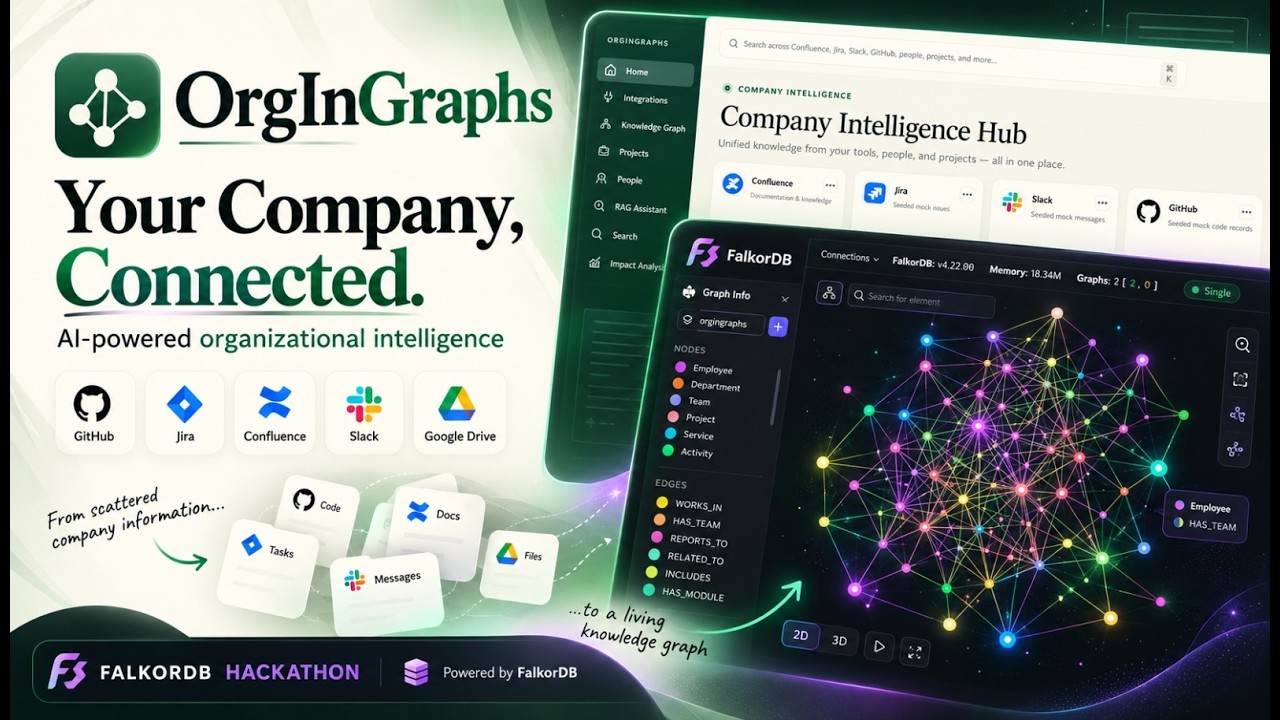
▶ Click the thumbnail above to watch the full demo on YouTube.
On the roadmap: exploring gRPC for a future typed, high-throughput service boundary alongside today's REST API. This is future exploration, not a currently implemented transport.
OrgInGraphs (OIG) is a company intelligence platform built around a company graph and two specialized AI workflows. OrgMind Assistant reasons over graph entities, typed relationships, and bounded neighborhoods. Company Brain runs a retrieval-augmented generation (RAG) pipeline: it embeds the question, searches indexed graph chunks, assembles evidence, and asks the backend-configured Bedrock model for a cited response. That split keeps graph navigation and document-grounded synthesis explicit and inspectable.
Install Node.js 20 or newer, npm, Git, and access to a FalkorDB instance. The repository has independent frontend and backend packages, each with its own lockfile.
git clone https://github.com/Garima040106/OrgInGraphs.git
cd OrgInGraphs

cp backend/.env.example backend/.env
cp frontend/.env.example frontend/.env.local

cd backend && npm install
cd ../frontend && npm install
Edit backend/.env with the connection details for the FalkorDB graph you intend to use: FALKORDB_HOST, FALKORDB_PORT, FALKORDB_USERNAME, FALKORDB_PASSWORD, FALKORDB_TLS, and either FALKORDB_DATABASE or FALKORDB_GRAPH. Keep credentials in backend-only environment files and do not commit .env files. For a local backend, frontend/.env.local may set NEXT_PUBLIC_API_BASE_URL=http://localhost:8080; the frontend API client uses that value and defaults to the same URL when it is absent.
Seed the organization graph only after FalkorDB is configured. Product Progress data is seeded separately when needed:
cd backend
npm run seed:falkordb
npm run product:seed:falkordb
Start the services in separate terminals:
# Terminal 1
cd OrgInGraphs/backend
npm run dev

# Terminal 2
cd OrgInGraphs/frontend
npm run dev
The backend listens on port 8080 by default and the Next.js frontend on port 3000. Optional provider and model settings are documented in backend/.env.example; they are not required to inspect the graph itself.
The backend uses parameterized openCypher through the FalkorDB client to create nodes and relationships with MERGE, retrieve typed records with MATCH, and traverse connected entities through relationship patterns. These examples mirror the queries used by the API:
MATCH (e:Employee)
RETURN e
ORDER BY e.name;
Lists employees ordered by name, matching the employee collection route.
MATCH (p:Project {id: $projectId})
OPTIONAL MATCH (p)<-[:WORKS_ON]-(e:Employee)
OPTIONAL MATCH (p)<-[:IMPLEMENTS]-(pr:PullRequest)
OPTIONAL MATCH (p)<-[:CREATES]-(t:Task)
RETURN p, collect(DISTINCT e) AS employees,
       collect(DISTINCT pr) AS pullRequests,
       collect(DISTINCT t) AS tasks;
Returns a project with its recorded contributors, pull requests, and tasks using the route’s $projectId parameter.
MATCH (start:Employee {id: $employeeId})-[r]-(n)
RETURN start, n, type(r) AS relationship
LIMIT 100;
Traverses incoming and outgoing relationships around one employee for a bounded connected-entity view.
Coding assistants and agents supported selected development tasks, including code auditing, identifying and fixing backend errors, resolving DevOps and configuration issues, and making reasonable code improvements. Generated changes were reviewed and tested where applicable; this does not mean every repository change was AI-generated or independently verified.
flowchart LR
  subgraph Browser[Next.js workspace]
    UI[Dashboard, directories, graph explorer]
    OA[OrgMind Assistant]
    CB[Company Brain chat]
    APIClient[Typed API client]
  end

  subgraph Service[Express API - port 8080]
    Routes[Validated REST routes]
    Assistant[LangGraph assistant workflow]
    Ingest[LangGraph source ingestion]
    RAG[LangGraph RAG retrieval workflow]
    Sync[Incremental sync worker]
  end

  subgraph Storage[Configured FalkorDB graph]
    CompanyGraph[(Company and product graph)]
    VectorIndex[(RAGChunk vectors - cosine/HNSW)]
    Memory[(Assistant conversation memory)]
    Jobs[(RAG sync jobs and checkpoints)]
  end

  Model[Optional configured model provider]
  Sources[Configured source adapters]

  UI --> APIClient
  OA --> APIClient
  CB --> APIClient
  APIClient --> Routes
  Routes --> Assistant
  Routes --> RAG
  Routes --> Ingest
  Routes --> Sync
  Assistant <--> CompanyGraph
  Assistant <--> Memory
  Ingest --> Sources
  Ingest --> VectorIndex
  RAG --> VectorIndex
  Assistant -. optional structured synthesis .-> Model
  RAG -. grounded synthesis .-> Model
  Sync --> Jobs
  Sync --> Sources
  Sync --> VectorIndex
The browser uses the frontend API client (NEXT_PUBLIC_API_BASE_URL, default http://localhost:8080). FalkorDB, model credentials, source credentials, and RAG administration keys are backend concerns. The UI does not invoke Bedrock directly.
The frontend is a Next.js App Router application built with React and TypeScript. Workspace pages use a shared shell and a typed API layer; graph exploration uses React Flow through @xyflow/react. Tailwind CSS provides the utility styling layer, with project styles in the app stylesheet. Lenis is included for smooth scrolling and Lucide supplies the icon set.
| Area | Implementation | Reference |
|---|---|---|
| Workspace and routes | Next.js App Router 15, React 19 | Next.js, React |
| API access | frontend/lib/api.ts, base URL from NEXT_PUBLIC_API_BASE_URL |
Fetch API |
| Graph visualization | @xyflow/react |
React Flow |
| Styling | Tailwind CSS 4 and application CSS | Tailwind CSS |
| Interaction utilities | Lenis, Lucide React | Lenis, Lucide |
Primary UI surfaces: dashboard, company/people/project views, graph explorer, integrations and source records, search, OrgMind Assistant, and Company Brain. The API client handles JSON requests and maps the RAG response into the frontend's typed response shape.
The backend is a Node.js 20+ TypeScript service using Express 5 and the FalkorDB JavaScript client. It persists graph nodes by stable id and writes node properties through parameterized openCypher queries. Public graph responses use stable entity IDs and include relationships only when both endpoint nodes are part of the exposed company graph.
The company graph covers Company, Employee, Department, Team, Project, Repository, Service, Document, Decision, Incident, Task, PullRequest, Channel, and Message. Product Progress adds Product, ProductModule, Feature, FeatureRequest, Ticket, Bug, Release, Commit, Comment, Activity, and Review; organization labels such as Employee, Department, Team, and Project are reused. Product records are marked with graphDomain: "product-progress" and carry source/provenance fields.
Representative relationship families include reporting and membership (REPORTS_TO, MEMBER_OF, WORKS_IN), ownership and delivery (OWNS, WORKS_ON, IMPLEMENTS, FIXES), and product lineage/dependency (HAS_FEATURE, HAS_TICKET, DEPENDS_ON, RELATED_TO). Product Progress constrains returned node labels and relationship types through an allowlist.
OrgInGraphs is built around FalkorDB's graph data model. That choice lets the application represent company knowledge as typed nodes and typed relationships, then traverse those relationships as first-class structure. An employee is not just a row with a department name: the graph can record and query (:Employee)-[:WORKS_IN]->(:Department), ownership, reporting, project work, and the links among issues, pull requests, services, and decisions.
FalkorDB also hosts the RAG corpus in the same graph database. RAGChunk nodes carry source metadata and 384-dimensional vectors, while a native cosine/HNSW index finds semantically similar passages. The backend can then apply organization and source filters and return citations tied to the indexed graph records. This gives OrgInGraphs one graph-native persistence and query layer for relationship traversal and semantic retrieval, instead of maintaining disconnected graph and vector stores.

flowchart LR
  E[Employee] -->|WORKS_IN| D[Department]
  E -->|WORKS_ON| P[Project]
  T[Ticket] -->|RELATED_TO| P
  PR[PullRequest] -->|IMPLEMENTS| T
  K[RAGChunk node] -->|384-D embedding| VI[(FalkorDB cosine/HNSW index)]
  Q[Question embedding] -->|nearest-neighbor search| VI[(FalkorDB cosine/HNSW index)]
  VI --> C[Ranked passages and citations]
  C --> A[Bedrock grounded answer]
The graph provides the typed organizational structure and referential links; the vector index adds semantic recall over chunk text. The workflows combine those capabilities while preserving their distinct contracts: OrgMind follows graph entities and edges, and Company Brain retrieves text evidence and returns source citations.
OrgInGraphs coordinates six specialized backend agent components. Each owns a bounded task and hands validated results to graph persistence, retrieval, or the next processing stage. The Company Brain agent contains two explicit LangGraph subworkflows for ingestion and retrieval.
| # | Agent | Responsibility |
|---|---|---|
| 1 | OrgMind Assistant | Classifies company questions, retrieves graph entities and bounded neighborhoods, uses conversation context, and returns a validated structured answer with graph citations and suggested actions. |
| 2 | Company Brain | Runs RAG ingestion and query workflows: source discovery, chunking, 384-dimensional embeddings, FalkorDB vector upserts, semantic retrieval, evidence assembly, and Bedrock-grounded responses with source citations. |
| 3 | Ticket Identification | Parses ticket records, resolves referenced projects and people, validates ambiguous or unsupported fields, and persists accepted records with stable identifiers. |
| 4 | Feature and Activity Update | Classifies and parses engineering activity, resolves graph references, validates updates, and persists supported product-progress records. |
| 5 | Document Processor | Routes normalized source records to document, ticket, activity, or message handling according to source type. |
| 6 | Connector Fetcher | Retrieves source records through configured backend adapters, normalizes responses, and preserves source identity and provenance for ingestion. |
flowchart LR
  subgraph API[Express API]
    R[Validated REST routes]
  end

  subgraph Agents[6 specialized agent components]
    A1[1. OrgMind Assistant]
    A2[2. Company Brain\nIngestion + Retrieval]
    A3[3. Ticket Identification]
    A4[4. Feature / Activity Update]
    A5[5. Document Processor]
    A6[6. Connector Fetcher]
  end

  subgraph Stores[FalkorDB]
    G[(Typed company graph)]
    V[(384-D RAGChunk vector index)]
    M[(Conversation memory)]
  end

  B[Amazon Bedrock Mantle]
  C[Configured upstream systems]

  R --> A1
  A1 <--> G
  A1 <--> M
  A1 -. optional synthesis .-> B
  R --> A2
  A2 --> V
  V --> A2
  A2 -. evidence-grounded generation .-> B
  C --> A6
  A6 --> A5
  A5 --> A3
  A5 --> A4
  A3 --> G
  A4 --> G
  A5 --> G
The components are implemented as bounded application workflows using LangGraph StateGraph stages where applicable. Validation, reference resolution, persistence, and response-shape checks happen at explicit boundaries. Model use is provider-configured; graph writes are governed by validation and backend admin controls.
Company Brain is an end-to-end RAG system over the organization's indexed knowledge. The pipeline combines a local Hugging Face sentence encoder, native FalkorDB vector search, source-aware ranking, bounded evidence assembly, and server-side Amazon Bedrock generation. Each stage has a defined input/output contract and contributes retrieval metadata and citations to the response.
The backend's GeminiEmbeddingService name is a legacy name; the default implementation is not Gemini. It dynamically imports @huggingface/transformers and initializes pipeline('feature-extraction', 'Xenova/all-MiniLM-L6-v2'). Text is mean-pooled and L2-normalized. Every embedding is exactly 384 finite numeric values (384 dimensions); the implementation validates width and finiteness before accepting vectors. Batch inference defaults to 16 texts and supports bounded batches of 1-64. The production embedding path runs locally in the backend process; no embedding credential or vector is exposed to the browser.
The chunker keeps Markdown sections together when practical, groups paragraphs, and splits oversized paragraphs into sliding windows. Defaults are 2,000 characters per chunk and 300 characters of overlap. Chunk metadata carries organization ID, source type/path, title, document hash, content hash, timestamps, and available source metadata such as URL. Chunk IDs are deterministic from source path and chunk ordinal, with the document hash included in the standard chunking path. Unchanged sources are skipped by document hash, and graph MERGE semantics prevent ordinary reruns from blindly appending duplicate records.
Production vectors are persisted on RAGChunk nodes in the embedding property as vecf32. FalkorDB's vector index is configured for 384 dimensions, cosine similarity, and HNSW with M=16 and efConstruction=200. Initialization inspects CALL db.indexes(), reuses a compatible existing index, and creates one only when missing. Upsert writes node properties and vector data without redefining the index. Existing incompatible indexes are reported with the observed and expected settings; the error directs operators toward a side-by-side migration while preserving existing data.
Queries use CALL db.idx.vector.queryNodes to find nearest vectors. Candidate retrieval is oversampled to topK * 8 (maximum 100), with inactive staged chunks excluded. Organization and source constraints are then applied; ranked results are deduplicated by content/hash and near-identical text, and query-specific summary records can be prioritized. The final evidence set is capped at five chunks. Citation records retain source title/type/platform, path, optional URL, excerpt, chunk identity, and similarity score.
The retrieval graph builds an evidence context with an adjustable maximum size (default 16,000 characters). Each passage is labeled with source and chunk identifiers ([S1], [S2], ...). The system prompt treats retrieved documents as untrusted input, tells the model to answer only from supplied evidence, requires factual claims to cite supplied labels, and asks the model to state uncertainty when evidence is insufficient or contradictory. When retrieval returns no qualifying chunks, Company Brain responds with an explicit insufficient-evidence message without calling the model.
When AWS_BEARER_TOKEN_BEDROCK is configured, BedrockService uses the OpenAI-compatible chat-completions client with Amazon Bedrock Mantle. The default model is openai.gpt-oss-120b. It receives a system prompt and a user prompt containing the question, available follow-up context, and bounded retrieved passages. Defaults are a 45-second timeout, 1,000 output tokens, and temperature 0.2. Authentication/permission failures are surfaced directly; transient throttling, server, connection, and timeout failures receive up to three controlled attempts with exponential delay. The credential remains exclusively in backend runtime configuration.
If Bedrock is not configured, the RAG workflow reports that state as partial; if generation fails, it returns an explicit degraded response and error status. It does not silently select another model or claim a successful grounded answer.
POST /api/rag/query accepts a strict JSON body with a required question and optional source-type filters:
{
  "question": "What is the team working on?",
  "filters": { "sourceTypes": ["confluence", "jira"] }
}
The response contains answer, sources, retrieval: { candidateCount, usedChunks }, and evidenceFound. Each source entry includes documentId, chunkId, citationIds, sourceType, title, optional url and excerpt, and score. This keeps the generated answer auditable back to indexed chunks instead of presenting model text as unsupported fact.
sequenceDiagram
  participant C as Chat UI
  participant A as Express API
  participant E as Hugging Face Transformers.js
  participant F as FalkorDB HNSW index
  participant B as Bedrock Mantle
  C->>A: POST /api/rag/query { question, filters? }
  A->>E: feature-extraction, mean pooling, L2 normalize
  Note over E: all-MiniLM-L6-v2 returns 384 floats
  E-->>A: normalized query vector
  A->>F: cosine ANN search, candidate oversampling
  F-->>A: ranked RAGChunk nodes
  A->>A: organization/source filters, dedup, top 5 evidence chunks
  A->>B: question + bounded, labeled evidence
  B-->>A: grounded answer
  A-->>C: answer + citations + retrieval counts
Incremental synchronization is polling-based. The worker tracks RAGSyncJob work, leases, hashes/checkpoints, retries, and dead-letter replay in FalkorDB. It is not a CDC or webhook feed. Current connector adapters bound work per poll; absence from a partial scan is not sufficient evidence to delete an indexed source. Full re-scan/cleanup is guarded separately from selected-source ingestion.
Confluence retrieval supports a configured backend-side Atlassian REST connection. Jira, GitHub, and Slack records are retrieved through configured backend connector endpoints and normalized by the backend; the ingestion pipeline verifies provenance before accepting source records into the company graph. Source-library routes read persisted graph records rather than calling providers from the browser.
GET /api/integrations/status performs a bounded sample fetch for each configured source, reports cumulative distinct indexed counts, and returns the latest recorded sync outcome. Sample reachability does not establish a successful ingestion run. Confluence is the live provider; Jira, Slack, and GitHub currently use the seeded mock API.


The backend currently exposes Express routes directly; it does not publish an OpenAPI specification. The table below groups the main application contracts. See docs/api-capability-inventory.md for page mappings and integration details, and docs/rag-pipeline.md for the complete RAG operations notes.
| Method and route | Request / response purpose |
|---|---|
GET /health |
Database connectivity status: { status, database }; returns 503 when unavailable. |
GET /api/dashboard |
Company, graph snapshots, source counts, and aggregate totals for the workspace. |
GET /api/dashboard/summary |
Lightweight company, source counts, and totals. |
GET /api/graph |
Stable-ID graph { nodes, edges } for company graph views. |
GET /api/company |
Company node; 404 if missing. |
GET /api/employees[?departmentId&teamId&employmentStatus] |
Employee list with optional filters. |
GET /api/employees/:employeeId |
Employee detail with manager, reports, department, team, skills, and projects. |
GET /api/departments[/:departmentId] |
Department records and associated teams/employees. |
GET /api/projects[/:projectId] |
Projects and associated contributors, owners, services, tasks, and pull requests. |
GET /api/graph/neighborhood/:entityType/:entityId |
Bounded direct neighborhood with relationship direction. |
GET /api/search?q=... |
Up to 50 name/title/email matches. |
GET /api/documents, /api/tickets, /api/conversations, /api/proactive-insights |
Paginated indexed records by source family; these read graph data rather than calling upstream APIs. |
GET /api/integrations/status |
Bounded connector sample check plus recorded sync/index status. |
POST /api/integrations/:source/sync |
Administrative source sync; requires RAG_ADMIN_API_KEY. |
GET /api/product-progress/graph |
Product Progress graph in the common node/edge response shape. |
POST /api/product-progress/tickets, /activities, /workflow |
Validated graph-writing workflows; requires RAG_ADMIN_API_KEY. |
POST /api/assistant/query |
OrgMind structured graph answer; accepts { question, conversationId?, context? }. |
GET /api/assistant/conversations[/:conversationId] |
Conversation listing or persisted turns for the supplied workspace identity. |
POST /api/rag/query |
Company Brain query; accepts { question, filters?: { sourceTypes? } }. Returns { answer, sources, retrieval, evidenceFound }. |
GET /api/rag/status |
Indexing, vector-store and sync-worker status. |
POST /api/rag/ingest, /api/rag/reindex, /api/rag/sync/replay |
Administrative ingestion, reindex, and dead-letter replay operations. |
POST /api/ingestion/process |
Administrative source fetch/process request, with per-record outcomes and safe diagnostics. |
The RAG response sources entries expose documentId, chunkId, citationIds, sourceType, title, optional url/excerpt, and score. The /api/assistant/query response is a different schema: answer is structured (type, title, summary, findings, citations, related_entities, suggested_actions, uncertainty) alongside a constrained ui description and execution stage statuses.
| Component | Runtime | Primary configuration |
|---|---|---|
| Frontend | Next.js on port 3000 in local defaults |
NEXT_PUBLIC_API_BASE_URL points to the backend API. |
| Backend | Node.js >=20, Express 5 on port 8080 by default |
Node.js, Express; PORT, NODE_ENV, FRONTEND_ORIGINS, ORGANIZATION_ID. |
| Graph database | FalkorDB | FalkorDB; FALKORDB_HOST, FALKORDB_PORT, username/password, TLS, and graph/database selection. |
| Embeddings | Local Hugging Face Transformers model by default | Transformers.js; RAG_EMBEDDING_PROVIDER, chunk and context limits. |
| Answer model | Optional backend model provider; Bedrock Mantle is the configured RAG integration | Amazon Bedrock; AWS_BEARER_TOKEN_BEDROCK, AWS_REGION, BEDROCK_MANTLE_BASE_URL; model openai.gpt-oss-120b. |
| Source adapters | Backend-side Confluence and configured provider connector endpoints | Provider credentials and connector endpoint configuration in the backend environment. |
| RAG administration | Backend only | RAG_ADMIN_API_KEY for protected write/maintenance routes. |
The relevant variable names and example values are maintained in backend/.env.example. Credential values belong only in backend runtime configuration; never expose them in browser bundles or NEXT_PUBLIC_* variables.
- Authentication boundary: the current backend has no authentication middleware. RAG identity and assistant memory ownership use the
x-orgmind-user-idheader, which is client-supplied and can be spoofed. Do not treat it as authorization in a public deployment; bind ownership to a trusted server-side session or verified token. - Administrative writes: ingestion, reindex, replay, and other write operations require the configured backend admin key and valid identity handling. Keep
RAG_ADMIN_API_KEYand provider credentials on trusted server-side callers. - Prompt-injection boundary: retrieved documents are explicitly treated as untrusted evidence. The Company Brain prompt limits responses to retrieved content and valid citation labels; deterministic no-evidence behavior is defined in the workflow.
- Structured output: OrgMind model output is validated against a strict schema and known graph IDs. Invalid or unavailable model output falls back to a deterministic graph-grounded response.
- Impact semantics: impact analysis is bounded graph traversal over recorded direct relationships. It is not causal analysis, risk scoring, or simulation.
- Sync semantics: synchronization is polling/checkpoint based, not real-time CDC. Partial source absence does not authorize deletion.
- Provider health: integration status is configuration/index reporting, not proof of successful upstream authentication or current availability.
- Data provenance: ingestion validates source identity and provenance before accepting records. Current API contracts and integration boundaries are tracked in
docs/api-capability-inventory.md.
backend/
  src/api/                         Express routes and request validation
  src/agents/company-assistant/    Graph assistant memory and response types
  src/agents/organization-intelligence/
    workflow/                      RAG ingestion and retrieval graphs
    embeddings/                    Embedding provider
    vector-store/                  FalkorDB vector and persistence adapters
    sync/                          Polling sync worker, queue and change checks
    sources/                       Source discovery and connector adapters
  src/workflow/                    Assistant, ingestion, ticket and activity workflows
  src/graph/                       Public company graph projection
  src/db/                          FalkorDB query and persistence layer
  scripts/                         Data import, RAG rebuild and verification commands
  tests/                           Backend API, workflow, graph, ingestion and RAG tests
frontend/
  app/                             Next.js App Router pages and global styles
  components/                      Workspace, assistant, graph and data views
  lib/api.ts                       Frontend API client and response mapping
docs/
  rag-pipeline.md                  RAG, index, sync and operational details
  api-capability-inventory.md      Verified route inventory and integration limits

Garima Varma Team Prometheus 
|

Nick Team Prometheus
|

Mohit Srivastava Team Prometheus
|
OrgInGraphs · graph-grounded company intelligence