






AI engineer with a cybersecurity background. I turn everyday needs into practical web applications, with a focus on clear interfaces, useful features and deployable products. My personal projects combine product exploration, hands-on iteration and AI-assisted development.
- 🎓 Cybersecurity engineering at ISEP, Paris (class of 2026), with an Erasmus semester at ISCTE Lisbon in machine learning and computer science.
- 💼 Final-year internship at Good iD, a Google partner integrator: two internal tools in production, for customer support and inventory.
- 📦 Earlier internship at The Lost Recordings: a Node.js service that requests La Poste shipping slips as soon as an order is ready.
- 🤖 I work with AI coding agents (Claude Code, Codex): I shape the product and the specs, they write the code, I review, test and ship it.
- 🔎 Looking for an AI engineering, software, cloud or cybersecurity role, in France or abroad.
- 🎯 Sightline: Counter-Strike 2 demo analysis platform
🟢 In production for my esports team · 📂 public code - 📱 Sightline mobile: its pocket companion, on the web and Android
🟢 Live · 📂 public code - 🔥 Brazil Fire Calendar: NASA Space Apps Challenge 2026, twenty years of NASA fire data over Brazil in one calendar
🟢 Live · 👥 team project, I owned the infrastructure · 📂 public code - 📚 Mangathèque: self-hosted manga reader for my household
🟢 Live · 🔒 private code - 📒 Caderno: Portuguese-learning notebook
🟢 Live, password access · 📂 public code - 🛒 AI-built e-commerce shops: Shopify shops coded and illustrated by AI
🟢 First paid orders in Sept. 2026 · 🔒 private - 🚧 Up next: CS2 training servers: on-demand practice servers for my team, the training side of Sightline
🟡 In planning, November 2026
A Counter-Strike 2 demo analysis platform, in production for my esports team.
Import match demos and get a 2D and 3D replay, team and player analytics, scouting reports and an AI assistant that answers questions about the team's own matches.
🔗 Explore the project and source code →
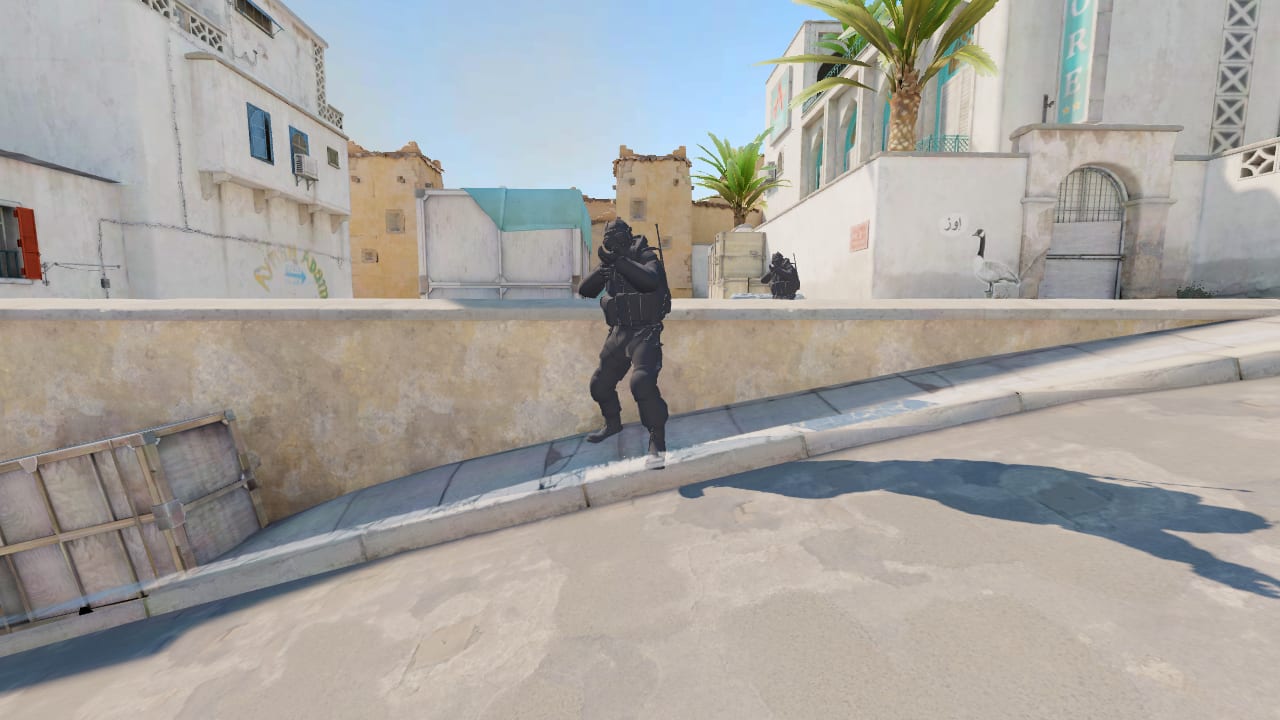
- ⚙️ FastAPI (Python) backend that parses demos into 32 Hz replays, SQLite with migrations, Docker deployment.
- 🖥️ React and TypeScript interface, with a WebGL (three.js) 3D replay: maps exported from the game, animated player models and ragdoll physics computed in a Web Worker.
- 🤖 AI assistant (Claude or Gemini) grounded on the team's match data.
- 🔌 Integrations: n8n automations, a Chrome extension, a TeamSpeak plugin in C++ and a mobile app.
- ✅ 1,400+ automated tests, run in CI on every push.
🧭 My role: defining the product with my team, prioritizing features and directing the work with AI coding assistance (specs, test-first plans, independent reviews), then deploying and running it in production. The repository explains the architecture and how it was built.
The pocket companion to Sightline, designed around the moments a player actually picks up their phone.
Before the match, prepare for the opponent; right after it, read your own debrief; during practice, keep a map's grenades in view next to the keyboard; over time, follow your progress. Same accounts and same data as the web app, plus a notebook for the team's strategies and personal notes.
🔗 Explore the source code → (the mobile/ folder of the Sightline repository)


Demo mode, iPhone format: public professional matches embedded in the app, no account needed.
- 🧱 Expo SDK 58, React Native and expo-router in TypeScript, with TanStack Query and Reanimated.
- 📲 One codebase, two free channels: an installable web app served by the Sightline backend, and an Android APK built in the cloud with EAS. No app-store fees.
- ⏱️ A home screen that knows what moment it is: the next match comes first with a countdown, and a debrief less than 24 hours old goes ahead of everything else.
- 📊 Opponent prep where every figure shows its reliability and sample size, so two rounds are never presented as a trend.
- 📐 Grenade lineups made for a phone propped next to the keyboard: the screen stays on, the angles are large and the practice command copies in one tap.
- 🗓️ Upcoming matches with the opponent's likely maps, shown in each team member's local time.
- ♿ Accessible by design: screen-reader labels, a one-sentence summary for every chart, and simple fades instead of motion when the user asks for less animation.
- 🧪 Unit tests on the app's logic (Vitest), and a demo that weighs about 400 KB of embedded data.
🧭 My role: product and UI/UX design (moments of use, screens, visual system), the specification, verification and release. The code is written by AI agents (Claude Code); the first version went live in two days.
NASA Space Apps Challenge 2026: more than twenty years of NASA fire detections over Brazil, harmonized into one burning calendar.
Built in a team over the hackathon weekend, for the challenge Harmonization of MODIS and VIIRS Hot Spots. MODIS (since 2000) and VIIRS (since 2012) do not count fires the same way, so a change of satellite used to create fake jumps. Pick an area of Brazil and a date: see when fires usually happen, whether this month is unusual, and an experimental next-week estimate, then download the data.
🔗 Explore the project and source code →
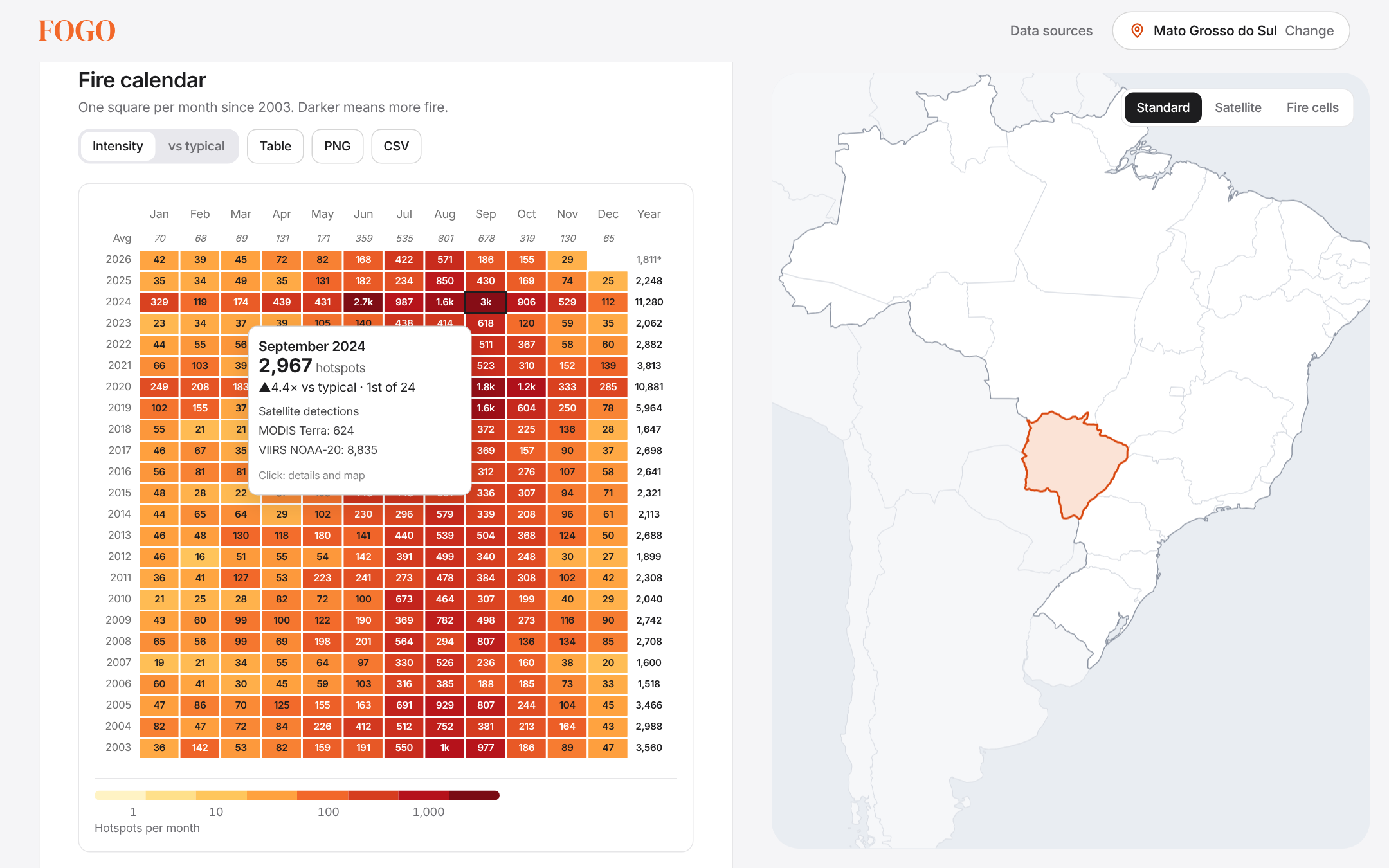
- 🛰️ A re-runnable data pipeline from NASA FIRMS to the calendar: download, Brazil extraction, cleaning into Parquet, fire-days on a ≈1 km grid, harmonization. 41.6 million cleaned hotspots over Brazil, from 2000 to 2026.
- 📏 A first harmonization checked on held-out years (fitted on 2012–2017, predicting 2018–2019): 6.6 % median error on Brazil's monthly totals.
- ⚡ A FastAPI and DuckDB API that only reads the slice of the map an area covers: the Pantanal answer went from 6.5 s to 0.2 s and memory from about 1.5 GB to about 330 MB, with an answer cache that brings all of Brazil from about 10 s to about 1 s.
- 🔮 The science team's next-week fire model served by the API, as a chance of fire per 5 km cell, always labelled as an experimental model estimate.
- 🔐 Hosted on a VPS in its own capped Docker container, without disturbing the server's other sites. The website goes live on every merge to
mainthrough a GitHub Action whose SSH key can only upload files into the site folder: no shell, nosudo(tested). - 🖥️ On the website (React, TypeScript, MapLibre, ECharts): the "month over the years" card, and map flames placed where the satellites actually saw fire.
🧭 My role: infrastructure owner: the data pipeline, the API, hosting and automatic deployment, plus a few website features. The code was written with AI coding agents (Claude Code) under my direction, through small pull requests to a shared repository.
A self-hosted manga reader for my household, installable on iPhone, iPad and PC.
Search a public manga catalogue, read in manga (right-to-left), page or vertical-scroll mode, download chapters to read offline in airplane mode, and export them as CBZ or PDF. Each family member has their own account and their own downloads.
🔒 Private repository — I'm happy to walk through the code and architecture on request.
- 🧱 SvelteKit 2 and Svelte 5 in strict TypeScript, Node 24 and SQLite, packaged as a Docker image and served over HTTPS behind Caddy.
- 🛡️ Deployed on a VPS that already runs another production app: verified backups, config validation before reload and a before/after state check, so that app never went down.
- 🚦 A server-side proxy that plays fair with the content API: rate limiters, automatic pause when asked to slow down, a circuit breaker and a size-capped image cache.
- 📲 Installable PWA: service worker, per-user offline downloads in IndexedDB that resume where they stopped.
- 📄 CBZ and PDF exports streamed page by page, to stay within a 512 MB memory limit.
- 🔐 Security by default: scrypt password hashing,
__Host-session cookies, login rate limiting and a strict Content Security Policy. - 🧪 About 600 unit tests (Vitest) and end-to-end browser tests (Playwright) against a fake API server, so no test ever hits the real service.
🧭 My role: defining the need and taking every product decision, then directing an AI-driven workflow end to end: a design document checked by six independent AI reviewers, a shared contract and a 14-task test-first plan (about 350 steps), one coding agent per task followed by an independent review agent, and a step-by-step production deployment run from my own machine, with the server keys never leaving it.
A personal Portuguese-learning notebook, inspired by life in Brazil.
Translate between French and Brazilian Portuguese, save useful vocabulary, add personal notes and look up verb conjugations from a mobile-friendly interface.
🔗 Explore the project and source code →
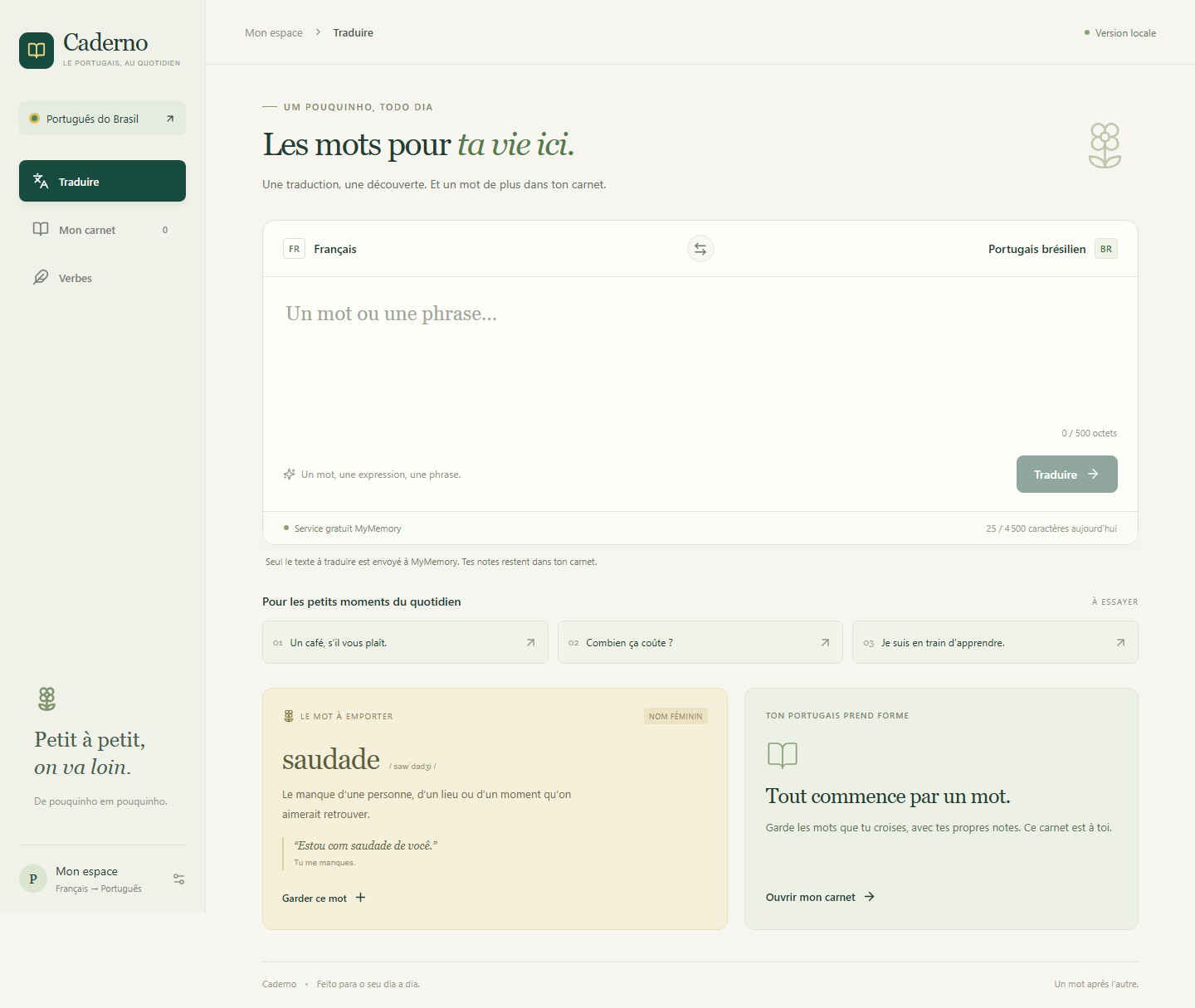
- 🖥️ React and TypeScript interface, designed for mobile and desktop.
- 🗄️ Express API and persistent SQLite storage.
- 📖 60 built-in verbs, custom verb imports and notebook export.
- 📲 PWA with offline reading of previously loaded content.
- 🧪 Automated tests and a Docker deployment setup.
🧭 My role: defining the problem, shaping the product, prioritizing features and iterating on the result with AI coding assistance. The repository explains the implementation, trade-offs and current limitations.
Shopify dropshipping shops whose code and visuals are produced by AI, with every release still under my control.
Since August 2026 I have been launching Shopify shops on small European markets, in languages I do not always speak. AI coding agents write the theme code and image and video models produce the ad visuals. I decide what gets built, review and test every release, and run the shops.
🔒 Private work — products, suppliers, pricing and the marketing playbook are intentionally left out. The diagrams below show how the work is organised and checked.
🟩 In green, the steps I never delegate.


- 📜 Working rules written for the agents: nothing goes live without my approval; one file at a time, so the shop settings are never overwritten; a full copy of the live theme before every batch; nothing private in the files served; credentials, bank details and identity handled by me alone.
- 🔍 Pre-launch audit: 29 URLs returning the expected 200, 301 and 404 responses, 293 resources loaded across three pages without a single 404, and no third-party scripts.
- ⚡ Lighthouse mobile, in lab conditions: accessibility 100, SEO 100, performance between 52 and 76.
- 🌍 Domains, payments and translated versions live in September 2026, and the first real, paid orders the same month.
🧭 My role: choosing products, markets and pricing; writing the specifications and arbitrating trade-offs; setting up domains, payments and shop settings; testing every release; art-directing the ads, generated by AI and then edited. The code is written by AI agents (Claude Code, Codex).
On-demand Counter-Strike 2 practice servers with training modes, built for my esports team: the training side of Sightline.
Sightline shows the team what went wrong in a match; this project gives each player a private server to work on it. From a web dashboard, a player picks a mode and a map, starts a server and joins in one click, and the session results come back to the dashboard.
🗓️ In planning: specification and observation phase, November 2026.
- 🧩 Training modes driven by one scenario engine (spawns, bot behaviour, weapons, reset and win conditions) and per-map data files, instead of one plugin per mode: aim, prefire, retakes, spray transfer, AWP and grenade practice.
- 🔌 Game-server plugins in C# on CounterStrikeSharp (Metamod), talking to the web backend for access control and session stats.
- 🖥️ Web dashboard with Steam sign-in, a team allowlist and live server status; servers start on demand and stop when idle to keep hosting costs low.
- 🏗️ Built first against a local CS2 dedicated server; team hosting chosen once the first modes are measured (managed CS2 hosting or a dedicated machine).
- ➡️ Next step after that: link Sightline's match analysis to recommended training modes.
🧭 My role: studying how existing training platforms behave from a player's point of view, writing the specification for each mode, choosing the hosting, and directing the AI-assisted build and tests.
🤖 AI 


🖥️ Front end 


⚙️ Back end and data 


🚀 Ship and test 




🔌 Automation and commerce 


- 🎯 Building around a real user need.
- 📱 Keeping interfaces understandable and comfortable on a phone.
- 📦 Making personal data portable.
- 📝 Documenting what works, what is tested and what still needs improvement.
The best place to start is my portfolio: each project page sets out the context and my exact role, and my internship tools come with a mock-up you can try. You can also find me on LinkedIn.