A 3D viewer for accelerator lattices. Every lattice that lattix
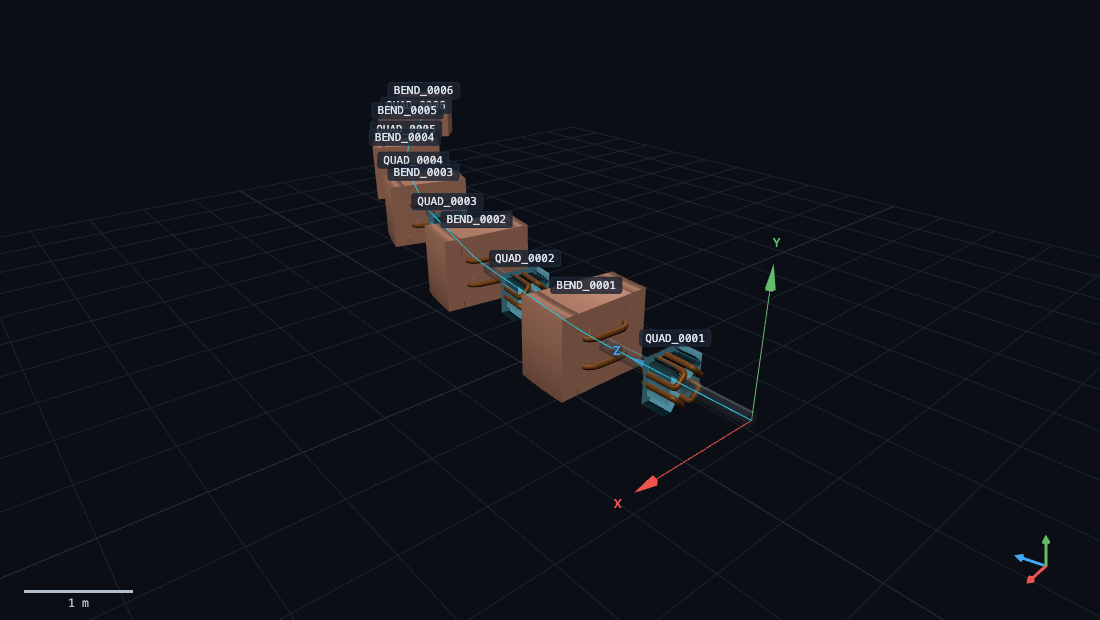
reads, twenty-eight formats, is drawn element by element on its survey coordinates, with a model
per element, a hover label, measurement tools and exports. It runs in the browser as a tab of the
lattix workbench (lattix ui) or on its own, and loads nothing from the network.
pip install lattix-view                # brings lattix 0.2.0 or later with it
lattix ui --root decks/                # the workbench, now with a 3D tab
lattix-view view linac.dat             # the 3D page for one deck
lattix-view scene linac.dat -o scene.json                    # the scene as JSON, no server
lattix-view overrides linac.dat --overrides site.yaml # which of a site's models replace which elements- Every element on its survey frame. Positions and orientations at the entrance, centre
and exit of every element, and the misaligned body frame, come from
lattix.ir.frames, held to the surveys of MAD-X, xtrack and Bmad; vertical bends, rolled bends, patches and misalignments included. The site pose (the MAD-XSURVEYstart) puts the whole scene in site coordinates. - A model for every element. Twenty procedural archetypes sized from the element's own
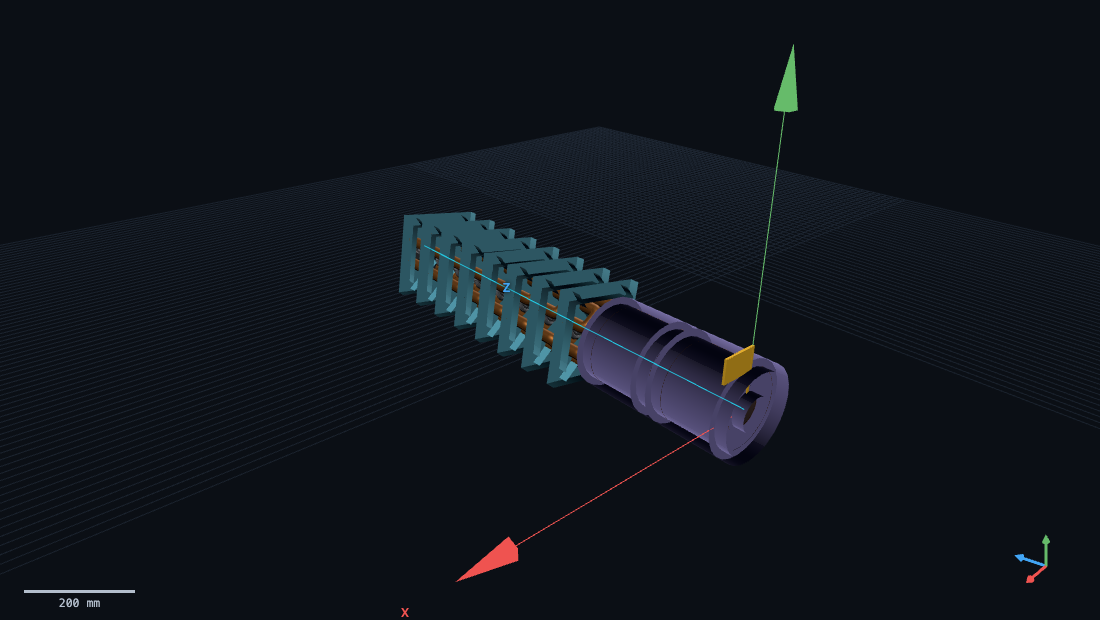
parameters: multipole magnets with poles and coils, sector and rectangular dipoles with pole
faces swept along the arc, solenoids, elliptical, spoke, half-wave and travelling-wave
cavities, DTL tanks with drift tubes, RFQ vanes, correctors, collimators, foils, BPMs, profile,
current and loss monitors, valves, markers, patches, field-map extents; the beam pipe through
everything with the deck's apertures. A site replaces any of them with its own glTF through
YAML rules (
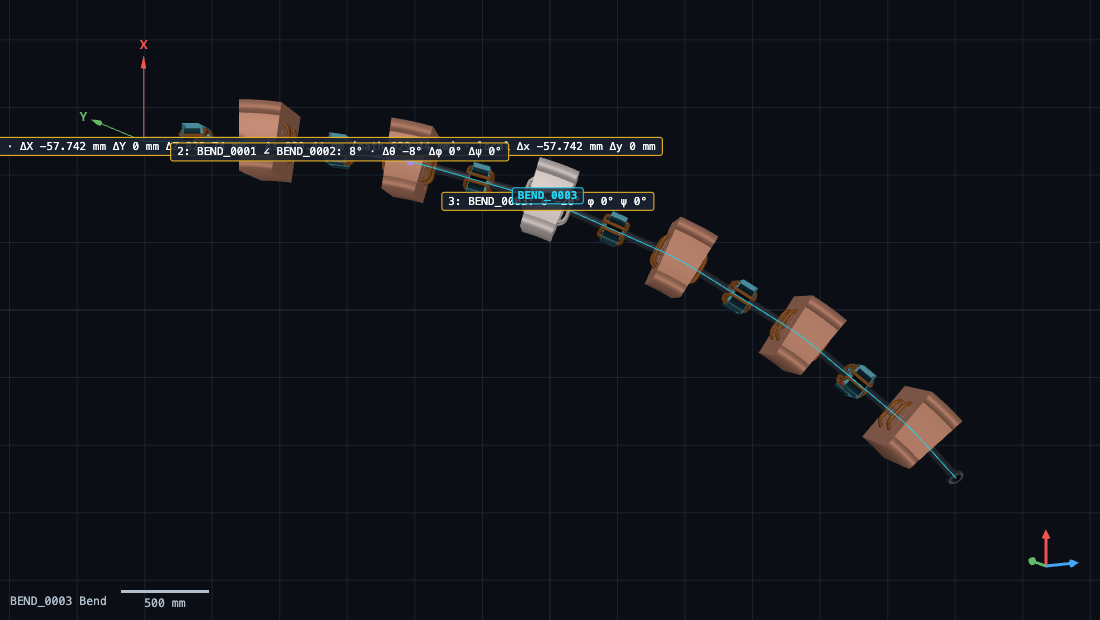
docs/overrides.md). - Measurement on the frames, not on the pixels. Distances between snapped frame points or
beam-axis points, gaps and angles between elements, headings, coordinate probes and a section
plane, at 12 significant digits in the copied table (
docs/measure.md). - Exports. The survey table (CSV, JSON) from lattix's own route, the scene as glTF or OBJ
with one named node per element, screenshots at up to 4×, turntable and fly-through video
(
docs/exports.md). - Kept in step with the workbench. Selection, hover, cursor, theme and the per-kind colours
are shared with the 2D synoptic and floor plan;
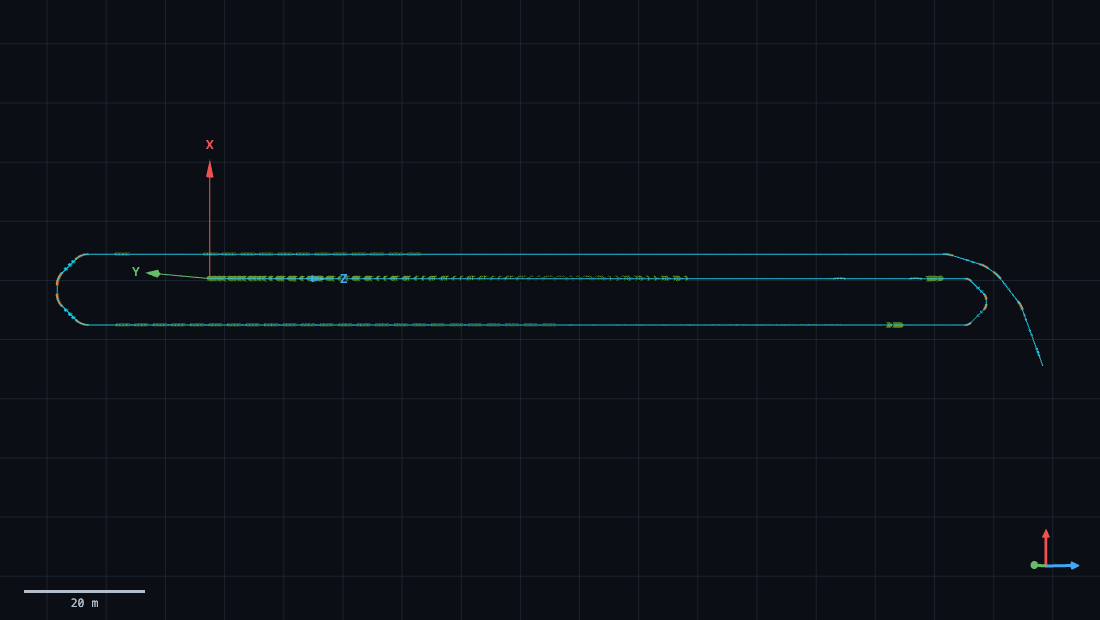
blooks along the beam at the selection,rrides it. - Scale. Chunks with three levels of detail keep a 2500-element linac at 50 draw calls from afar and full detail up close; picking walks only what is on screen.
docs/index.md is the map: running it (standalone.md, with the keys), the model library and
its sizing rules (models.md), a site's own models (overrides.md), the tools (measure.md),
the exports (exports.md). The conventions of the frames are lattix's (docs/conventions.md
there, "Survey frames").
git clone https://github.com/Accel-Toolkit/lattix.git       # the public sample decks live there
git clone https://github.com/Accel-Toolkit/lattix-view.git
cd lattix-view && pip install -e ../lattix -e ".[dev,browser]" && playwright install chromium
pytest                     # Python and, with node, the JavaScript tests
pytest tests/e2e           # headless Chromium: three decks, tools, exports, overrides, budgets, goldens
lattix-view check
CONTRIBUTING.md has the rules. The page is offline and self-contained; three.js r186 is
vendored under its MIT licence (THIRD_PARTY.md), pinned by checksum. Licence: BSD-3-Clause.
Cite it with CITATION.cff.